



Singer Rabbi Shergill defends Rehman’s communally biased remarks: How can anyone deny this?
Rabbi Shergill said AR Rahman’s suggestion of a communal angle in entertainment cannot be dismissed. He linked the issue to propaganda cinema, film financing and broader ideological change.
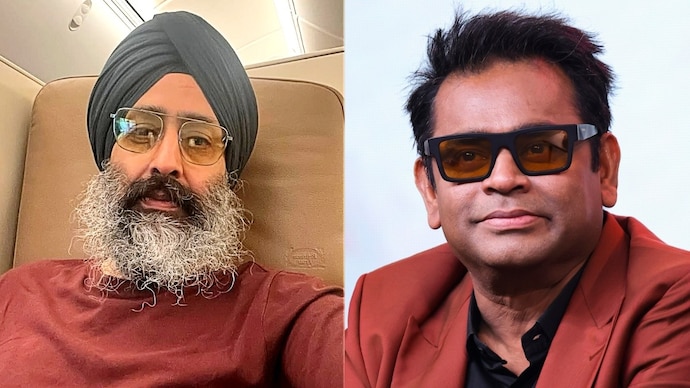

Singer-songwriter Rabbi Shergill has commented on the musician AR Rahman’s recent comment About possible communal bias in India’s entertainment industry. In a recent interview he said that in the current environment this concern cannot be dismissed. Speaking on The Life Savers Show, Shergill said he did not know the exact context of Rehman’s statement, but added that it was difficult to rule out a communal angle at this time.
❮❯
Shergill described Rahman’s comments as part of broader changes in film financing and politics. Stating that he could not comment specifically on the music industry as he does not live in Mumbai or interact daily with people from that region, he said that large amounts of film financing had gone into what many would call promotional cinema, and argued that the issue was part of a broader global trend.
Responding to Rehman’s comment, Shergill said, “I don’t know in what context he said it, but how can you deny it now? How can you deny the communal angle?” He then referred to the term propaganda cinema and said, “I can’t say specifically whether it’s in the music industry because I don’t live in Mumbai or interact with them on a daily basis. But a lot of film financing would be called propaganda cinema.”
Shergill cited as an example kashmir files And story of keralaFilms that have received major attention at the box office in recent years have also been debated for bias and political intent. He said, “These are political films, and they don’t necessarily present an unbiased view of things. So if Rahman is saying this, I think you have to take him at his word. It probably exists, and it is one of the biggest problems of our time. It’s not just India; it’s happening all over the world.”
He placed the issue in a broader political context. Asked if this reflects broader global change, Shergill said, “Absolutely. If you look at the 1960s, left-leaning politics were influential around the world. Today, if you look around, you see right-wing governments and ideologies becoming more dominant in many countries. Maybe this is cyclical and things will change again, but no one is immune to these global currents right now.”
He said, “Just look around our neighbourhood. Pakistan has changed dramatically over the last few decades. China is deeply ideological. Sri Lanka has also become increasingly ideologically driven. It is not difficult to conclude that politics everywhere is moving in this direction.”
Rabbi Shergil on AR Rahman’s vast resume of work
In a previous conversation shared on Divas Gupta’s YouTube channel, Shergill had also talked about Rahman’s work in Hindi films and said that the lyrics became secondary once the composer entered that field. He said, “I admire Rahman’s creative talent. He is a genius. There is no doubt about it. But Rahman Charan is not a pro poetry or pro song charan in the Hindi film industry. It means that the words in his songs are just ornaments and not the whole thing.”

He said, “I think after Rahman’s arrival, songs became secondary in the Hindi film industry and if songs became secondary, it means expression became secondary, it means that somewhere your humanity and existence became secondary. That’s my issue with Rahman.” Shergill also said, “It’s not his fault because it’s not his language. He doesn’t understand it. What he does in Tamil music is really representative of him. It’s another ball game, at least that’s what I hear.”
What did Rahman say that created controversy?
Rehman, In a prior interview with BBCwas asked whether he faced “any prejudice in the Hindi film landscape”. Although he said he has never faced it directly, he suggested that the changing power dynamics in Bollywood have changed the way opportunities reach him.
He replied, “Maybe I never knew about it. Maybe it was hidden, but I didn’t realize anything of it. Maybe in the last eight years, because there has been a change of power and people who are not creative have power now. It could also be a communal thing, but that doesn’t come to me. It comes to me in the form of Chinese whispers that they booked you, but the music company went ahead and hired 5 of their musicians. I’m good.” I have more time to relax with my family. I don’t want to go looking for work. I want to be honest.”
Shergill’s comments kept the focus on Rahman’s statement, while also expanding the discussion to film financing, political cinema and changes in ideological currents. Additionally, his past comments on Rahman’s Hindi film work added another layer to the conversation about the composer’s place in the industry.