





The people next to me during Pedi explain why Janhvi is shown to be overly sexualized in the film
I saw Peddi alone, and the two guys next to me invaded my space, laughing through Janhvi Kapoor’s scenes. If this is how some people in the theater react, perhaps it’s time to question what we’re normalizing on screen.



What do you really mean when you say you need a safe space?
It’s a phrase we throw around all the time, but let’s stop and strip away the academic jargon. This is not a soft, polite question just for women to debate among themselves. This is a fundamental question that each of us must answer, no matter who we are. Regardless of gender.
❮❯
To me, a safe space is not some abstract, grandiose concept. It’s an incredibly small and remarkably simple thing. It is that slight, invisible perimeter on which my own body resides when I walk down the street, sit in a restaurant, or look for a seat at the cinema. It is a simple freedom to live in the public sphere without having my boundaries quietly, carelessly destroyed.
Yet, as women, we are forced to defend this small territory every day.
This entire conversation matters because of Janhvi Kapoor – and the complete waste of her talent in a Telugu film pedi. What director Buchi Babu Sana does with him on that screen is disappointing, but we’ll get to the cinema mechanics in a minute. First of all, you need to understand how all this onscreen nonsense directly impacts our real lives.
Take what happened to me a few months ago. I was going back to my hometown. Due to disorganized last minute booking, I missed the window and aisle. Ultimately I had to sit in the dreaded middle seat. If you’ve ever traveled alone as a woman, you already know the kind of anxiety it creates. There was a man sitting on either side of me.
The flight started off pretty well and I was dreaming of seeing my parents. But within thirty minutes, I felt sharp, excruciating pain. My legs were locked in a tight, unnatural position and my buttocks were completely shrunk. Why? Because people from both sides had occupied my space unhindered. One person was fast asleep, completely unaware of how much physical discomfort he was causing me. The other was completely glued to his phone and watching happily. fun 4A raw Hindi sex comedy (I lost it here). I actually snapped a quick photo to send to my sister later, a silent acknowledgment of how women are generally expected to shrink themselves in order to be present in public.
This leads me directly to last Sunday, and why the current conversation about the hyper-sexualization of women on our cinema screens matters so critically in the real world.
I went to watch director Buchi Babu Sana’s new Telugu sports drama, pediStarring Ram Charan. Because I wanted to see the film in its original language, I deliberately chose a quiet 10:00 am showing, assuming the theater would be mostly empty. I did a brisk 3km run that morning. I felt energetic, excited and ready for a good theatrical experience. I even managed to book the best seat in the house and to my delight, the entire row was empty when I reached there. The theater was at barely 15 percent capacity – only a few couples, a handful of solo movie lovers and a nuclear family.
Then, ten minutes into the movie, two men walked down the aisle.
I watched them come in, silently crossing my fingers and praying they wouldn’t move towards me. No such luck. He took the seat right next to me and the peaceful illusion of my morning was completely shattered. Almost immediately, the person next to me began violating my personal space. I’m sure he didn’t do it maliciously. The inconvenient truth is that men are rarely taught what a safe space means. They are barely aware, conscious.
Think about it. From the time a girl is three years old, she is given a strict, lifelong curriculum on how to survive. We are taught how to sit, how to walk, how to speak and how to constantly monitor our appearance in public so that we don’t attract the wrong kind of attention. But are boys ever given the same lecture? Are they taught how to behave when a woman is around them? Have they been trained to ensure they feel they have equal, unquestionable rights to the physical space they have paid for?
barely. And so, this guy sat down with his legs wide apart, his left elbow and forearm swinging far beyond my armrest, and slid straight into my seat. I had to pull my legs in, distort my posture and sit in complete tension. I spent the first half in the dark tracking his movements out of the corner of my eye.
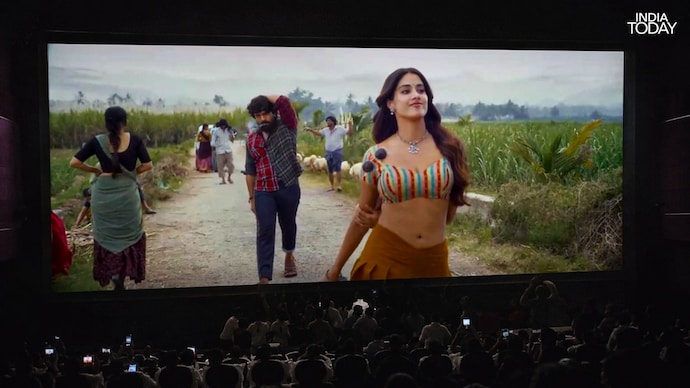
I had just managed to bend my seat as far as I could when Janhvi Kapoor’s character Achiamma entered the frame.
By now, anyone who follows Indian cinema is well aware of the massive online controversy surrounding how his character has been presented in this film. But watching it happen in a dark room full of strangers is a different story altogether. As soon as she appeared on the screen, a wave of distinctive, recognizable laughter erupted next to me. The raw, unfiltered commentary you usually find in the dark corners of the YouTube comments section suddenly became a loud, real-world conversation.
And looking at the screen, can we really blame the audience for this kind of reaction?
For a large portion of the film, the camera treats Kapoor’s character with a startling level of objectivity. It routinely refuses to travel up his neck. Entire sequences are built around long, close-up shots of her midsection or her chest. It feels as if director Buchi Babu Sana had clear instructions to the cinematographer to find as many fragmented, reductive frames as possible and keep them there.
This scene choice perfectly mirrors a deeply problematic line in the script, where Ram Charan’s character Peddi casually tells his friend that he wants to touch Achiamma without her consent while she is doing political campaigning, because that is the only way he knows how to express his love. When this happened, the people sitting next to me burst into sharp, sarcastic laughter.
I know what that specific laugh means? This is the sound of the audience recognizing a classic cinematic trick.


Later in the film, when her character marries Peddie, an attempt is made to create a sudden, unsettling change in the tone of the film. She is seen in a neatly draped, traditional cotton saree and the camera finally decides to look generously at her face.
It realizes that the filmmaker has spent the last hour using a woman’s body as a commercial magnet, but as soon as she becomes a wife, suddenly asks us to respect her character.
It’s a toxic, profitable loop that modern filmmakers and audiences have created together. The directors argue that they are simply giving the public the “masala” element they want to ensure a big opening at the box-office. Meanwhile, viewers consume these images, internalizing the idea that a woman’s body is a public object to be gazed at, picked apart, and commented on.
How can we expect men to respect the boundaries of a real, live woman sitting next to them in the dark, when the giant screen in front of them is actively teaching them that a woman’s boundaries are entirely optional?
A casual invasion of a woman’s space – whether it’s a big elbow in flight or a man’s outstretched posture in a cinema row – does not happen by accident. This has been nurtured and legitimized by the film industry which is limiting women to visual material for cheap entertainment.
Yes, after severe public reaction, the makers of pedi It has been claimed that they have removed some extremely disgusting scenes from the film. But the fact that these scenes were written, shot, edited and celebrated in the first place proves just how deep the rot has run in 2026.
This cycle has to stop. It is no longer acceptable to excuse blatant commodification as harmless mass entertainment. And no, it’s not just lazy filmmaking; This has real-world consequences for every woman who tries to go into a public place.
And filmmakers need to find better ways to entertain without compromising the dignity of their female actors. At the same time, the audience needs to look at their own reactions to the darkness and ask themselves why they find a woman’s lack of humor so incredibly amusing.
Until both parties take real accountability, cinema will remain exactly as I felt it last Sunday: just another place where women are forced to shrink themselves in order to feel safe.