





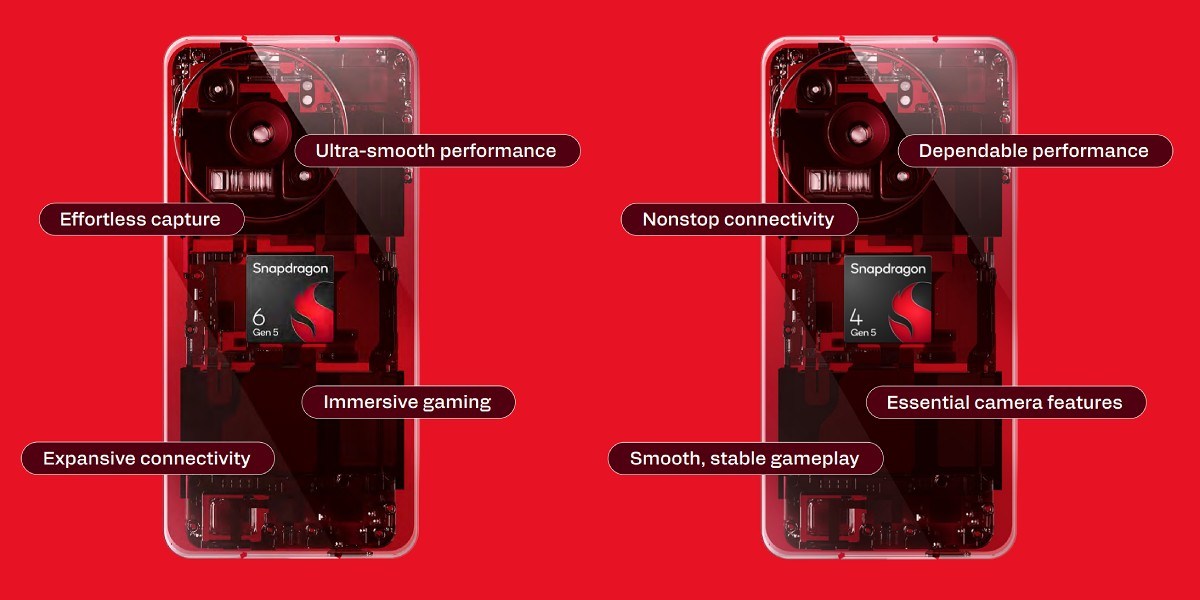
Snapdragon released its first Gen 5 chips last year with the Snapdragon 8 Elite Gen 5 and vanilla 8 Gen 5. Now the company is expanding this generation into the entry-level and mid-range segments with the 4 and 6 series chips. Both focus on long battery life, smooth UI, and better gaming performance.
Snapdragon 6 Gen 5
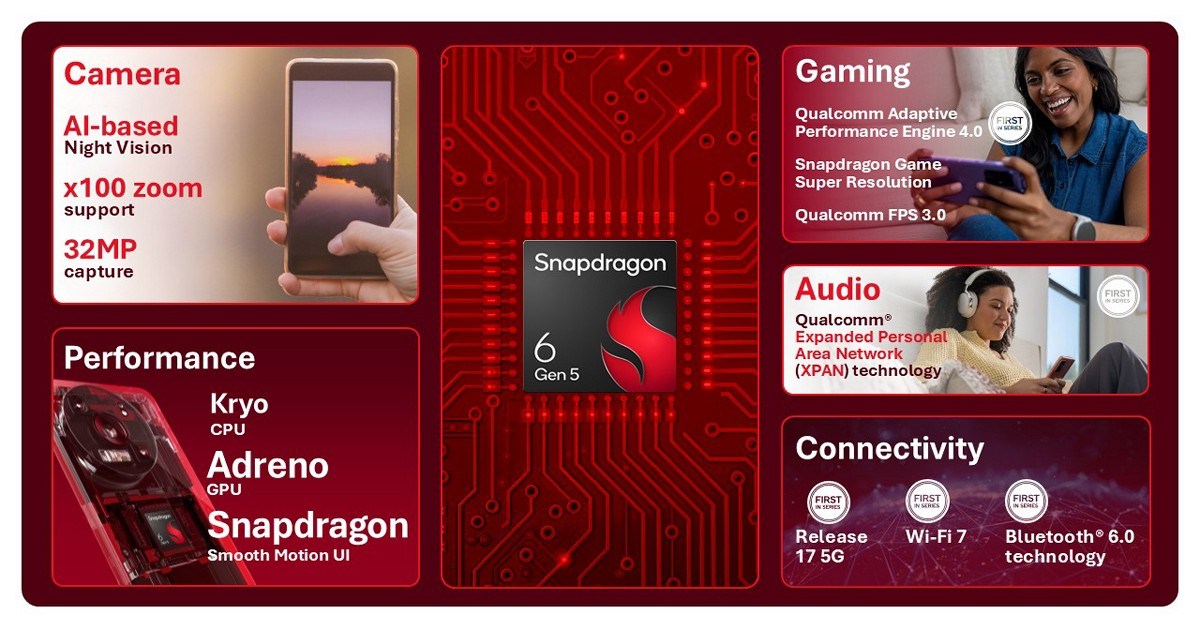
Key features of the Snapdragon 6 Gen 5 (SM6850) are Adaptive Performance Engine 4.0 and Qualcomm Adaptive Performance FPS 3.0, which promise stable frame rates while gaming. Snapdragon Game Super Resolution is available for enhanced visuals and helps extend battery life.
Key details are not clear yet, but the CPU has four cores clocked at up to 2.6GHz. This promises a solid increase in single and multi-core performance since the Snapdragon 6 Gen 4 only had one core clocked at up to 2.3GHz. The new Adreno GPU delivers 21% more performance. Meanwhile, Qualcomm managed to improve power efficiency by 8%.
Snapdragon 6 Gen 5

The Gen 4 chip was the first 6-series model to be fabbed on TSMC’s 4nm node and since the official information for Gen 5 only states “4nm”, we assume it’s the same node. Like its predecessor, this chip supports LPDDR5 RAM up to 3,200MHz. LPDDR4X is also an option for cheaper designs. The chip is designed to use UFS 3.1 storage. The display adapter supports displays up to 1080p+ at 144Hz. And no, there is no AV1 decoding hardware yet.
Both chips feature something called Snapdragon Smooth Motion UI. It aims to enable smooth-scrolling, lag-free interface and faster app launches. According to Qualcomm’s internal testing, the Snapdragon 6 Gen 5 launches apps 20% faster and has 18% less lag than the Gen 4 chip.
Next, camera. Qualcomm equipped the Snapdragon 6 Gen 5 with dual ISP (12-bit), while the Gen 4 chip had a triple ISP. It supports up to 200MP single camera (zero shutter lag, up to 64MP with ZSL) or 16+16MP dual-camera (vs 32+16MP). The video encoding engine can handle 4K at 30fps, so no upgrades here (it can do H.264 and H.265).
Since we are in the age of AI, Qualcomm has loaded the chip with a number of AI-powered camera features like AI night vision, AI image quality enhancements, and up to 100x digital zoom.

Moving towards connectivity, the 5G modem can provide downlink speeds of up to 2.8Gbps. However, it lacks mmWave support, which was present on the Gen 4 chip. Locally, Wi-Fi 7 is now supported with tri-band connectivity (2.4GHz, 5GHz and 6GHz). The new chip has Bluetooth 6.0 (up from 5.4) and supports aptX Adaptive (but aptX lossless support has been removed).
As for the situation, the chip supports major groups and we see another omission – it only works with L1 and L5 bands, while its predecessor also had L2.
In an even more questionable decision, USB-C support drops to USB 2.0 levels, while the Gen 4 chip can handle USB 3.2 Gen 1. Perhaps Qualcomm talked to manufacturers and found that no one was using USB 3 on phones using Snapdragon 4 and 6-series chips, but we’re just guessing.
Here is a table that compares Gen 4 and Gen 5 chips.
| Snapdragon 4 Gen 4 | snapdragon 4 gen 5 | Snapdragon 6 Gen 4 | Snapdragon 6 Gen 5 | |
|---|---|---|---|---|
| CPU | 2x 2.3GHz 6x 2.0GHz |
2x 2.4GHz 6x 2.0GHz |
1x 2.3GHz 3x 2.2GHz 4x 1.8GHz |
4x 2.6GHz 4x 2.0GHz |
| gpu | adreno 613 | +77% | adreno 810 | +21% |
| Display | 1080p+ @ 120Hz | 1080p+ @ 144Hz | 1080p+ @ 144Hz | 1080p+ @ 144Hz |
| to hit | up to 16GB LPDDR5 3,200 MHz LPDDR4X 2,133MHz |
LPDDR4X 2,133MHz | up to 16GB LPDDR5 3,200 MHz LPDDR4X 2,133MHz |
up to 16GB LPDDR5 3,200 MHz LPDDR4X 2,133MHz |
| storage | UFS 3.1 | UFS 3.1 | UFS 3.1 | UFS 3.1 |
| camera | dual isp up to 108MP |
dual isp up to 108MP |
triple isp up to 200MP |
dual isp up to 200MP |
| Video | 1080p 60fps | 4K 30fps | 4K 30fps | 4K 30fps |
| 5g | Sub-6GHz 2.5 gbps |
Sub-6GHz 2.8 Gbps dual sim dual active |
Sub-6GHz + mmWave 2.9 Gbps |
Sub-6GHz 2.8 Gbps |
| wifi | Wi-Fi 5 (dual-band) | Wi-Fi 5 (dual-band) | Wi-Fi 6E (Tri-Band) | Wi-Fi 7 (Tri-Band) |
| Bluetooth | bluetooth 5.1 | bluetooth 5.1 | Bluetooth 5.4 (aptX Adaptive, aptX Lossless) | Bluetooth 6.0 (aptX Adaptive) |
| GPS | L1/L5 | L1/L5 | L1/L2/L5 | L1/L5 |
| USB | usb 3.1 | USB 2.0 | usb 3.1 | USB 2.0 |
| charge | quick charge 4+ | quick charge 5 | quick charge 4+ | quick charge 5 |
snapdragon 4 gen 5
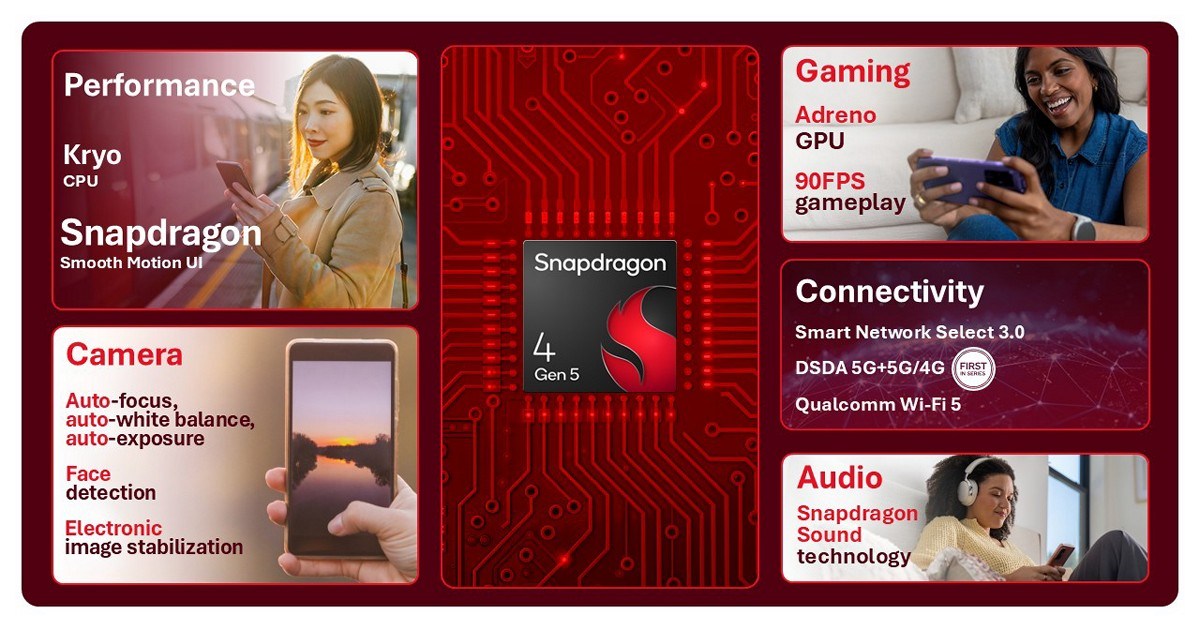
The Snapdragon 4th Gen 5 (SM4850) promises many of the same things as its 6-series sibling, but with an even greater improvement in performance over its predecessor – the Adreno GPU performance is an impressive 77% compared to the Snapdragon 4th Gen 4 GPU. Qualcomm says this will be the first 4-series chip that can handle 90fps gaming.


Snapdragon Smooth Motion UI will deliver 43% faster app launches and 25% less screen stutter compared to Gen 4. The CPU clock speed is slightly higher (2.4GHz vs 2.3GHz) and the refined design should result in 10% power savings.
snapdragon 4 gen 5
However, the impact of the RAMpocalypse is on full display – the Gen 4 chip works with LPDDR5 RAM up to 3,200MHz, while the new Gen 5 chip only works with LPDDR4X up to 2,133MHz.
Cellular connectivity has received a major upgrade with support for dual SIM dual active 5G + 5G/4G, which will allow the phone to connect to two networks simultaneously. The 5G modem has a maximum download speed of up to 2.8Gbps (up from 2.5Gbps) using 140MHz of bandwidth (up from 100MHz) in the sub-6GHz band.
Unfortunately, local connectivity barely got any upgrades – we’re still looking at dual-band Wi-Fi 5 (ac) and Bluetooth 5.1, now with aptX Adaptive. GPS supports L1 and L5 bands.
The camera hardware is almost identical with dual ISP (12-bit) and support for cameras up to 108MP (up to 32MP with ZSL). The good news is that the video encoder can now handle 4K resolution. The display driver can handle 1080p+ resolution with a higher refresh rate – up to 144Hz (up from 120Hz).
Phones coming later this year
The first phones to be powered by the new Snapdragon 6 Gen 5 and Snapdragon 4 Gen 5 will arrive in the second half of this year. Qualcomm has confirmed that Honor, Oppo, Realme and Redmi are working on phones that will use the new silicon.