



Bee colonies work in an organized manner, even though no bee tells the others what to do. Young bees care for the queen and baby bees, older bees build and protect the hive, and the oldest workers go out to gather food. Scientists have long known this pattern, but they didn’t know how the bees’ brains controlled these changes.Researchers at Heinrich Heine University Düsseldorf, in collaboration with scientists from the universities of Cologne and Frankfurt, say they have found an important clue. Their study shows that specific brain circuits help decide which tasks a worker bee will perform as it ages.As Science
Bees change jobs with age
Unlike people, bees do not have a leader to delegate tasks to. Yet the colony functions smoothly because worker bees naturally change jobs as they age.Young worker bees spend their time feeding and caring for the queen and the developing larvae. As they grow, they help build and defend the hive. At the end of their lives, they leave the hive to collect nectar and pollen.Although worker bees typically follow an age-based sequence of jobs, scientists have learned that this system is flexible. If a colony suddenly loses many young worker bees, some of the older bees may return to nursing duties. Similarly, according to a 2008 study, if more food collectors are needed, young bees may start finding food earlier than usual. The new study helps explain how the brain may control these changes.Scientists knew that age-dependent patterns existed, but they did not understand how the bee brain controlled these changes. This research focused on a gene called doublesex.
.

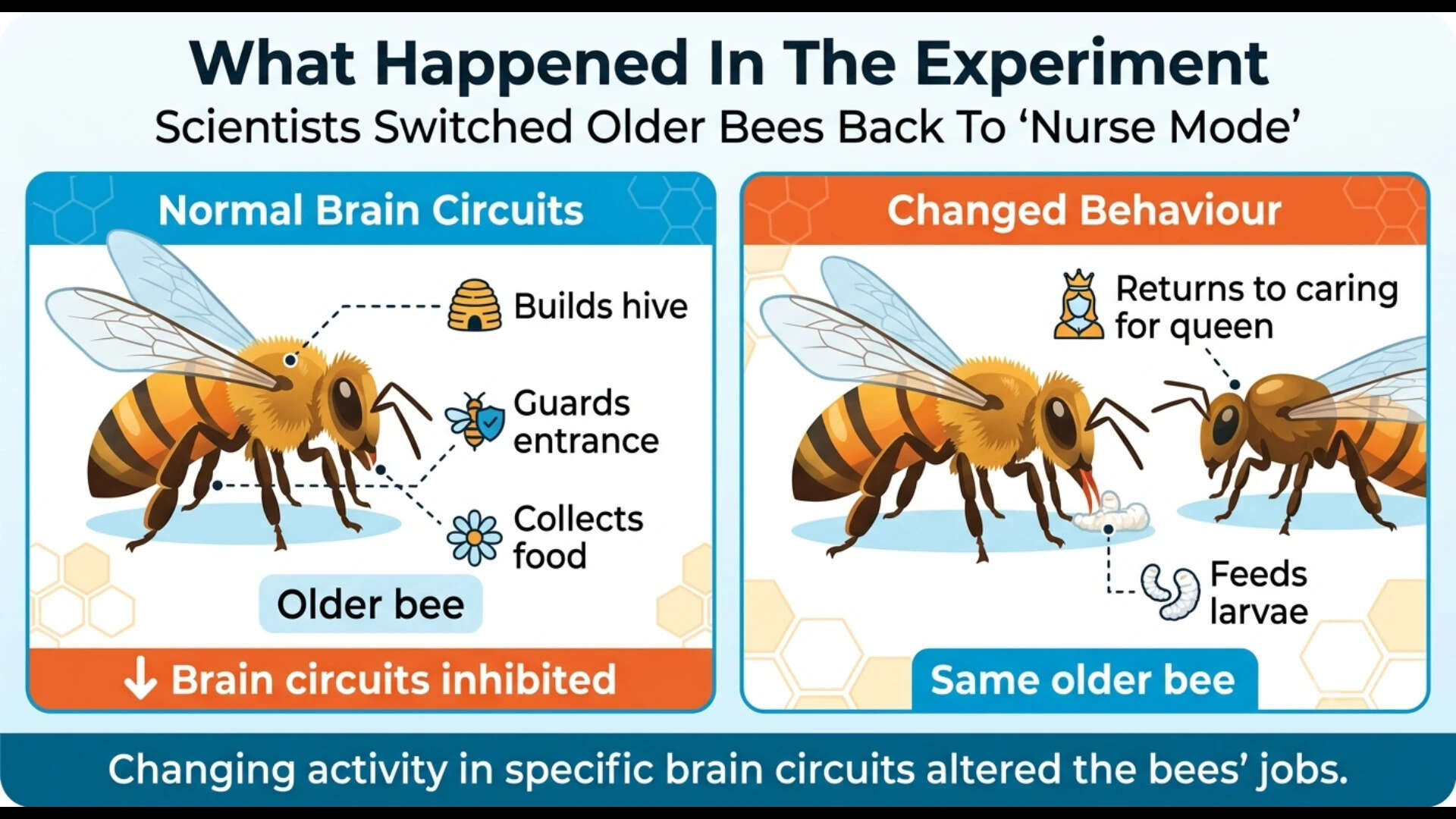
Earlier studies by Professor Martin Bay’s team had shown that when this gene was switched off in older worker bees, they returned to caring for the queen rather than continuing to do the work they normally did at their age. This revealed that genes may play an important role in controlling work behavior inside the colony.Because the gene is active only in certain brain circuits, researchers used it to study how those circuits affect the bees’ function. Scientists used a method that allowed them to temporarily reduce the activity of brain circuits associated with doublesexgene. They did this by activating neuron-silencing proteins after feeding bees a specific substance.When these brain circuits slowed down, the older worker bees began caring for the queen again. When the circuit was left unchanged, the bees continued their normal age-related work patterns.Lead author Dr. Jana Seiler was quoted by Science
what do the findings mean
The researchers say the study provides evidence that communication between different brain circuits helps determine which tasks bees perform during their lives. This means that reducing the activity of one set of brain cells allows another set of brain circuits to become active, changing the bee’s behavior. The team believes this helps explain how bee colonies organize their work without any central planning.Professor Martin Bay said, “The ability to control the social behavior of bees provides us with new opportunities to explore innate behavioral diversity and the fundamental principles of social cooperation. The solution to the mystery of how bees and other animals cooperate so well without a task template probably lies in the neural circuits of the brain.”The researchers say their work provides a better understanding of how the brain controls social behavior in bees and may also help scientists study how cooperation evolves in other animals as well.