





K Bhagyaraj: The script emperor who became the voice of middle-class India
Veteran filmmaker K Bhagyaraj, popularly known as the Screenplay King of Tamil cinema, died in Chennai on June 27 due to a heart attack. His death, just days after the death of Guru Bharathiraja, is another big loss to the industry.

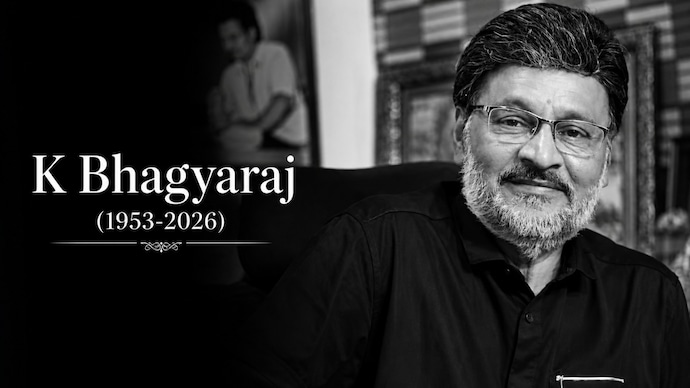


A maverick and a man with the Midas touch, filmmaker and master storyteller K Bhagyaraj was responsible for transforming the everyday lives of middle-class Tamil families into some of the most enduring entertainers of the 1980s and 90s. He died in Chennai of a heart attack on 27 June. He was 73 years old.
Three decades later, established and aspiring filmmakers still refer to his films and his screenplays to help with their writer’s block. That was K. Bhagyaraj’s timeless contribution to Tamil cinema and the art of filmmaking.
❮❯
What is even more shocking is that his death occurred barely a fortnight after the death of his own guru Bharathiraja. In a span of a few weeks, Tamil cinema lost two of its stalwarts who left an indelible impact on the industry.
Bhagyaraj is survived by his wife, actor Purnima Bhagyaraj, son Shantanu Bhagyaraj and daughter Saranya Bhagyaraj.
his early years
Born as Bhagyaraj Naidu on January 7, 1953 in Velancoil near Gobichettipalayam in Erode district of Tamil Nadu, he broke into Tamil cinema, trying his luck with editing and assisting. He worked as an assistant director to G Ramakrishnan and, most notably, as an AD for Bharathiraja – the Kamal Haasan-Sridevi-Rajinikanth. 16 Vayathinile (1977) and Sudhakar-Radika’s Kizhakke Pogam Rail (1978), and turned in blink-and-miss roles in both that film and Sigappu Rojakkal (1978).
It was in this apprenticeship that his true gift was revealed: not in performance, but in writing. He worked with Bharathiraja Kizhakke Pogam Rail and wrote dialogue for Sigappu RojakkalThe audience knew his face long ago.
Bharathiraja then did what gurus do – he cast Bhagyaraj as the hero in his production, Puthiya Warpugal (1979), opposite Rati Agnihotri. He won the Tamil Nadu State Film Award for Best Dialogue Writer for his work in the film.
In the same year, Bhagyaraj directed his first film, Suvarilladha ChithirangalStepping behind and in front of the camera simultaneously. Little did anyone know that one man’s do-it-all approach would define the next decade and a half of his career.
How he became the king of the script
What followed was an extraordinary period in which Bhagyaraj often wrote, directed, produced and acted in the same film – oru kai osai (1980), Mauna Geetangal (1981), Age-defining blind 7 drama (1981), Darling darling darling (1982), Mundnai Mudichu (1983), Dhvani Kanavugal (1984), Chinna Veedu (1985), Enga Chinna Ras (1987) and Avasara Police 100 (1990) among them.
blind 7 dramaAn emotional love triangle, it is widely considered to be his masterpiece. Dhvani KanavugalA socially conscious film, it still remains a script reference material for filmmakers.

His scripts had a signature, which became his calling card. His heroes never win battles through manliness, but through intelligence and stubbornness. His women brought everyday battles to life and demonstrated their identity and agency, and never ended up as decorative objects. The conflicts in her films are drawn from universal domestic battlefields – mother-in-law versus daughter-in-law, the battle of the sexes, and changing gender roles.
His dialogues are sharp, often double-edged, making you sit, think and understand the underlying meaning. Even decades later, these dialogues are often quoted.
His classic trademark was mastering the art of screenplay, and his major works of the 80s and 90s are still remembered by audiences today.
Through his scripts, he engineered emotions, built each scene around a purpose and every line had weight, while industry voices noted that he was a pioneer of content-driven cinema, before it became fashionable to call it that.
His professional instincts crossed language and boundaries and came to Hindi cinema. Mundnai MudichuStarring Swayam and Urvashi, in which he won the Filmfare Best Actor (Tamil) Award, it was remade in Hindi as Sir With Rajesh Khanna.

Oru Kaidiyin Diary – A The story he wrote for Bharathiraja with Kamal Haasan in the Tamil version became last way (1986) in Hindi, directed by Bhagyaraj and starring Amitabh Bachchan in a dual role, a big hit that took his name beyond Kodambakkam.
beautiful tuberose Bollywood’s done style (1994); Rasukutti became Raja Babu (1994); Avasara Police 100 was rebuilt as Gopi Kishan.
MGR’s artistic successor
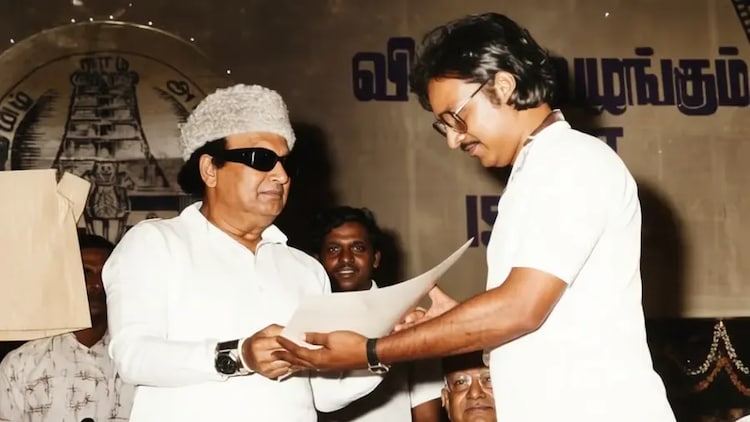
One of the first public accolades Bhagyaraj received was not from a critic, but from Tamil Nadu’s biggest star and politician ever. Bhagyaraj recounted on several occasions that MGR, aka MG Ramachandran, had described him as his “artistic heir” after watching his films, adding that he felt he constantly glorified and disrespected women on screen.


By his own account, MGR’s penchant for the safety and welfare of crowds at public meetings deepened his admiration for the leader, whom he considered a model of mass appeal coupled with genuine concern for the common people.

The guru who created a generation of directors
If Bharathiraja gave Bhagyaraj his start, Bhagyaraj repaid that debt many times over during the 1980s by running a finishing school for future directors from his own film sets.
Before stepping out on his own as a director, Pandiarajan came up as one of his assistants, achieving notable success with Aan Pavam, and later settling into a long, illustrious career as a full-time character actor.
R. Parthiban is one of his most respected disciples. Parthiban began his career as an assistant director to K. Bhagyaraj in 1984, and the two worked together in more than 20 films between 1984 and 1991. Parthiban directed his own National Award winning work – Pudhiya study (1989) and housefull (1999) won both the National Film Award for Best Feature Film in Tamil and his solo performance Otha Seruppu Size 7 (2019) won the Special Jury Prize at the 67th National Film Awards.
He introduced actor Urvashi to Tamil cinema Mundnai Mudichu And gave a chance to his sister Kalpana to debut Chinna Veedu.
Bhagyaraj’s set served as a working class for screenplay craft for years, according to a filmmaker who believed – and proved again and again at the box office – that writing, not star power alone, could carry a Tamil film.
a multidimensional person
Bhagyaraj was never a solo filmmaker. He composed the music for his own directorial venture Idhu Namma PotatoHe edited many of his films, ran the weekly magazine Bhagya as its editor, wrote novels and books on cinema and even ventured into politics – forming his own organization MGR Makkal Munnetra Kazhagam in 1989, later forming an alliance with the AIADMK and briefly with the DMK.
He continued to act well into the 60s and 70s Kanithan (2016), Thuppariwalan (2017), Ponmagal Vandhal (2020), Murungakkai ChipsAnd super senior heroes (2022) – never left the industry he helped reshape decades ago.
Bhagyaraj proved long before it became fashionable to use the term “content-driven cinema” that the script could be the hero of a Tamil film. The king of the script may have fallen silent on June 27, but his lines resonate even louder in the history and hearts of Tamil cinema.