





French Prime Minister Sebastien Lecornu said on Tuesday that at least 40 people have drowned in France over the past five days as much of Europe is hit by extreme heat. Most of the victims were young people who were swimming in unsupervised areas.Lecornu called an emergency cabinet meeting, calling the sinking a “tragic crisis”. Marina Ferrari, a minister whose responsibilities include young people, said the drownings occurred mostly in lakes and canals. “During such heat waves, it is no small thing to go swimming in areas that are not supervised,” he told French radio.Among those killed was a 13-year-old girl who, not knowing how to swim, had gone to take a dip in the Seine river with her family. A young professional footballer remains in a serious condition after being pulled out of the Rhone river near Lyon. Two children, aged two and four, were found dead inside a family’s car on Monday in Carpentras, southern France.Also read: 20 people drowned in rivers and lakes to escape heat wave in France
‘Omega Block’ heat dome sits over Europe
France recorded its hottest June day with an average low of 29.8 °C, and its hottest night ever with a low average of 21.6 °C. More than half the country is on red alert, with Météo-France warning of “exceptionally high temperatures both day and night” which could have a “profound impact on health”.Forecasters expect temperatures in Paris to reach 40°C this week, while parts of central France will reach 43°C. The current heatwave is the second in about a month, following record-breaking temperatures in May.

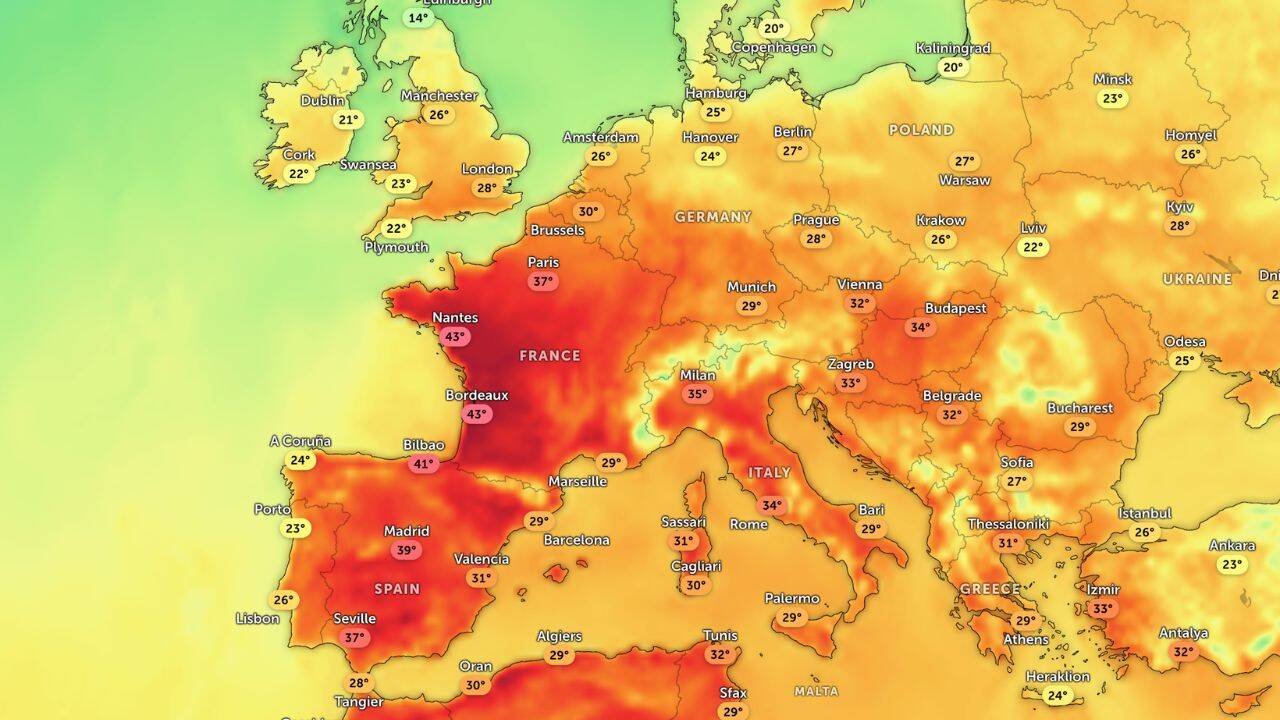
Birth heat is going on in most of the countries of Europe.


Meteorologists attribute the extreme conditions to the “Omega Block” – a weather pattern named after the Greek letter Ω, in which a bulge of warm, organized high pressure forms between two cold low pressure systems. Under normal circumstances, the jet stream continuously moves weather systems from west to east. But during the Omega Block, that flow is disrupted and can tilt dramatically north and south, separating the pressure systems. The result is that warm, cool air gets stuck in the same area.Omega block usually lasts between three to 10 days, but can last for weeks. Conditions become hot and dry under the high pressure area in the centre. The high pressure also prevents the formation of clouds, resulting in clear, sunny skies that raise temperatures.The Royal Meteorological Institute of Belgium described the event as “the lid of a saucepan”, adding: “It has never been so hot for so long as it was at the beginning of this year.”According to the UK Met Office, Britain lies on the boundary between a high pressure system in the north-west and cold air, producing intense heat in the south and east and cool, wetter conditions in the north and west.
Major developments across Europe:
Eiffel Tower: Shut down early at 4pm on Tuesday and are expected to do so again on WednesdayLouvre: Closing time being brought forward from Wednesday to Saturday at 4pmNuclear Plant: Golfeque in south-western France closed as river water reached 28 degrees Celsius, the legal limit of coolingSchool: 845 schools closed on Monday, another 1,800 allowed early leaveSpain: Red alert in Andalusia, Cantabria and the Basque Country; Temperature can reach up to 44°CUK: The Met Office issued a rare red warning for extreme heat, indicating a danger to life.Italy: Red alert in 15 cities including Rome, Milan, Florence, Turin and VeniceGermany: Six fatal swimming incidents were reported; Lifesaving Association warns men to overestimate their abilitiesNetherlands: Code Orange alert issuedBelgium: National Heating Scheme activated for only the second time