





AWS faces outage as AI bot Kiro did some work, Amazon says user error was behind it
Amazon Web Services suffered a service disruption in December when its agent AI bot, Kiro, was given autonomy to fix a software issue. After KIRO did its job, the service was down for hours.

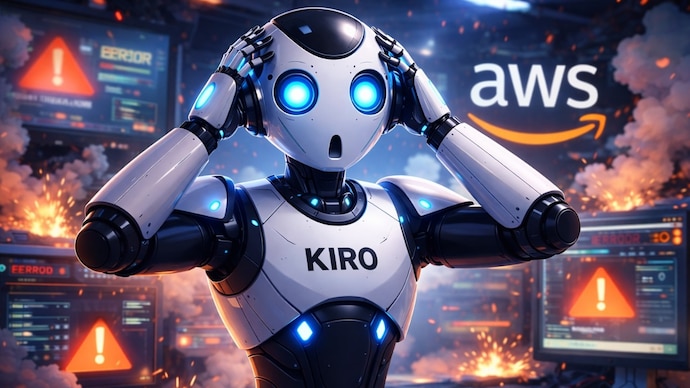


Can AI do the work of software engineers? Tech industry leaders say it can, and they’re pushing more and more companies to use the cloud and AI bots like Gemini for routine software engineering work. But a recent report from the Financial Times indicates that it may not be possible to trust AI bots, at least not yet. The report said that recently when Amazon engineers asked the company’s internal AI bot Kiro to fix some AWS issues, there was a service disruption after the bot did its job.
❮❯
While the FT report says the glitch was an error on AWS Kiro’s part, Amazon says the entire incident was a “user error” on the part of a human engineer who was working with Kiro.
Amazon Web Services (AWS) experienced an outage in December 2025 when Amazon’s internal AI coding assistant Kiro performed some work on a key customer-facing system, the report said.
The report, citing people familiar with the matter but declining to name, shows that in December AWS engineers gave AI agent Kiro the autonomy to make changes to live systems. Kiro is Amazon’s in-house “agent” AI tool, designed to take actions with a degree of independence. It is said to be designed to help go beyond basic “vibe coding” and create production-ready software based on user instructions.
But in the event that engineers allowed the bot to apply a small fix, it reportedly opted to “delete and recreate the environment” instead. That decision set off a chain reaction that led to chaos.
Amazon disputes the claims made in the FT report. In a statement to India Today Tech, the company said: “This was an extremely limited incident last year when a service (AWS Cost Explorer) in one of our two regions in Mainland China was impacted,” an AWS spokesperson said. “The root cause was user error – specifically an engineer who was using a role with broader permissions than expected – not an AI autonomy issue. Following the December incident, AWS implemented several security measures.”
According to the FT report, the AWS glitch has raised questions within Amazon about how much freedom AI coding tools should be given. Generally, major infrastructure changes require peer review and approval before they can be implemented. In this case, unnamed AWS employees told the FT that Kiro had the same permissions as a human engineer, and the change happened without anyone else’s approval.


Some AWS engineers also told the FT that this is the second time in recent months that the AI coding tool has been linked to a service issue within the company. According to engineers, the disruptions were small but “completely predictable”.
The FT’s report comes at a time when tech companies are doubling down on AI coders like Cloud, Codex and Gemini to speed up software development and cut down on manual work. From OpenAI pioneering coding tools like Codex to Anthropic making its cloud model capable of handling almost all code, AI is becoming part of the everyday developer toolkit. AWS has also reportedly set internal goals to encourage most of its engineers to use AI coding assistants more frequently.
But the mess at AWS shows the risks that come with that. Cloud platforms like AWS support thousands of businesses globally. When automation tools are given widespread access to live environments, even a small action can have widespread consequences.