



Alibaba launches Qwen 3.5 small model series, beats ChatGPT and Gemini, Elon Musk is also impressed
Alibaba has launched four compact Queue 3.5 models (0.8b to 9b), claiming that the top 9b variant offers performance close to much larger system powering tools like OpenAI’s ChatGPT and Google’s Gemini.
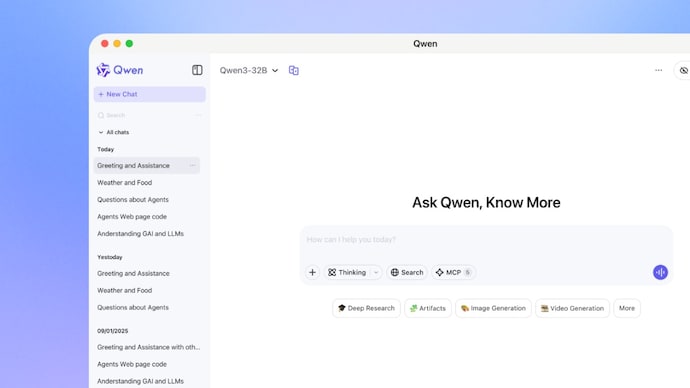

As the AI race between the US and China heats up, Chinese tech giant Alibaba has expanded its open-source ambitions by launching four new smaller models under its Quen 3.5 series. The lineup includes the Qwen3.5-0.8B, 2B, 4B and 9B. These models are positioned as lightweight options for developers who want multimodel capability and solid logic performance without having to run very large systems. And judging by the benchmarks, these models are giving tough competition to nano and mini offerings from Silicon Valley giants like OpenAI and Google.
❮❯
All four models are built on the same Queue 3.5 architecture and support native multimodel processing, meaning they can handle both text and images within the same model. Alibaba says the series includes architectural upgrades and scaled reinforcement learning. The company has released two versions of each model: a ‘base’ version for researchers who want to fine-tune from scratch, and an ‘instruction’ version for immediate deployment.
Gemini and ChatGPT face tough competition
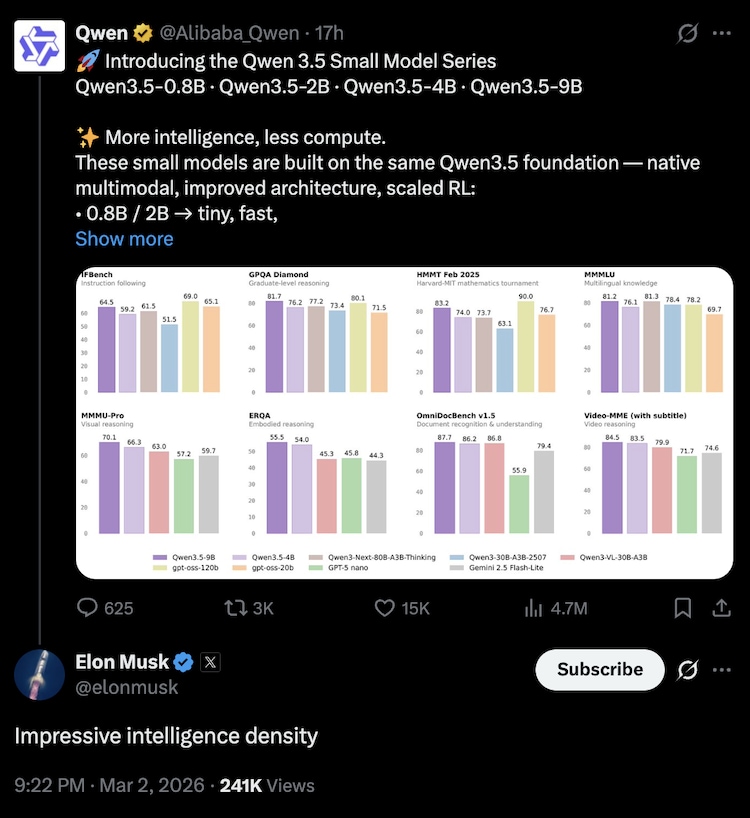
The most powerful model in this latest release is the Qwen3.5-9B. According to benchmark results shared by Alibaba, the 9B model performs close to the GPT-OSS-120B, despite being much smaller in size. In practice, Alibaba is claiming comparable performance to systems with power tools like OpenAI’s ChatGPT and Google’s Gemini in a number of reasoning and knowledge-based tests – but with much smaller models.
In tests covering logical reasoning, mathematical problem-solving, multilingual knowledge and document comprehension, version 9B scores very similarly to much larger AI systems. It is also said to perform strongly in image-based reasoning tasks and document analysis benchmarks. In short, the model promises the same capabilities in a more compact form.
The second model, the Qwen3.5-4B, is just below it. Alibaba says this version comes close to the performance of its earlier 80B-parameter model. This makes it a practical option for developers who want solid logic and multimodal capabilities without running heavy infrastructure. It is positioned as a balanced option – stronger than entry-level models, but lighter than full-scale systems.
On the smaller scale, the Qwen3.5-0.8B and 2B are designed for light use. These versions are for phones, laptops and edge devices where computing power is limited. According to Alibaba, these models are faster and require less memory, although they are not as strong at complex logic as the 4B or 9B variants. Nevertheless, they still support both text and image input, allowing them to handle basic multimodal tasks.

Alibaba has publicly released models with open weights on Hugging Face and Modelscope. Developers can download Checkpoints and run them locally using common AI frameworks.
Meanwhile, Quen’s launch of these small model series is also attracting the attention of the broader AI community. XAI boss Elon Musk responded to the X’s results in response to benchmark comparisons shared for the latest Quon 3.5 miniseries, calling it “impressive intelligence density.”
Alibaba’s latest launch adds to the growing competition around compact AI systems. Instead of focusing solely on larger and more powerful models, Google, ChatGPT and other companies are now pushing smaller, more efficient versions like the Gemini Nano and lightweight ChatGPT variants. With the Quen 3.5 smaller model, Alibaba is targeting developers who are building on-device AI tools, lightweight reasoning systems, and multimodal applications without relying entirely on larger cloud-based models.