



After firing 4,000 employees, Salesforce admits confidence in General AI is waning, believes Zoho’s Sridhar Vembu
Salesforce is reducing its use of generative AI after facing reliability challenges. The change highlights the industry’s growing concerns over AI’s unpredictable behavior and the need for more deterministic automation.
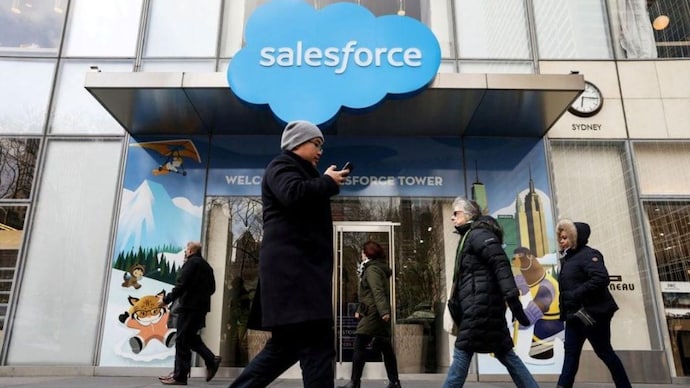

It looks like the AI party is coming to an end, at least for Salesforce. The enterprise software giant, once one of the loudest cheerleaders for generative AI, is quietly reducing its reliance on large language models after running into major reliability issues. The company, which recently cut nearly 4,000 support roles by automating tasks through its AI platform Agentforce, is now openly admitting that its trust in AI models has declined over the past year.
“A year ago we were all more confident about the larger language models,” said Sanjana Parulekar, senior vice president of product marketing, according to The Information. Salesforce’s new strategy? Shift the focus from the unpredictable power of generic AI to more “deterministic” automation, systems that behave exactly as programmed, without the random quirks that plague larger language models.
From AI magic to manual mode
The revelation marks a sharp turnaround for a company that once promised AI would revolutionize enterprise software. Parulekar’s comments confirm what many in the industry have been whispering: The models are not yet reliable enough. “The profession is being changed dramatically,” he said, indicating that the company is now working to ground its AI in strict rules and predictable outcomes.
According to CNBC, CEO Marc Benioff revealed in a podcast that Salesforce has reduced its support workforce from 9,000 to about 5,000 people through AI deployment. “I’ve reduced it from 9,000 heads to about 5,000 because I needed less heads,” Benioff said, underscoring how deeply AI was woven into Salesforce operations — and how much confidence the company initially placed in it.
But that faith has been tested. Muralidhar Krishnaprasad, chief technology officer at AgentForce, said models start “skipping instructions” when given more than eight instructions, a worrisome threshold for precision-heavy business processes. One customer, home security company Vivint, reportedly found that AgentForce sometimes failed to send customer satisfaction surveys despite being instructed to do so. To ensure that such tasks were not skipped, Salesforce had to implement “deterministic triggers”, a rule-based safety net.
Another issue flagged by executive Phil Mui in October was AI “drift”, when chatbots or agents lose track of their intended goals after being distracted by irrelevant questions. “Chatbots designed to guide form completion can become distracting when customers are asked unrelated questions,” Mui explained.
Benioff’s AI ambitions face reality and Zoho’s Vembu emerges
For Benioff, the pivot to Salesforce is a reality check. CEOs, who spent last year promoting AI as the company’s next big frontier, now believe that data quality and control matter more than the power of raw models. He recently told Business Insider that Salesforce’s new strategic plan “puts the data foundation, not the AI model, as the top priority,” pointing to the dangers of “hallucinations” when AI operates without solid data context.
Benioff also joked that Salesforce might one day rebrand as “AgentForce”, saying “It wouldn’t shock me,” after learning that customers no longer resonate with the buzzwords of cloud computing. Yet the irony is not lost: The rebrand enthusiasm comes as their team grapples with the messy reality of AI.
The company’s stock has fallen about 34% since a December 2024 peak, though AgentForce is still projected to generate more than $500 million in annual revenue. In an update, Salesforce stressed: “While LLMs are wonderful, they can’t single-handedly run your business. Companies need to connect AI to accurate data, business logic, and governance. We keep AI within strict guardrails and deterministic frameworks, optimizing LLMs to deliver enterprise-grade reliability.”

Zoho co-founder Sridhar Vembu noticed this immediately. In an X post, he shared a report from The Economic Times, writing: “Salesforce overhyped AI, now pulling back.”

He compared Salesforce’s approach with Zoho’s more cautious use of AI, saying, “What we are doing with Xia AI at Zoho is to put AI in a software loop, extract structure from unstructured information using AI, but ensure that the resulting structure is validated by the software. This approach is prudent and provides useful results to customers. Most importantly, we do not publicize it and we do not impose AI on customers, Due to which they have to face huge increase in prices.”
As both Benioff and Vembu acknowledge, the AI gold rush is headed for a new phase, where hype gives way to hard lessons, and the real winners are those who keep their automation predictable, their data clean, and their promises realistic.