





10,000mAh battery is available in smartphones, the new trend means that the days of power banks are now numbered.
To ensure that your smartphone doesn’t die before the day is over, you might have used a power bank. But as phone makers have started using larger batteries, going from 7,000mAh all the way up to 10,000mAh, battery worries may soon become less of a concern, and power banks may have to bear the brunt of it.

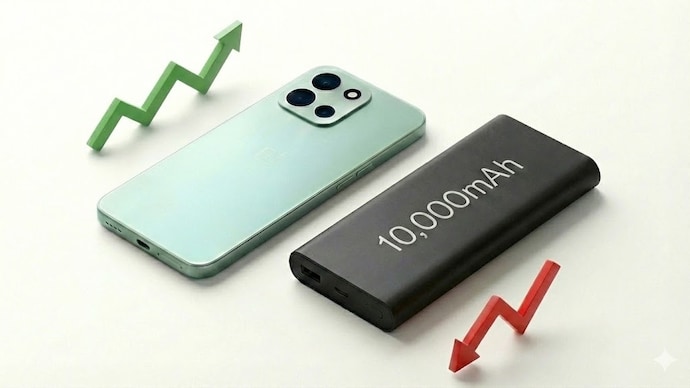


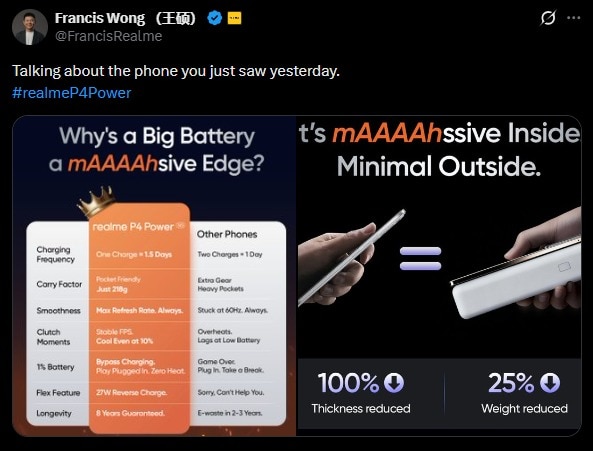
Realme is going to launch a new smartphone in a few weeks. It is called Realme P4 Power. The specialty of this new phone of Realme is that it has a big battery. How big? Well, 10,000mAh. A few days ago, OnePlus launched a phone called OnePlus Turbo 6. It has a 9,000mAh battery. 7,000mAh or even 8,000mAh seems to be the new normal now, especially among Chinese players. Not long ago, you’d expect 10,000mAh from a power bank. One has to wonder, when phones start getting power bank sized batteries, where do the good old power banks go? The writing is on the wall. The days of power banks are now numbered.
For anyone who has used a smartphone, battery life is one of the most important aspects. During a long day of traveling or traveling away from home, sometimes we get worried that our phone’s battery will drain before we even put it on the charger. Now, over the years, power banks have come to the rescue. Are you going out for a long day? Carry a power bank with you and extend your phone’s battery on the go. No need to worry about finding a charging socket.
But things are changing, and they’re changing fast. Battery packs in smartphones have increased in size since phone manufacturers began using silicon-carbon batteries. While a 5,000mAh battery was considered the norm a few years ago, companies like OnePlus and Realme are launching 9,000mAh and 10,000mAh batteries in their new phones. And these aren’t demo units that just showcase future technology – larger smartphone batteries are already here.

And there are plenty of phones with larger batteries that you can buy today. For example, the Oppo Find X9 Pro comes with a 7,500mAh battery pack. And this is not limited to expensive smartphones. Realme 16 Pro comes with a 7,000mAh battery. When I used this phone as my daily driver, I usually ended the day with about 40 percent left in the tank.
But how are such big batteries coming into the phone? This is where silicon-carbon cells come in handy. Lithium-ion batteries have been used in phones for the first time. In comparison, silicon-carbon batteries have a higher density, which allows manufacturers to pack more capacity into a thinner cell. As a result, we may see phones getting much larger battery packs without any increase in thickness.
Soon you won’t need a power bank for your smartphone
For some people who have phones with small batteries, power banks are very useful, if not a necessity. But given the larger batteries found in smartphones today, the future may be bleak for this product category.
If a smartphone gives you more than 8 hours of screen-on time, even if you use it for gaming and multitasking, it can last a whole day on a single charge. Even if you have to travel for a good 2-3 hours a day, you won’t have to face battery worries, as your phone will have enough battery, maybe even for two days. And even new phones with 7,000mAh batteries are more than enough for this kind of work, let alone future phones that are expected to come with larger batteries.
Now, the most popular power banks are between 10,000mAh and 20,000mAh. If a phone has a 10,000mAh battery, a power bank with the same battery capacity will not be able to charge it completely. A power bank can lose about 10 to 20 percent of its energy due to heat generation. So even if your power bank is marketed and sold as 10,000mAh, in real terms, that number depends on how well it can handle heat or whether it’s completely wired or wireless. While you can get yourself a 9,000-10,000mAh phone, suddenly carrying it as a power bank becomes even more of a hassle if it’s big and heavy.
Scrolling through the
Another factor here is the charging speed. Some phones can reach fast charging speeds of up to 100W, but these proprietary charging standards are not usually supported by power banks.
Yes, most power banks support PD charging, but you usually don’t get the same speeds as proprietary VOOC or flash chargers. The ability to charge multiple devices at once does come in handy though, more on that later.


Power banks are already facing the heat
Now, on a different note, there is another aspect that could hamper the demand for power banks – regulation. On January 4, 2026, the Directorate General of Civil Aviation (DGCA) banned the use of power banks on flights citing safety concerns.
Power banks contain lithium-ion batteries, which are known to pose a fire hazard if damaged, overheated, or defective. Aviation safety experts say even a small battery fire inside an aircraft cabin can grow rapidly, making prevention critical.
So now, even if you carry a power bank while traveling in flight, you have to stare at it without any real use inside the plane. And keep in mind that you weren’t already allowed to have a power bank in your checked-in luggage.
You might say you can use a power bank at the airport, but when combined with larger batteries on smartphones, we come back to the same point – you might not need it in the first place.
However, power banks are not dying out
It may seem like we’re writing an obituary for power banks as a whole. But the product line still has some purpose, albeit to an increasingly niche audience. When it comes to larger power banks whose capacity can exceed 40,000mAh and in some cases even reach 1,00,000mAh, not much is going to change.
These high capacity power banks are meant for heavy users who want to charge multiple devices simultaneously, especially outdoors. On camping trips or long road trips, you and your friends will find such a power bank useful. Or perhaps, you’re a content creator who needs extra juice during an outdoor shoot.