



Why did BTS’s early songs resonate in India’s NEET protests?
The NEET paper leak protests in India found an unexpected soundtrack in BTS’s early music, which was resonating deeply among the youth. This cultural moment highlights how art transcends borders and generations, inspiring hope and resilience amidst adversity.
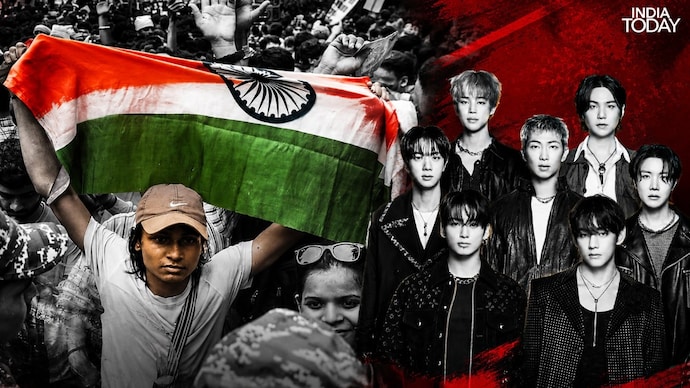

The images were hard to ignore. Students marching with placards. Crowd demanding accountability. Voices demanding fairness in the system they had trusted with years of preparation and sacrifice. As the NEET paper leak controversy continued to spark protests across the country, many youth found themselves revisiting BTS’s past discography, which can easily be described as youth empowerment anthems.
On Instagram, X and fan communities, BTS’s early songs-no more dream, No, silver spoon (bepse) And not today—got an unexpected second life. The protest video is being edited to their music. The song appears on photographs of Jantar Mantar protests and marches across the country. The memes compare scenes from BTS’s “School Trilogy” to the realities of students preparing for high-stakes exams. Fan accounts are piecing together clips of protests, speeches and news footage with songs released more than a decade ago, and turning them into short expressions of desperation, resilience and hope.
❮❯
This is, in many ways, a typical Gen Z moment. A song becomes a caption. A music video becomes a meme. A 13-year-old song becomes the soundtrack of a 30-second reel. Social media has given a greater voice to old art, allowing it to move faster, reach a wider audience, and find new meanings in real time.
The songs themselves explain why.
“what is your dream?” bts asked no more dreamHer 2013 debut single Challenged the Youth to question whether they were pursuing their own ambitions or simply inheriting someone else’s ambitions. In NoThey urge listeners to “everyone says no”, pushing against an education system where grades and rankings matter more than personality. silver spoon (bepse) Whereas, it reflects the frustration of a generation that is expected to work harder despite inheriting fewer opportunities not today It became a song of perseverance, reminding listeners not to give up in the face of setbacks.
Overall, the songs paint a portrait of youth – of pressure, expectation, inequality and resilience.
Released between 2013 and 2017, they reflected ongoing conversations in South Korea around education, generational divides, and the burden of social expectations. More than a decade later, they are resonating in a very different landscape.
Popular culture has always worked this way. Some stories refuse to be confined to the moment of their creation. They are rediscovered, reinterpreted and, sometimes, reclaimed.
For millennia, Rang De Basanti became shorthand for youth finding their voice. Swades turned patriotism into an intensely personal thing, asking what responsibility toward one’s country really looks like. Years after their release, both films keep resurfacing whenever India finds itself reflecting on accountability, aspiration and change.
It seems that BTS’s early music is searching for a similar rebirth. When the group debuted in 2013, they stood apart from many of their contemporaries. While most of mainstream K-pop leaned toward sophisticated fantasy and escapism, BTS presented themselves with stories rooted in classrooms, report cards, parental expectations, and the uncertainty of growing up. He didn’t pretend the pressure didn’t exist. He wrote about them.
As their music evolved, so did the conversations. Am I wrong Reflects public conscience and collective responsibility during a politically tense moment in South Korea. Even outside the group’s discography, RM and August D would continue to explore themes of identity, inequality, freedom, and the systems people live in. Social observation was an integral part of BTS’s artistic identity long before they became a global cultural phenomenon.
The conversation around the NEET controversy has also moved beyond just one exam. They have become a reflection of larger questions involving fairness, merit, opportunity, and the emotional cost of preparing for a future that can feel uncertain despite years of effort.

Those feelings are hard to measure. Music often does this more effectively.
Perhaps that’s why BTS’s debut setlist sounds so refreshing to many young Indians today. On social media, fans are not only revisiting old songs; They are reusing them. View of a classroom from no more dream A student sits near footage of the march. No Joins the conversation around academic pressure. not today Appears in the reels that talk less about winning and more about refusing to lose hope. songs like spring day, Rogue, aliens Found its way into these edits as well.
The lyrics of the song have not changed. It’s a moment.
There is a tendency to dismiss pop music as escapism, separate from the outside world. Yet some of its most enduring works have done just the opposite. He has recorded the anxieties, contradictions and aspirations of his generation so honestly that they continue to resonate long after the headlines around them have faded.
This is true about Rang De Basanti. This is the truth of Swades. And this is true of BTS’s “school trilogy.”
None of these tasks last because they provide easy answers. They endure because they ask questions that every generation must eventually grapple with. Pressure. Expectation. Ability. Identification. Hope.
Details may change but feelings rarely do.
For the Indian Army, revisiting BTS’s early music today feels less like an exercise in nostalgia and more like a form of cultural reinterpretation. Through reels, edits, memes and lyrical posts, fans have given these songs a new context – one shaped by the realities of Indian students who navigate a highly competitive education system and demand accountability from the institutions in which they place their faith.
That’s the strange thing about culture. Once a work of art enters the world, it no longer belongs only to the person who created it. It evolves with every audience that embraces it.
More than a decade after BTS first asked, “What is your dream?”, that question is resonating once again – not in classrooms in Seoul, but across timelines, Jantar Mantar and conversations in India.
Perhaps this is the real measure of the durability of art. It never stops asking questions that we’re still trying to answer.