



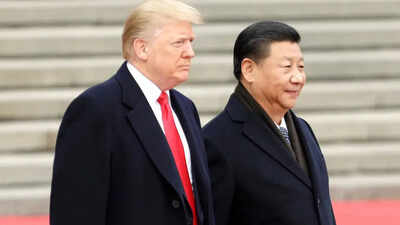
 TOI correspondent from Washington: US President Donald Trump returned to the White House on Friday and, despite claims to the contrary, brought with him the seeds of discord from Beijing. Xi Jinping’s promise of Chinese rose seeds for the White House Rose Garden, meant to be a diplomatic bouquet, instead highlighted the increasingly prickly relationship between the world’s two biggest powers, as their 36-hour summit was dominated not by trade or tariffs, but the explosive question of Taiwan.Although Trump declared his Beijing visit a “tremendous success” and a “historic moment” in brief comments to reporters (in contrast to his normally volatile engagement), the US foreign-policy establishment is concluding that the summit has highlighted the changing balance of power in which Taiwan has become the central fault line in US-China relations. In the podcast, Trump’s former communications director Anthony Scaramucci bluntly said that Trump had “given up his hand” in Beijing, and former US Ambassador Chas Freeman, who as a young diplomat served as a translator during Richard Nixon’s successful visit to China, said that Americans are underestimating Beijing’s growing influence and regime change. Now it turns out that the trip that was ostensibly focused on trade, Iran and economic stabilization quickly turned into an intense conversation on Taiwan, with Xi reportedly warning Trump that mishandling the “Taiwan question” could jeopardize “the entire relationship” between Beijing and Washington.Trump went home from the summit with far more ambiguity than many Taiwan supporters in Washington expected. Speaking aboard Air Force One, he repeatedly declined to say whether the US would defend Taiwan militarily in the event of a Chinese attack. In an interview on Fox News, he was even more frank about his reluctance to become involved in the conflict on the island.“I will say this: I don’t want anyone to become independent,” Trump said, referring to Taiwan. “And, you know, we have to travel 9,500 miles to fight a war. I’m not looking for that. I want them to calm down. I want China to calm down.”The remarks sparked concern among supporters of both parties in Taiwan, who fear Trump is moving away from Washington’s long-standing posture of “strategic ambiguity,” what some critics call strategic capitulation. The US President also revealed that he discussed arms sales to Taiwan “at length” with Xi and declined to commit to a pending $14 billion arms package for Taipei. Critics said discussing a potential Taiwan arms transfer with Beijing risked undermining one of President Reagan’s “Six Assurances” to Taiwan, which promised that Washington would not consult China on such matters.The summit also underlined why Taiwan has become the center of global geopolitics. The island dominates advanced semiconductor manufacturing, producing many of the world’s most sophisticated chips needed for artificial intelligence, military systems and global technology supply chains. Trump himself highlighted the issue and urged Taiwanese companies to make chips in the US. Xi, meanwhile, appeared to use the summit to reinforce Beijing’s long-standing position that Taiwan represents China’s last red line, while disdainful of the US offer to sell Nvidia H-200 chips. US analysts from across the ideological spectrum described a US president who appeared eager for deliverables while Xi calmly set the terms.The optics of the summit ultimately reinforced the perception in Washington that China now holds the stronger hand. Trump nevertheless insisted he had won a major business victory. “We made very good deals. We made very good trade deals,” he declared, despite skepticism about the benefits of the trip in Washington, where prominent people outside the MAGosphere trust what comes from Beijing and Tehran more than what comes from the White House. Trump claimed that China would order 200 Boeing planes, with the purchase eventually reaching 750 planes. Yet Beijing issued no formal confirmation, and Boeing shares fell sharply as investors expected a large immediate order of more than 500 planes. Similarly vague were Trump’s claims that China would buy large quantities of American soybeans, corn and agricultural products. Analysts said there were few specifics, no signed agreement and no detailed outline on the tariffs. Notably, Trump acknowledged that tariffs “did not come up” in talks with Xi despite trade tensions being at the center of the visit.Trump also appeared unable to secure Chinese cooperation on Iran or extract concessions from jailed Hong Kong media tycoon Jimmy Lai. During the 2024 campaign, Trump claimed that it would be “easy” to secure Lai’s release, in the same spirit as he claimed that he would end the Russia–Ukraine war on day one. “I raised Jimmy Lai (with Xi). I will say the reaction to that was not positive,” Trump said in a rare admission of failure.Even the final fantasy of the trip reflects the deep distrust underlying the diplomatic choreography. As the US delegation boarded Air Force One, White House security personnel reportedly threw Chinese-issued phones, commemorative gifts, pins and souvenirs into a bin near the plane’s stairs amid spying fears.