





South Africa’s Cyril Ramaphosa re-elected president after coalition deal
The African National Congress lost its majority for the first time in the May 29 election and spent two weeks in negotiations with other parties that ended on Friday morning as the new parliament was convening in Cape Town.

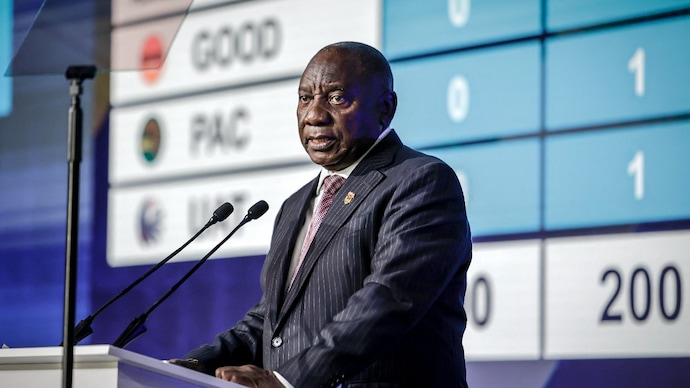
The African National Congress and its biggest rival, the white-led, pro-business Democratic Alliance, agreed on Friday to work together in South Africa’s new government of national unity, a major change after 30 years of ANC rule.
Once unimaginable, the agreement allowed President Cyril Ramaphosa to win election to a second term. He was re-elected by MPs by 283 votes.
The agreement between the two bitterly opposed parties is the most significant political shift in South Africa since Nelson Mandela led the ANC to election victory in 1994, signalling the end of apartheid.
“It will be a privilege and a joy to once again serve this great nation as president,” the 71-year-old leader said in a speech to parliament. He described the incoming government as an era of hope and inclusiveness.
“Many parties that were opposing each other… have decided to work together to achieve this result, which has given a new birth, a new era to our country,” he said.
The ANC lost its majority for the first time in the May 29 election and spent two weeks negotiating with other parties that continued until Friday morning, when the new parliament convened in Cape Town.
“Today is a historic day for our country,” said DA leader John Steenhuisen.
“And I think this is the beginning of a new chapter … in which we will put our country, its interests and its future first.”
Earlier, the National Assembly chose a DA legislator as deputy speaker after electing an ANC politician as speaker – the first concrete example of power-sharing between the two parties.
The ANC, long considered unbeatable in national elections, has lost support in recent years as voters grow fed up with rising levels of poverty, inequality and crime, power cuts and corruption within the party.
watershed moment
The DA’s entry into the national government is a significant moment for a country that still bears the legacy of racist colonial and apartheid rule.
The party wants to end some of the ANC’s black empowerment programmes, saying they have not worked and have mostly benefited the politically connected elite. It says good governance and a strong economy will benefit all South Africans.
For this reason, some ANC politicians have expressed hostility towards the DA’s presence in government. The hard-line left-wing Economic Freedom Fighters, who won about 10% of the vote, meanwhile accused it of representing the interests of the privileged white minority – a charge the DA strongly denies.
“We do not agree with this marriage of convenience to consolidate white monopoly power over the economy and the means of production,” EFF leader Julius Malema said in a speech to parliament after Ramaphosa’s election.
“We refuse to sell.”
Others took a less pessimistic view of the new racial dynamics.
“The ANC is also failing. They need a partner so they can rise again. The DA is mostly white people, so if they come together we can have more power and maybe change a lot, even create jobs,” Bongani Msibi, 38, a street vendor in Soweto, told Reuters TV earlier in the day.
Former party leader Helen Zille, herself a senior DA, said Steenhuisen’s skin colour was irrelevant.
“The melanin-part of the DA leader is the least important aspect of this historic agreement,” he said in a post on X, criticising some media headlines.


Investors welcome deal
Two smaller parties, the socially conservative Inkatha Freedom Party (IFP) and the right-wing Patriotic Alliance, will also participate in the unity government.
The ANC won 159 of the 400 seats in the National Assembly, while the DA got 87. The populist Umkhonto we Sizwe (MK) party led by former president Jacob Zuma got 58, the hard-left Economic Freedom Fighters got 39 and the Inkatha Freedom Party got 17 seats.
The inclusion of the IFP, which has a Zulu ethnic base, could help sweeten the DA’s pill for ANC voters. The Patriotic Alliance gets its support from the Coloured (mixed race) community.
A statement of intent for a government of national unity was distributed to party negotiators by the ANC’s Mbalula.
The “basic minimum programme of priorities” outlined in the document seen by Reuters included rapid, inclusive and sustainable economic growth, promoting sustainable capital investment, job creation, land reforms, infrastructure development, structural reforms and fiscal sustainability.
London-based research firm Capital Economics said investors favour a coalition involving the ANC and DA because it is expected to bring policy continuity or accelerate reforms – and because the EFF and MK – who both want to nationalise banks and privately owned land – are shut out of policy making.
Zuma’s MK party came third in the election, but alleges it was denied victory through vote-rigging, and is boycotting the new parliament. On Friday, an IFP official was elected premier of Zuma’s stronghold KwaZulu-Natal province, where the DA, the ANC and another party backed and defeated the MK candidate.
Ousting MK from the provincial government, even though it won a landslide 45%, could cause serious problems in KwaZulu-Natal, where hundreds of people were killed in violence in 2021.
#South #Africas #Cyril #Ramaphosa #reelected #president #coalition #deal