



Samsung was the first major smartphone maker to commit to foldables with the Galaxy Fold in 2019. Since then, it has introduced the Z Flip and now a third form factor enters the race. No, Samsung isn’t the first manufacturer to make a widespread foldable, but it’s certainly a company with the widest reach that could popularize the form factor.
We got some hands-on time with both Samsung Galaxy Z Fold8That’s called a wide foldable, and the Galaxy Z Fold8 Ultra – that’s the new name for the larger book-style foldable and it’s the successor to the Galaxy Z Fold7 (we know, we know, the naming scheme is confusing).
But before we get into the details, here’s an example of what these two are about.
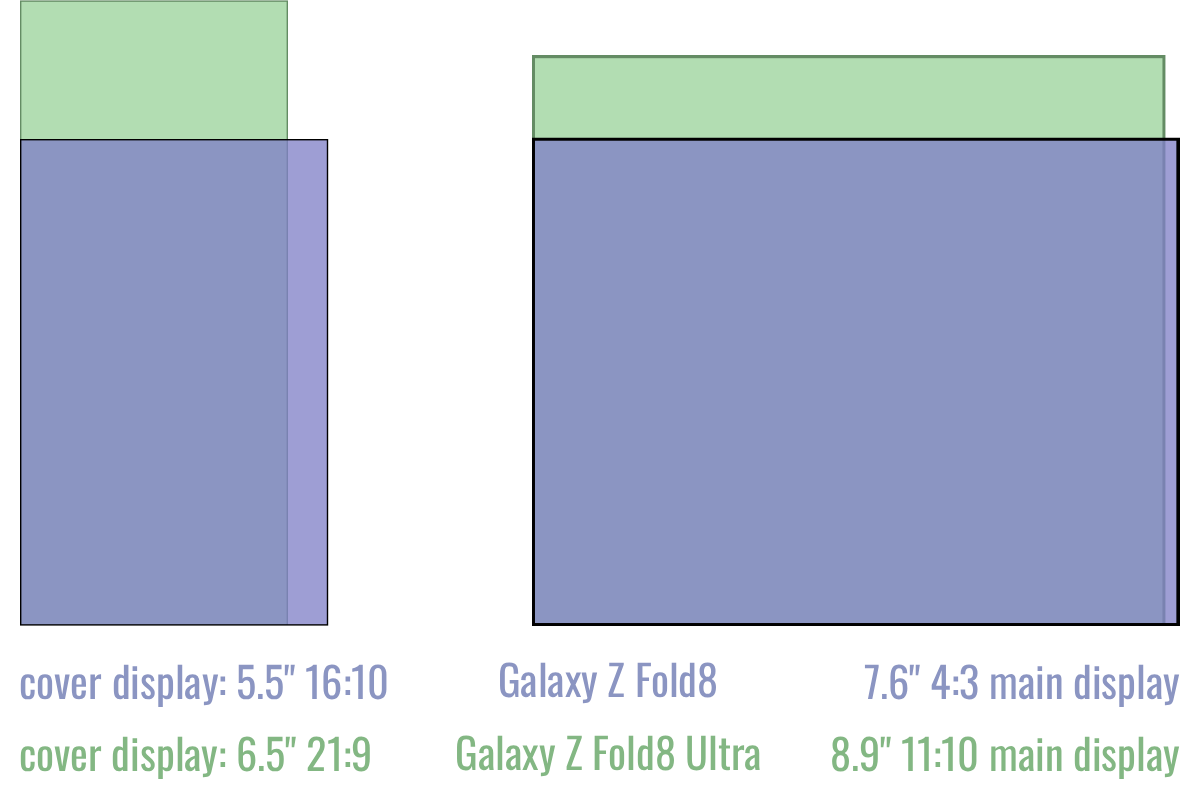
The Z Fold8 has a 5.5″ 16:10 cover display. As you can see, it’s smaller but wider than the 21:9 6.5″ cover display on the Ultra. This aspect ratio is very close to the 16:9 format that a lot of online videos use and is also great for gaming.
The main displays are also quite different. The Z Fold8 display is a 7.6″ 4:3 panel. This makes it better for text-oriented uses – be it documents, websites or books. Photos also default to 4:3, which is a perfect match.
Meanwhile, the 8.0” 11:10 display Samsung Galaxy Z Fold8 Ultra Designed for multitasking. You can split it between multiple apps and each will get plenty of usable space. The square aspect ratio is also great for documents and other text-based content. For video, you can use the cover display as it (while technically showing you a larger picture) suffers from a lot of letterboxing.
We calculated the surface area of each display overall and when showing 16:9 video (ie how much is left after letterboxing). Note that all four displays are LTPO OLED panels with a 1-120Hz refresh rate.
| Galaxy Z Fold8 | Galaxy Z Fold8 Ultra | |
|---|---|---|
| cover display | 5.5″ 88.2 cm² | 6.5″ 98.7 cm² |
| Cover Display (16:9 Video) | 78.4 cm² | 75.2 cm² |
| cover display resolution | 1,248 x 1,972px 428ppi |
1,080 x 2,520px 422ppi |
| main display | 7.6″ 179.2 cm² | 8.0″ 205.3 cm² |
| Main display (16:9 video) | 133.6 cm² | 128.2 cm² |
| main display resolution | 1,848 x 2,448px 403ppi |
2,504 x 2,256px 422ppi |
Viewing video on the main display is as follows:
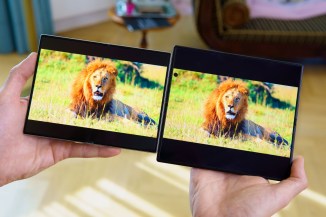
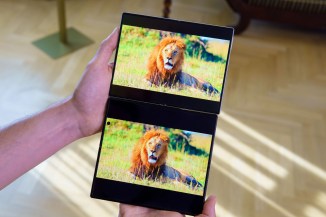
Viewing video on the main display of the Galaxy Z Fold8 and Z Fold8 Ultra
Moving back to the cover display, the Z Fold8 is significantly wider than its Ultra sibling. Its width is 81.9 mm, which means typing with one hand isn’t the easiest, but typing with two hands is quite good. For reference, the Galaxy S26 Ultra is 78.1mm wide.
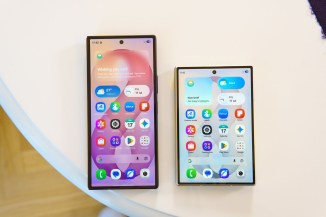
Cover screen size comparison: Galaxy Z Fold8 Ultra (left) and Galaxy Z Fold8 (right)
Talking about dimensions, the Galaxy Z Fold8 Ultra is the sleeker of the two with its narrower body (72.8mm vs 81.9mm). The difference in thickness also helps a lot (8.9mm vs 9.7mm). When closed, the Ultra is as wide as the smaller Galaxy S26 (71.7 mm).
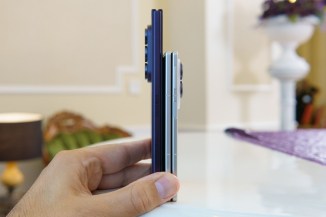
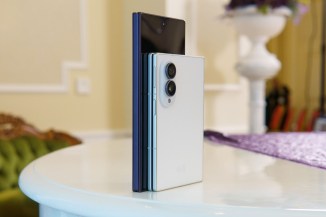
Z Fold8 is 9.7mm thick, Z Fold8 Ultra is 8.9mm thin
The Ultra is 158.4mm long – that’s the exact measurement of the Galaxy S26+. The slab phone is wider (75.8 mm vs 72.8 mm) and thinner (7.3 mm vs 8.9 mm), but Samsung has done an excellent job of making the book-style foldable feel like an ordinary phone when closed. It weighs 215 grams, which is only one gram heavier than the S26 Ultra.
The Z Fold8 is 123.9 mm long. This makes it the smallest smartphone we’ve seen in a long time – although as mentioned above, it’s quite a bit wider. There’s a reason phones moved away from 16:9 screens (it’s pretty close at 16:10), you know. Still, you can hold it up to show that it’s a small phone.
The only hurdle in doing so is that the 201 gram weight makes a wide foldable quite heavy for a mini phone – for example, the S26+ is 190 grams and the vanilla S26 is 167 grams. A more favorable comparison for the Z Fold8 is the iPhone 17 Pro, which weighs 206 grams and is 8.8 mm thick (9.7 mm for the Galaxy).
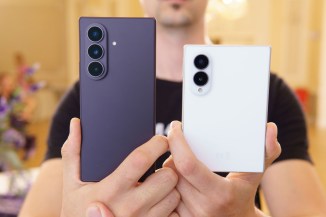
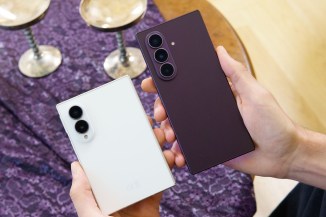
Galaxy Z Fold8 and Galaxy Z Fold8 Ultra in hand
Samsung eventually adopted silicon-carbon batteries, which enabled major battery upgrades on the Samsung Galaxy Z Fold8 Ultra. At 5,000mAh, it’s not the largest, but it’s a solid increase compared to the Galaxy Z Fold7’s 4,400mAh battery (which is the Ultra’s predecessor, despite the nomenclature).
Samsung also finally enabled fast charging – with 45W wired support, the phone can reach 67% in half an hour. The Z Fold7 only supports 25W wired charging and according to official figures, despite having a smaller battery, it can reach 50% charge in half an hour. The Ultra also has faster wireless charging, 20W versus 15W on its predecessor, and supports reverse wireless charging.
Even the smaller Samsung Galaxy Z Fold8 has a bigger battery than the Z Fold7. Its capacity is 4,800mAh, which almost matches the Ultra. There’s also 45W wired charging, although it works a little slower here – it only gets to 63% in half an hour. We wonder if Ultra’s “new dual-path charging architecture” has something to do with it. Anyway, the Z Fold8 has the same 20W wireless charging.
Both phones are powered by the same Snapdragon 8 Elite Gen5 for Galaxy chipset. We saw it on the global Galaxy S26 Ultra and the S26 and S26+ in select regions. There is no Exynos variant of the Folds.

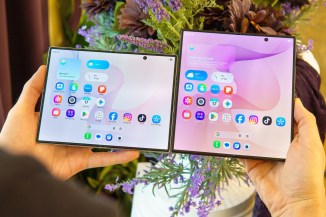
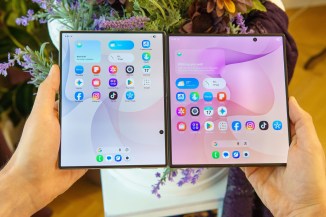
Samsung Galaxy Z Fold8 (left) and Galaxy Z Fold8 Ultra
Both phones come with 12GB of RAM if you choose the versions with 256GB or 512GB of storage. There are also top-shelf versions with 1TB of storage – these come with 16GB of RAM. The Ultra model has a larger graphite sheet to help dissipate heat, so it will probably have better sustained performance (this is something we’ll test in our review), but burst performance should be similar.
The two Z Folds launch with the new One UI 9, which is based on Android 17. They will receive OS updates and security patches for 7 years.
The final point of comparison we want to make here focuses on the cameras – the Ultra has a clear advantage. Just to get them out of the way, we’ll start with the selfie cameras since they’re identical between both models. Both phones have a pair of 10MP modules – the cameras with the cover display have 85° lenses, while the cameras with the internal display have a wider 100° lens.
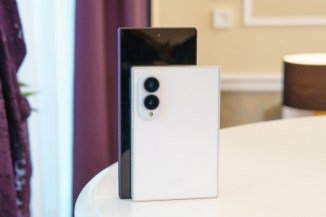
Triple camera for Z Fold8 Ultra vs dual camera for Z Fold8
The Galaxy Z Fold8 Ultra features a 200MP main camera with advanced HDR. It can record 8K video using the APV codec and supports Cine LUTs. The Galaxy Z Fold8 has a 50MP camera, which is also tasked with zooming duties – it supports 2x in-sensor zoom. The 200MP module on the Ultra also does 2x, but the Ultra phone can go further with its dedicated 3x 10MP camera (the wide foldable lacks a telephoto module). Both phones have 50MP ultra-wide cameras.
Stay tuned for more reports from the Galaxy Unpacked event.
Samsung Galaxy Z Fold8
| 256GB 12GB RAM | $1,934.98 |
€1,999.00 |
| 512GB 12GB RAM | $2,114.98 |
€2,199.00 |
| Show all prices | ||
Samsung Galaxy Z Fold8 Ultra
| 256GB 12GB RAM | $2,099.99 |
€2,199.00 |
| 512GB 12GB RAM | $2,294.98 |
€2,399.00 |
| Show all prices | ||