





Kalli Puri presents 9-point charter for appropriate AI use in media at AI Impact Summit
Speaking at the India AI Impact Summit, Kali Puri, vice-president and executive editor-in-chief, India Today Group, said the use of AI in media should be based on fairness, accountability and reciprocity.

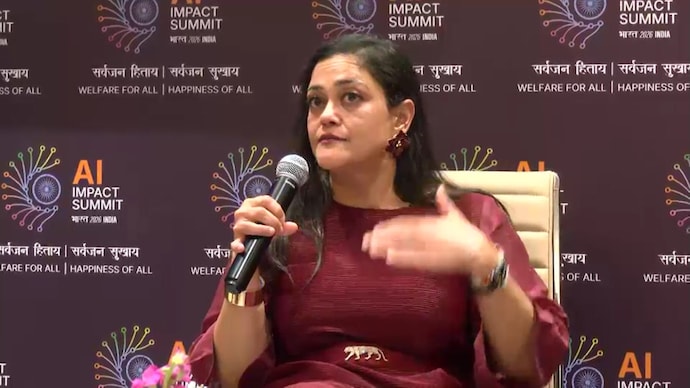


At the AI Impact Summit in New Delhi, India Today Group vice-president and executive editor-in-chief Kali Puri on Monday introduced a nine-point charter calling for fairness, accountability and reciprocity in the use of Artificial Intelligence in news media.
Speaking at the session AI and Media: Opportunities, Responsible Paths and the Way Forward in the presence of heads of major Indian media houses at the Bharat Mandapam, Kalli warned that uncontrolled AI could distort public discussion if journalism is reduced to raw material for larger language models without safeguards.
Unveiling the charter that puts journalism at the center of democratic accountability, Puri said, “Fair pricing for journalistic content cannot be compromised. We need transparency in how news is digested and metabolized by AI systems.”
9-point charter proposed by Kalli Puri
1. Fair prices for journalistic content, with transparency on how news is used by AI systems
2. Traceability and attribution as a democratic principle
3. To recognize journalism as a public interest
4. Award-winning stories that make social impact
5. Actual evaluation of verified content produced by trusted institutions
6. Severe penalties for AI hallucinations
7. Ending the disparity in reward and punishment between legacy media and social media platforms
8. Treating citizens’ attention as a scarce and limited resource
9. Reciprocity from the ‘Magnificent Seven’ tech companies – If they access this “rare mineral” of attention and content, “what are they giving us back?”
Kalli Puri argued that news brands like India Today do more than distribute information. “News and verified media brands shape opinion. In a country like India, where literacy levels vary, this responsibility should lie with accountable institutions, not anonymous algorithms,” he said.
India Today’s AI-first but human-led approach
Emphasizing that the India Today Group is not anti-technology, Kali Puri said the group has been actively using AI for more than two and a half years. “We love technology. We have AI anchors, AI clones, voice cloning, even AI-powered storytelling. But accountability for AI needs to have a human name attached to it,” he said.
He described India Today’s approach as an “AI sandwich” – human intent at the beginning, AI as a supporting layer, and a human editor who makes the final decisions. He said, “We don’t want to be a biscuit in an AI cookie-cutter world. We want to tell our stories, not AI stories.”
Warning against ‘digital imperialism’
Kalli Puri also criticized “digital imperialism” and argued that global tech platforms often treat Indian media differently from their Western counterparts. He called for paid use of original journalism by AI systems, saying, “Indian journalists go on the ground, invest resources and take risks to bring original stories. Influencers and AI summaries should not eat away at that labor for free.”


He emphasized that anyone who creates value in the news ecosystem is “obligated to protect consumer trust” and advocated for a sovereign AI stack keeping the consumer at its core.
Kalli Puri’s intervention focused strongly on the need for enforceable norms. He warned, “If journalism is hollowed out now, the cost of decolonization later will be much higher.”
Their nine-point charter is a framework to ensure that as AI reshapes media, it strengthens rather than weakens the foundation of trustworthy journalism, he said.
Their suggestions received industry-wide consensus at the AI Impact Summit. Leaders of The Hindu, Times of India, Amar Ujala and Dainik Bhaskar agreed to formalize the framework.