





Is AI better than humans? Google DeepMind CEO says AI humans can learn anything, Elon Musk agrees
There is a renewed debate on how AI can become human-like. This time the debate has been sparked by the comments of Google DeepMind CEO Demis Hassabis and AI expert Yann LeCun as both disagree on whether AI can match humans or not.

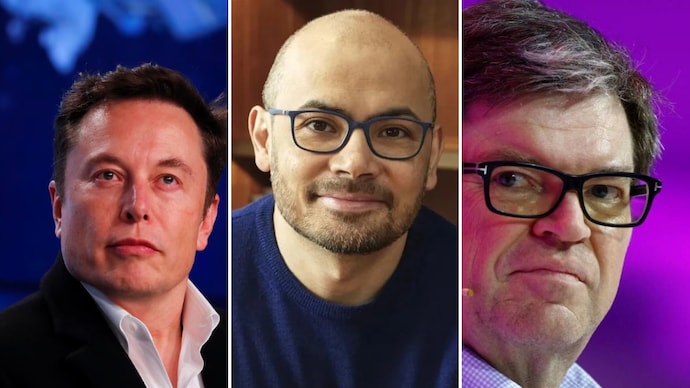


These are still early days in the world of AI, so early that even top AI gurus can’t agree on how to define its intelligence. In comments sure to spark debate, Google DeepMind CEO Demis Hassabis and Yann LeCun, who until recently was head of all things AI at Meta, disagree on the term general intelligence and whether AI can ever be as good as humans.
The debate is so passionate that two AI giants, one a Nobel laureate and the other a Turing Award winner, are debating on X, aka Twitter. And it’s not surprising that it has caught the attention of X boss Elon Musk, who has come out in support of Demis.
So, what is this debate? It’s about something called General Intelligence, which is the GI part in AGI. The term AGI stands for artificial general intelligence, which is considered a level of intelligence close to that of humans, among companies like OpenAI and Google. The idea is that AI tools like ChatGPT and Gemini will one day be so good that they will have the same “general intelligence” as humans. This means that when they encounter problems that they have never seen before during their training, these AI systems will be able to solve and deal with them just like humans, because of their ability to learn instantly.
Currently, AI tools like ChatGPT and OpenAI are not even close to this approach, and their “intelligence” pales in comparison to that of even a 10-year-old child, even if they can solve IIT papers and earn gold in Math Olympiads.
The contradiction between what AI systems can and cannot do led Yann LeCun to make his controversial statement, which sparked debate with Demis. LeCun has so far been less enthusiastic about creating AI systems with human-like minds, based on existing methods feeding terabytes of data to computers. Instead, he argues for a more holistic approach to AI that would involve giving computers longer memories and more sensory data.
Speaking recently about machine intelligence, Yann Lacan suggested that there is no such thing as general intelligence, not even in humans. He argued that human intelligence is highly specialized, and evolved biologically to deal with human problems. Furthermore, because of this highly specialized nature of intelligence, different humans are only good at different things. Not all of them can be mathematicians or great writers. More specifically, according to LeCun, human intelligence is driven by circumstances and biological limitations. He cites chess as an example. He says that unlike machines, which can remember and calculate millions of chess possibilities within seconds, even accomplished players like Magnus Carlsen can only calculate a small number of possibilities.
Demis Hassabis enters the debate in favor of machines
Yann LeCun’s loaded comments, essentially calling race and exploring AGI a fool’s errand, have received a response from Google DeepMind CEO Demis Hassabis.
Responding, Hassabis argued that LeCun, the Turing winner, was “confusing general intelligence with universal intelligence.”


According to Hassabis, the human brain is one of the most complex and general learning systems ever known in the universe. While no finite system can escape fundamental (biological) limitations, Hassabis argues that humans have general intelligence and this can be achieved by AI systems.
To strengthen his argument, Hassabis points to the Turing Machine, a theoretical computer that could be infinitely intelligent with infinite memory and computer resources. He argues that human brains are approximate biological versions of Turing machines, and modern AI foundation models are increasingly similar. In short, while neither humans nor machines are “completely optimal”, both are general enough to learn a vast range of tasks.
And the Hassabis are not alone in this view. Elon Musk also agreed with Hassabis’ counterargument to LeCun’s argument. In a brief reply, Musk wrote, “Demis is right.” In fact, Musk has long warned about both the risks and potential of advanced AI, often predicting that superintelligent systems are a matter of when, not if.
While Hassabis has laid out his argument in a lengthy X-post, Lacan has not backed down. In a follow-up response, he clarified that his objection is largely about the language of how we describe AI systems. He said, “I object to the use of “normal” to designate the “human level” because humans are extremely specialized.”