





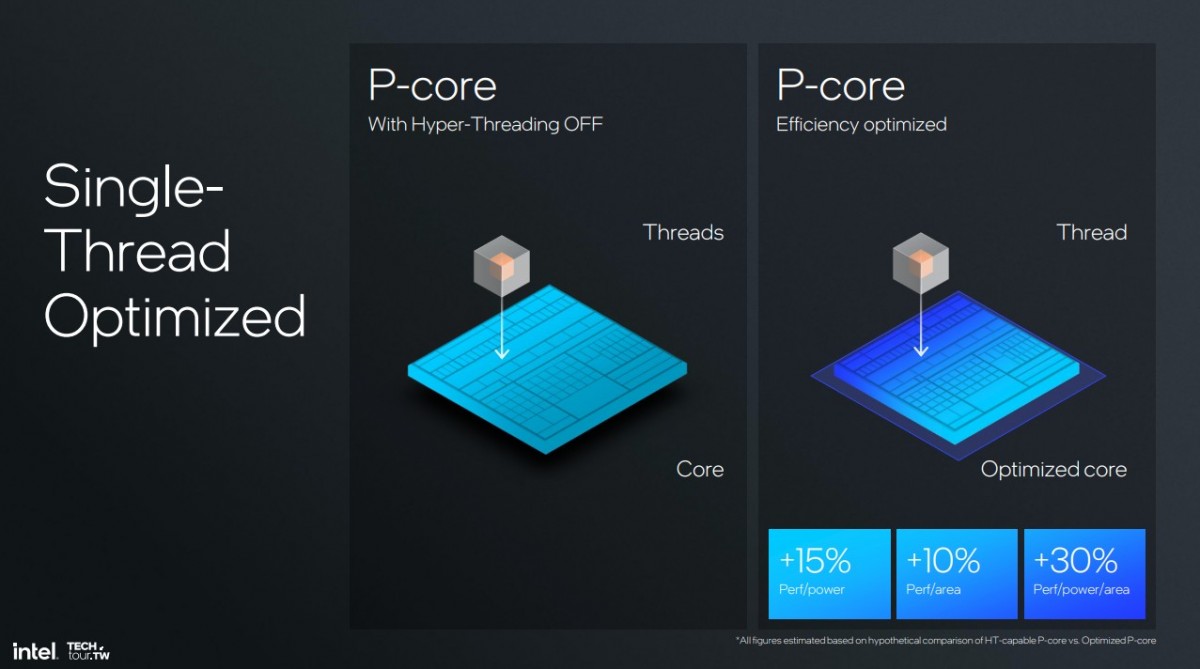
This June Intel unveiled its new series of laptop processors, dubbed Lunar Lake. It made the revolutionary choice of disabling hyperthreading, but Intel claims the new design is faster (14% higher IPC) and more efficient (60% better battery life), not to mention better graphics (50% more performance). The desktop version of these chips is expected to be unveiled on October 10, though Intel hasn’t officially set a date.
The desktop processors will be known as Arrow Lake and will also not feature hyperthreading. There should be 14 models in total and thanks to leakers, we already have detailed information about 12 of them.

These will be sold under the Intel Core Ultra branding and will range from 35W to 125W. They all come with a mix of performance cores (Lions Cove) and efficiency cores (Skymont). Calculating the number of threads is easy – just add up the number of P and E-cores.
| Processor | TDP | P-Core | E-Core | Base clock (P) | Base clock (E) | Turbo (P) | Turbo (E) | GPU Cores | GPU Clock |
|---|---|---|---|---|---|---|---|---|---|
| Core Ultra 9 285K | 125W | 8 | 16 | 3.7 GHz | 3.2 GHz | 5.4 GHz | 4.6GHz | 64 | 2.0 GHz |
| core ultra 9 285 | 65W | 8 | 16 | 2.5 GHz | 1.9 GHz | 5.3GHz | 4.6GHz | 64 | 2.0 GHz |
| Core Ultra 9 285T | 35W | 8 | 16 | 1.4 GHz | 1.2 GHz | 4.7 GHz | 4.5 GHz | 64 | 2.0 GHz |
| Core Ultra 7 265K | 125W | 8 | 12 | 3.9 GHz | 3.9 GHz | 5.2 GHz | 4.6GHz | 64 | 2.0 GHz |
| Core Ultra 7 265KF | 125W | 8 | 12 | 3.3 GHz | 3.3 GHz | 5.2 GHz | 4.6GHz | N/A | |
| core ultra 7 265 | 65W | 8 | 12 | 2.4 GHz | 1.8 GHz | 5.1 GHz | 4.6GHz | 64 | 2.0 GHz |
| core ultra 7 265f | 65W | 8 | 12 | 1.5 GHz | 1.2 GHz | 4.6GHz | 4.5 GHz | N/A | |
| Core Ultra 7 265T | 35W | 8 | 12 | 2.4 GHz | 1.8 GHz | 5.0 GHz | 4.5 GHz | 64 | 2.0 GHz |
| Core Ultra 5 245K | 125W | 6 | 8 | 4.2 GHz | 3.6 GHz | 5.0 GHz | 4.6GHz | 64 | 1.9 GHz |
| Core Ultra 5 245KF | 125W | 6 | 8 | 4.2 GHz | 3.6 GHz | 5.0 GHz | 4.6GHz | N/A | |
| core ultra 5 245 | 65W | 6 | 8 | , | , | , | , | , | |
| core ultra 5 235 | 65W | 6 | 8 | , | , | , | , | , | |
| core ultra 5 225 | 65W | 6 | 4 | 3.3 GHz | 2.7 GHz | 4.7 GHz | 4.4 GHz | 32 | 1.8 GHz |
| Core Ultra 5 225F | 65W | 6 | 4 | 3.3 GHz | 2.7 GHz | 4.7 GHz | 4.4 GHz | N/A |
Note that the F models don’t have an iGPU, the others have Intel Xe2 graphics. Also, the T models are low-TDP variants, while the K processors get higher clocks (there are some KF models as well). The two Core Ultra 5s still have details missing, but they’re on the lower end of performance.
We haven’t listed these in the table above, but all processors have Turbo Boost Technology (TBT) 2.0, which boosts a single P-core slightly higher. All except the Ultra 5 chips also have Turbo Boost Max Technology (TBMT) 3.0, which is another way to increase clock speeds (it targets the best-performing cores). Finally, Thermal Velocity Boost (TVB) increases clock speeds under certain thermal conditions (such as the CPU temperature must be below 70°C in desktop variants).
Here are the details posted @harukaze5719 And @jaykihan0If you want to take a closer look at the different Boost technologies, go here.
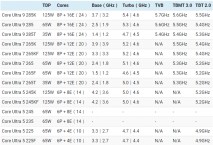
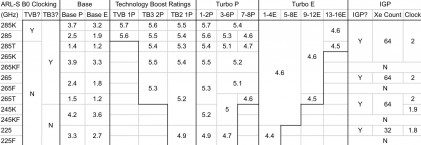
Details on Intel’s upcoming Arrow Lake desktop processors


Intel claims that the Lunar/Arrow Lake chips are not affected by the oxidation issues that plagued the 13th and 14th generation chips (Raptor Lake).