



In the late 1960s a small group of rats settled into what, at least on paper, looked like an ideal home in a laboratory in Maryland. There was no shortage of food, clean water came without fail, the temperature barely changed and disease was largely out of the picture. Every practical need was anticipated. If survival depended only on material comfort, the colony should have flourished indefinitely. Instead, the project became one of the most celebrated animal studies of the twentieth century. Long after the last rat died, the experiment continued to shape the conversation about cities, population growth, and human behavior, even as many of the conclusions people drew from it went far beyond what the research itself could support.
How john calhoun The mouse’s utopia became one of science’s most talked-about studies
The man behind the project was American biologist John B. Calhoun, whose career began with a practical rather than a philosophical question. Soon after completing his studies in zoology, he became involved in efforts to understand the rodents that had become frequent urban pests. Watching them for a long time gradually brought about a change in his interest. Instead of simply asking how to control rodent populations, he wanted to know how they organized themselves when the pressures of nature disappeared.By the time he created what later became known as Universe 25, Calhoun had already created more than two dozen experimental colonies. Each edition refined the ideas of the previous edition.
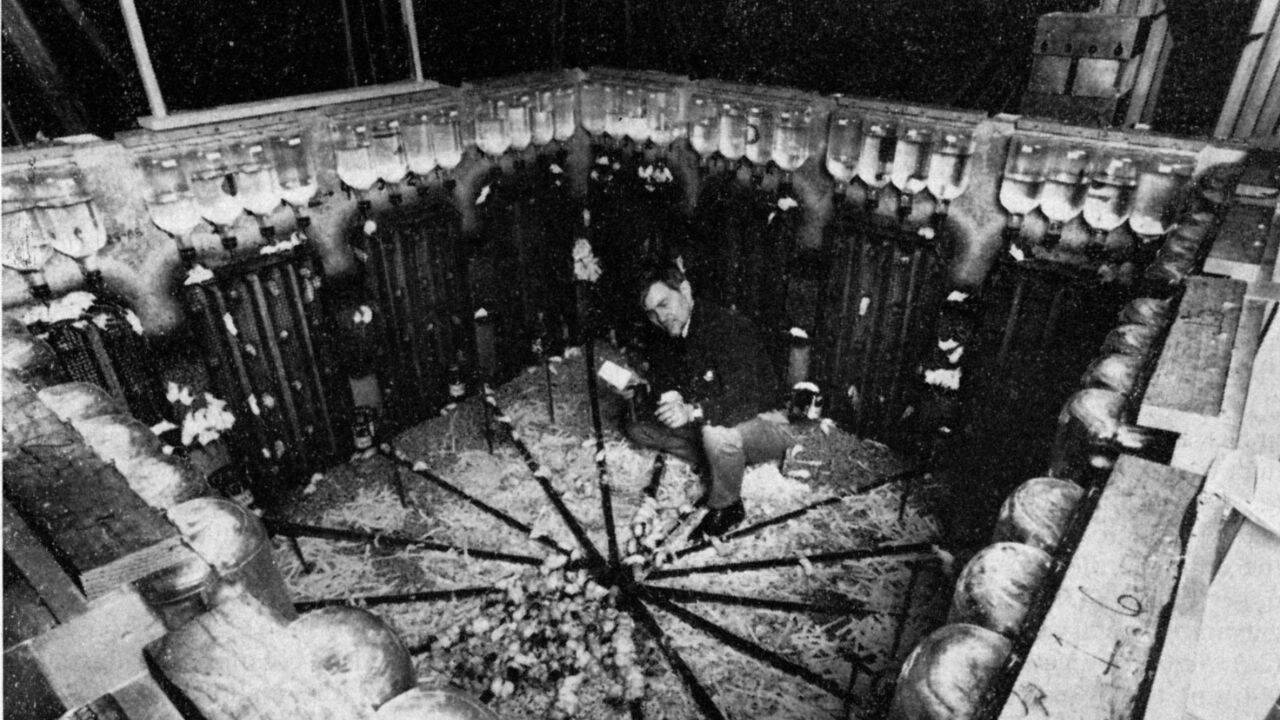
PC: National History Museum
The size of the enclosure was surprisingly modest. It measured approximately four and a half feet on each side, but every detail was planned. Food dispensers never dry out. Water was always available. There were hundreds of nesting sites on the walls, connected by wire walkways. The hunters were absent. The disease was carefully confined before the entry of rats.The official name, “Death-Inhibiting Environment for Rats”, sounded clinical. Among those familiar with the project, another detail immediately emerged.
A colony that grew almost without limits
Universe 25 began quietly in July 1968 with just eight healthy albino mice. Nothing seemed unusual for several months. Animals explored their surroundings, settled in nests and eventually began to reproduce. Once the first litter arrived, numbers increased rapidly. The population approximately doubled every few weeks, giving the impression that the carefully designed environment had succeeded.In less than two years, approximately 2,200 rats took over the enclosure. Yet the rising numbers masked changes that were previously hard to notice.Unlike wild populations, very few young rats died from exposure, predators, or disease. This meant that each new generation survived in unusually high numbers. Rather than replacing older animals, juveniles continued to accumulate until there were far more adults in the colony than were naturally present. The social balance that usually governed mouse communities began to change.
Trapped rats that changed the colony
Wild rats are no strangers to conflict. Males compete for territory and access to females, but defeated animals usually flee to establish themselves elsewhere. Universe 25 offered no such option.Dominant males defended preferred nesting areas, while unsuccessful challengers remained trapped inside the same enclosed space. Calhoun called these displaced animals “dropouts”. Many gathered in the central areas of the colony, bearing cuts and wounds from repeated confrontations. Big fights became common.Instead of settling disputes allowing weaker animals to move forward, violence began to be repeated without changing anyone’s position. Normal social patterns no longer resolve the stress. Prominent men also struggled. Territories became difficult to defend as new challengers constantly emerged. Some individuals gradually relinquished control over the nesting areas they had previously defended.
Unexpected behavior that surprised Calhoun

As areas became unstable, female rats found themselves facing repeated disturbances while raising babies.Intruding males enter nest sites more frequently, forcing mothers into more frequent confrontations. Some females expel the pups from the nest before they are developed enough to survive independently. Others left trash behind as they moved between nesting sites. Young rats that experienced neglect often reached adulthood without developing normal social behavior.Despite empty nesting areas nearby, some females became almost completely isolated and remained alone. Some men displayed another unusual pattern. They spent most of their time grooming themselves but showed little interest in mating, defending territory, or competing with rivals. Calhoun later described these males as “beautiful”, a phrase that became one of the best-remembered descriptions of the experiment.
a decline that could not be reversed
Reproduction slowed long before the colony reached its physical capacity. Until the twenty-first month, newborn puppies rarely survive long. Eventually births stopped completely. The remaining adults remained inside the enclosure for some time, but the colony had effectively reached its end. The old rats died one after another, with no younger generation taking their place. By 1973, less than five years after the experiment began, there were no living rats in Universe 25.A colony created to eliminate the usual causes of death had disappeared without starvation, epidemic disease, or predators.
Why did the experiment attract public attention?
Universe 25 emerged during a period when concerns about population growth dominated public discussion.Books warning about global overpopulation attracted huge audiences, while films imagined an overcrowded future marked by food shortages and crumbling cities. Calhoun’s work seemed to fit naturally into those fears, even though his rats never lacked food or shelter. Many commentators considered this experiment to be proof that if cities become too crowded, human societies will eventually follow the same path.Others saw different developments. Industrialized countries experienced a dramatic decline in infant mortality during the last century, allowing populations to grow rapidly. Decades later, birth rates began to fall in many developed countries. Some observers made comparisons between those demographic changes and the patterns observed inside Universe 25. However, the similarities remained incomplete.
A study remembered more for its symbolism than its science
More than fifty years after Universe 25 ended, this experiment still appears in debates about modern life. It is often presented as a prediction of humanity’s future, despite many ways in which human society differs from carefully controlled laboratory conditions.Perhaps the study’s lasting significance lies elsewhere. Universe 25 demonstrated how easily a single experiment can become a canvas on which different generations project their concerns. Environmental fears, political arguments, debates over cities, family life and social change have all found support in the same colony of rats.