





I attended a movie press conference where the press never got a chance to speak
If reporters can’t ask questions, is it really called a press conference? During film promotions, carefully crafted dialogues are replacing real conversations, with stars and PR teams controlling the narrative at every step. Result: Lots of publicity, but very little press.

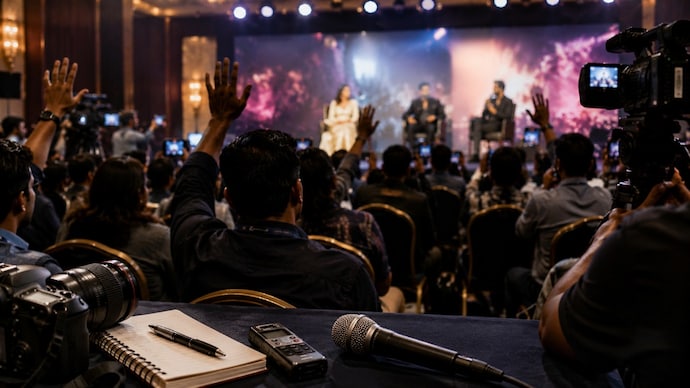


Before we get into it, it’s worth pointing out a quick distinction. A press conference is meant to be a two-way street – one where journalists ask questions, talent answers them, and the conversation unfolds in real time. On the other hand, a press event is largely a showcase, with the media present primarily to cover what is happening. So here’s the problem: more and more movie promotions today seem to blur that line. Events are being packaged as press conferences, but the real conversations that define the conference are being ignored.
So, when did press conferences start becoming covert press events?
Because I recently went to attend one such program and I felt as if the water had crossed the bridge so much that I could dedicate these words to him. Let me tell you exactly how it happened, as if I were sitting in front of you recounting the entire frustrating day.
It all started on a sunny Delhi afternoon – the kind that puts Rasna ads to shame. The temperature was 45 degrees, the kind of heat that makes you question every choice in life. I was in the office, immersed in work, right in the middle of my morning shift, but it was for a big, much-awaited pan-India film.
The invitation clearly said “press conference” and we double-checked with the team. So I quickly booked a cab, loaded my heavy 2 kg bag with my laptop, charger, recorder, notepad – everything I needed – and headed out at lunch time. Journalists rarely get food on time, right? I took whatever I could on the way, sweating in the back seat as the cab sped through the scorching roads.
I arrived at the venue, joining dozens of other journalists who had arrived hours earlier to set up cameras and prepare notes. Everyone looked ready for the real work. Then came the stars – the leading pan-India superstar and that certain golden girl. There was commotion, thunderous applause and sounds of flash everywhere.
He came on stage, chatted a bit about the film – the experience, the mood, the challenges on the set, the atmosphere, what the audience should expect. He smiled, waved, thanked everyone… and just like that, said goodbye in the same breath. The so-called press conference ended as soon as it started.
But that wasn’t even the worst part.
For the next two hours, we journalists were forced to sit there like obedient fans. The MC continued to make vulgar, crude and often downright misogynistic comments about the lead female actor throughout the event – comments that should have no place at any professional gathering. Instead of calling it quits, parts of the crowd laughed and cheered.
Meanwhile, we were faced with promotional clips, trailers, songs and pre-packaged videos playing on a loop one after the other. The MC then fired off a bunch of painfully generic, pre-programmed questions: “How are you feeling in Delhi?” “What’s your beauty routine?” “How incredible was it to work together on this film that everyone has been waiting for?” Blah blah… nothing meaningful. Nothing that really informed anyone. But still, we had to expose everything to record every moment, perhaps in any situation.
I kept looking at my watch, thinking about my unfinished tasks at the office, the cab fare I’d spent, the sweat still clinging to my shirt – all for this carefully controlled show that felt like a total waste of time.
It wasn’t just my bad day. This is a recurring trend that is becoming common. Journalists are called to different cities with big promises, only to face the same thing.
A friend who went to Vijayawada (from Chennai) came back completely disappointed with a similar setup. Another colleague in Hyderabad also faced the same dilemma. During the promotion of this film in Bhopal, the media was promised a complete concert-like experience with the star musician. Some even paid for tickets in advance. But it turned out to be another hollow campaign meeting. Fans later criticized it on social media, but no one took ownership.
Journalists are now asked to send questions in advance so that they can filter them. Excuse? “To save time, one person asks, everyone listens.” This controlling tendency has already begun in the one-on-one interview. There are backdoor ways to quietly sideline pushback journalists.
Even Zoom calls and special interactions are heavily monitored these days. A colleague of mine was interviewing a talent a few months ago, and the PR who arranged the call gave her strict instructions to refrain from asking any professional or film-related questions. I mean, then what was he supposed to ask? How did they gain weight recently or what does their current weekly binge-watching routine look like?
It seemed absurd, almost an insult to the very purpose of journalism.
Although all this was happening quietly behind closed doors, now it is spilling over into press conferences as well. Whatever little space was left for real journalism in entertainment reporting seems to be disappearing fast.


You can either escape the heat of Delhi or this kind of behaviour. both together? This is asking too much.
After sitting in the Delhi heat that entire depressing afternoon, one question kept echoing in my mind: What are these stars so afraid of?
They can always say, “I’m not comfortable answering this,” or “This isn’t the right time,” or “I don’t want to take the focus away from the movie.” This is their right. But why should we journalists be deprived of even the basic right to ask questions? Why turn every conversation into a tightly rehearsed performance where genuine curiosity is treated as a threat?
Are we really headed towards a future where press conferences will be reduced to glorified fan meetings and actors will speak only when the questions are pre-approved and flattering?
We have already reached the level where movie reviews are being controlled and managed. Now promotion scripts are written with the same care as films. This was understandable to some extent when it was limited to college fests, mall outings, train journeys or jungle safari gimmicks. But the press conference? Let’s take a breath already and save some of that energy for narrative control after release.
Me? I’m just a journalist who will be packing my bag tomorrow – laptop and equipment inside, maybe a book on good days – eating lunch on the go, trying to escape the Delhi heat. And sometimes try to beat the PR machinery at its own game.
Because if they’re going to keep scripting everything, the least we can do is refuse to shut up about it.
❮❯