



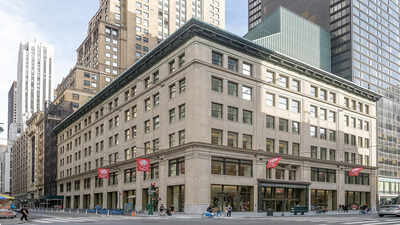
A significant $55 million donation revitalized the Mid-Manhattan Library, transforming it into the Stavros Niarchos Foundation Library. Image Credit: Wikimedia Commons
It is natural to conclude that in the emerging world of information technology, the traditional library as the central hub of urban life has become less relevant than ever. These libraries are romanticized in our minds as quiet halls of dusty books and studious scholars. However, in the context of urban life, the public library is one of the key elements without which day-to-day activities as well as professional development and networking would be significantly hampered. The issue with contemporary public libraries lies not in the lack of interest from the public at large, but in the physical structure that was designed many years ago.When the New York Public Library announced a massive contribution of fifty-five million dollars from the Stavros Niarchos Foundation, it seemed like another standard entry in the ledger of high-profile cultural philanthropy. The target of this funding was the Mid-Manhattan Library, a branch located just across the street from the main research building’s famous stone lions. For decades, this specialized branch served as the true workhorse of the city’s library system. It was a place where ordinary residents actually went to look for books, look for work, or find a quiet desk.As stated in the official press release titled A historic gift of $55 million by the Stavros Niarchos FoundationThe building continued to struggle due to its success. Before the renovations were made, the branch was visited by one million and seven million people each year and the library distributed two million items. Simply put, the library infrastructure suffered wear and tear due to the high amount of human activity occurring in the building. Thus, in this example, the donation was less about creating a need than about meeting an already substantial demand.

This renovation shifted the focus from book storage to community needs, creating dynamic spaces for learning, interaction and professional development. The redesigned Library now serves as a vital, free democratic center for ordinary New Yorkers. Image Credit: Wikimedia Commons
Why do modern civic spaces need a complete structural overhaul?With funding provided by donors, the library system was able to redesign its entire space and build an entirely new building focused on fostering media, education, and interaction between people. During the renovation, the branch was transformed into the Stavros Niarchos Foundation Library, fundamentally changing the way the modern library interacts with people. The building no longer prioritized shelves over the needs of human visitors – the renovated architecture includes wide open spaces, designated teaching areas, technical laboratories and an outdoor terrace for visitors to freely use.The immediate return on this structural change became apparent very quickly. According to the one-year impact report titled The New York Public Library’s completely transformed Central Circulating Library celebrates one yearThe reimagined building recorded hundreds of thousands of visits and massive circulation numbers within its first twelve months of operation. The facility hosted thousands of free public events, adult learning courses, and computer sessions, proving that the place had evolved into a highly functional public engine rather than a static architectural monument.This was reflected in creating separate floors for different demographics, including the creation of a special facility for youth and a large library for those looking for jobs. The new design demonstrated the potential of a contemporary form of giving, which can make a big difference in terms of unlocking resources and creating a large indoor area in which anyone can live, work, or learn absolutely free of charge.Democratic potential of free public spaceThe real meaning of this transformation goes beyond any reward or acknowledgement. In an expensive city centre, it is quite difficult to find a vacant area nowadays. All public spaces in urban contexts function according to the principle of consumption; To get the chance to sit and work with a laptop, you have to buy coffee or pay for access. This new library is a departure from the norm because it bills itself as a truly democratic facility.By installing this massive structural update to a permanent circulating branch, the project ensured that the daily lives of ordinary New Yorkers were enhanced. The change provided a streamlined, modern space where a student studying for an exam sits right next to an immigrant practicing English or an entrepreneur starting a business.The takeaway from all this spending is that the best way to give is one that reaches exactly where people are already meeting. This shows that if you provide a community with a place where their education and civic needs are respected, they will fill that place to the rafters. The real value of a library lies not in the large sums of money visible on the donation slip, but in the hundreds of thousands of individual eureka moments that occur every day within its walls.