



For decades, scientists believed that the tallest trees faced one of nature’s toughest challenges: deliver water from their roots to their leaves hundreds of feet above the ground. Now, a study of tall trees in Southeast Asia shows that some of the world’s tallest flowering plants have evolved special systems to overcome that problem.Researchers studying dipterocarps in Malaysia found that these giant rainforest trees have evolved ways to efficiently move water through their trunks, allowing them to withstand the physical demands of extreme altitude. The findings challenge a long-held belief that taller trees are more sensitive to drought.This study was published in the journal Science On 2 July. It focused on five species of Dipterocarps in the Kabili-Sepilok Forest Reserve on the island of Borneo. Scientists say the discovery could impact the way we understand forests in a changing climate, because the tallest 1 percent of trees contain more than half of the above-ground carbon stored in forests.“These trees are rare and important, and current predictions suggest they are at high risk of dying due to drought due to a weakened hydraulic system,” Paulo Bittencourt, a forest ecologist at Cardiff University in Wales and lead author of the study, said in a statement.He added: “That prediction is included in some models of climate change impacts, and our study suggests it may not be correct. More research is now needed to investigate the hydraulic systems and drought resilience of other tall trees.”
Study of trees taller than 20 storey buildings
The research team spent three months in 2022 collecting samples from 38 dipterocarp trees ranging from about 25 feet to 233 feet tall. The work involved collecting samples of branches, leaves and trunks from trees that could be as tall as a 20- to 30-story building.Samples had to be collected from the upper parts of the trees, so the scientists worked with trained climbers who scaled huge trunks and reached branches high above the forest floor.“These are people who can thread a rope up a tree as high as a 20- to 30-story building in the middle of the forest, climb it, and collect branches,” Bittencourt said in a separate statement.He added: “Some of the collection had to be done at night, without sunlight. It’s not just about knowing how to thread a rope and being physically fit. You have to check wasp nests, know whether a branch is suitable, whether the wood is strong – this is no trivial matter.The collected material was analyzed for characteristics related to water movement inside the trees. Scientists examined the structure of xylem, the plant tissue that is responsible for transporting water and nutrients from roots to leaves.
Tall trees adapted their internal plumbing
The researchers found that tall dipterocarps have extensive xylem vessels near the base of the trunk. These wide channels help reduce the resistance of water as it moves upward against gravity.The leaves growing near the tops of these trees also showed the ability to tolerate dry conditions without losing their function. Together, these adaptations allow trees to maintain water transport despite their immense height.The findings do not mean that all tall trees are safe from drought. Different species have different biological systems and face different environmental pressures. But studies show that height alone cannot determine whether a tree will be able to survive in dry conditions.To investigate how these trees responded to water scarcity, the researchers also measured trunk growth before, during, and after an El Niño-related drought between 2023 and 2024. They found that tall trees did not suffer a greater decline in growth than short trees during drought.
The world’s tallest trees face similar challenges
The results add to the understanding that tree size and drought survival are more complex than previously thought.Adrian Das, a forest ecologist with the U.S. Geological Survey who was not involved in the research, said the findings match patterns seen during drought in the Sierra Nevada mountains. “The relationship between size and mortality during drought varies by species,” he explains to Mona Patterson in Science.In those forests, factors such as susceptibility to bark beetles appeared to play a larger role in tree mortality than height alone.The research also offers a different perspective on how trees respond to their surroundings. Julieta Rosell, a functional ecologist at the National Autonomous University of Mexico who was not involved in the study, tells Fechi Inyama at Science News that the findings should prompt us to reconsider the nature of trees.“They’re doing things all the time, changing their anatomy all the time,” she tells the outlet. “And it gives a different perspective to the trees, because they seem so cool.”

Giant trees around the world reveal different survival strategies
The study of dipterocarps of Southeast Asia encourages research on other giant tree species that have developed their own ways of surviving in extreme conditions.The General Sherman Tree in Sequoia National Park, California is the world’s largest known living single-stemmed tree by volume. The giant sequoia stands approximately 83.8 meters tall and has an estimated 1,487 cubic meters of trunk volume. Although it is not the tallest tree on Earth, its sheer size has made it one of the most studied trees in the world.Estimated to be 2,200 to 2,700 years old, the General Sherman tree survives in part because of the giant sequoia’s thick, fire-resistant bark. The bark of old trees can be more than 90 centimeters thick. Fire also helps these forests by releasing seeds from the cones and reducing competing vegetation.
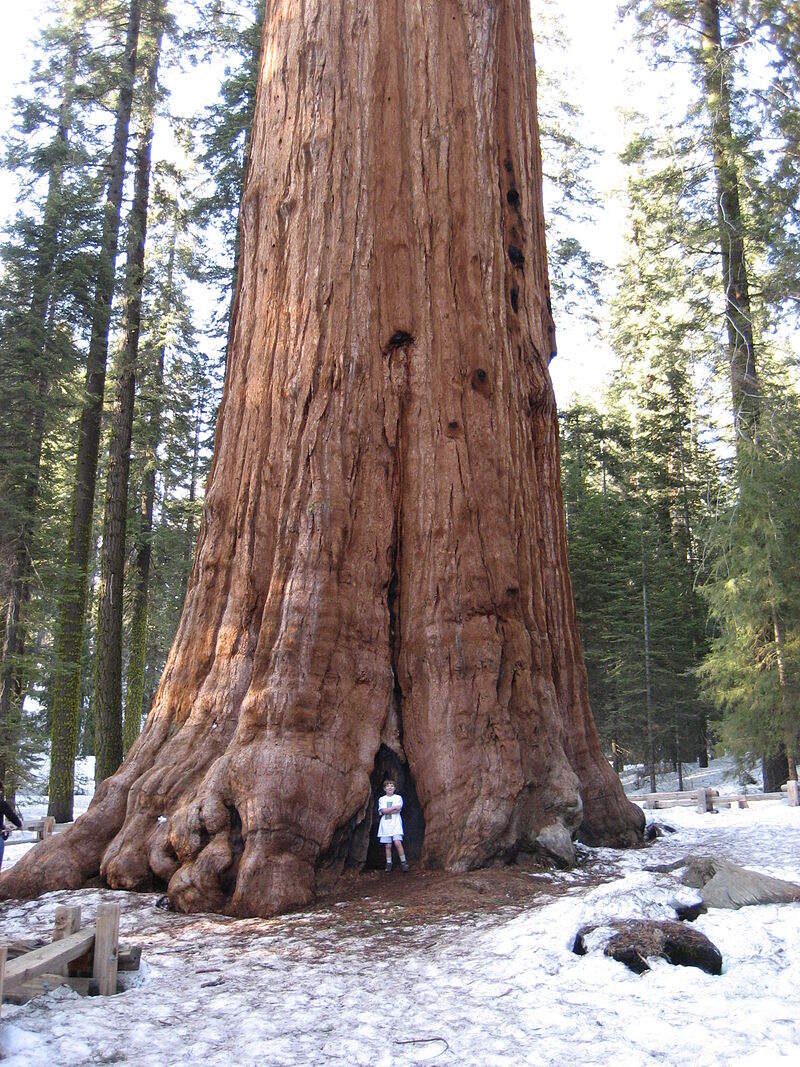
Largest Living Tree: General Sherman Giant Sequoia
The tallest trees known today belong to other species: coast redwood. Found in coastal areas of Northern California and southern Oregon, these trees can reach heights far greater than most other plants.The tallest known living tree is Hyperion, a coast redwood discovered in 2006 in Redwood National and State Parks. It measures approximately 115.9 metres, although its exact location is kept private to protect it from damage caused by too many visitors.Coast redwoods benefit from their cool, wet environment near the Pacific Ocean. Coastal fog provides additional moisture during dry periods, while their biological adaptations help them carry water through trunks that can rise more than 100 meters into the air.Some historical giants, such as the Dyerville Giant, were also coast redwood species. Before falling in 1991, the tree was approximately 113 meters high.Another tree capable of reaching extreme heights is the Mountain Ash of Australia. Some past specimens have grown over 100 m, although no living mountain ash currently reaches the height of the tallest coast redwoods.Scientists continue to study these giant trees because their existence provides clues to how forests may respond to future climate pressures. New dipterocarp research suggests that some of Earth’s tallest trees may have more control over their water systems than scientists realize.