



From Aishwarya Rai to Ella Bright, why can’t women escape body shaming?
From Aishwarya Rai Bachchan’s Cannes scrutiny to the backlash against off-campus actor Ella Bright, the internet’s obsession with ageing, thinness and women’s bodies reveals impossible beauty standards.
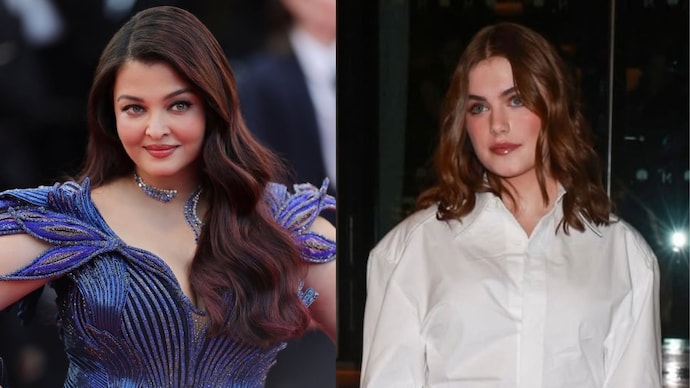

The Internet is a fascinating place. It will collectively promote “body positivity” at 9am, post “Age gracefully, queen” at 11am, and at lunchtime, zoom in at 400 per cent on a female celebrity’s face and ask if she has “let herself go”.
Which raises an important cultural question: Are we really that uncomfortable with aging and healthy bodies, or are we just uncomfortable when women stop looking as good as they do at 23?
❮❯
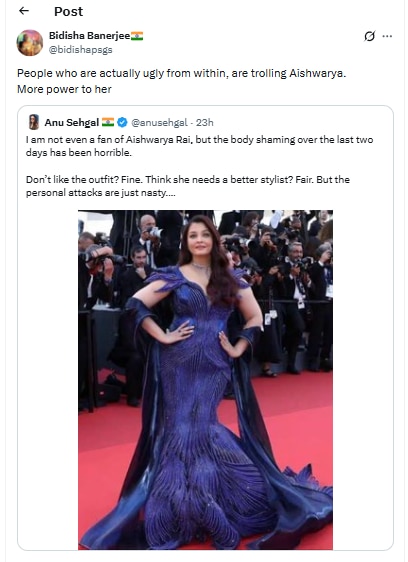
Because Aishwarya Rai Bachchan’s reaction during the closing ceremony at Cannes this year was not normal. It was anthropological. People weren’t even discussing cinema, fashion or the fact that she is one of the most globally recognized Indian faces to walk the red carpet. Instead, social media turned into a forensic lab dedicated to answering one question: Why doesn’t she look the same as she did in 2002, when she made her debut at the Cannes premiere. Devdas?
Well, because it’s 2026. Because time has passed. Because human age increases. Because the skin moves. Because there are fluctuations in the body. Because gravity exists. Because life exists.
Here’s Kangana’s reaction to trolls body-shaming Aishwarya:
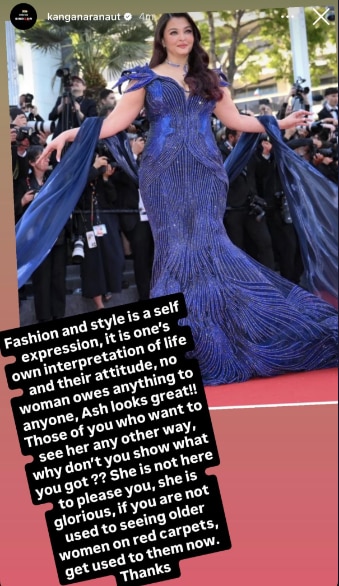
(Photo: Instagram/Kangnarnot)
And yet, the outrage felt oddly personal, as if Aishwarya had violated some unwritten contract we make with beautiful women: You can have fame, success, power, longevity and relevance, but under no circumstances are you allowed to age.
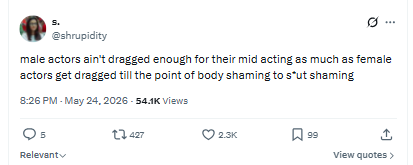
Men age into desirability. Women’s age is checked
Meanwhile, male stars are often repackaged by age. Eight out of ten aging male celebrities are suddenly rebranded as the “silver fox”, “salt-and-pepper icon”, or simply – “daddy”. His wrinkles are bumpy. His graying hair is sophisticated. His tired eyes are “seasoned”.
The same Internet that calls a 52-year-old male actor “zaddy” will look at a woman of the same age and ask if she’s “okay.” Women are assigned a completely different vocabulary: “hag”, “old”, “finished”, “bad”, “unrecognizable”.
This does not mean that men are immune. They also have to face body shaming. Despite speaking publicly about serious health conditions over the years, Salman Khan has been constantly mocked for his changing physique and bulging belly. Fardeen Khan became the butt of cruel memes over his weight gain, but after he slimmed down, audiences suddenly embraced him again. Even global celebrities like Justin Bieber have faced aggressive comments regarding looks, health and fatigue.
But this is where the story changes. For men, the conversation often returns to attraction. Rudeness. “He still has the aura.” Society leaves room for men to move toward desirability.
Women rarely get that grace. There is always an undertone of disappointment, as if women owe eternal youth to the public.
And nowhere is this more evident than in the conversation surrounding body size.
The backlash against Ella Bright, who played Hannah Wells in Off-Campus, was a clear example of how internet beauty standards have become completely disconnected from reality. The criticism was bizarre because Ella Bright does not remotely resemble what medicine or science would classify as “fat”. She simply has a healthy, full body that doesn’t fit the ultra-thin, Pinterest-based image of female leads that people have become accustomed to.
Apparently, having thighs now counts as controversy.
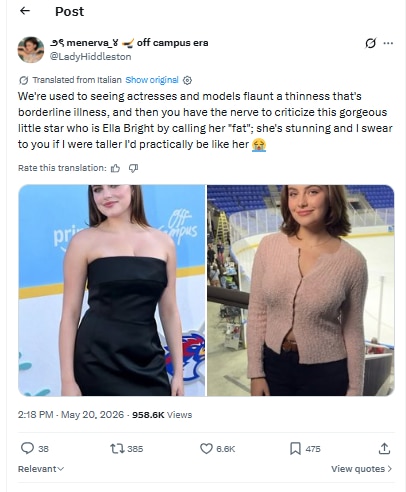
The Internet no longer recognizes normal dead bodies
Between Instagram filters, Ozympic discourse, and algorithm-driven beauty standards, society forgot what a real human body looks like. Anything that doesn’t have a sharp collarbone and no visible ribs is immediately considered “fat”. This begs the question: what exactly is considered fat anymore?
Because according to the internet the cheeks are plump. Having arms is thick. Obesity remains present after 35. Retaining water for three days is obesity. Sitting like a normal person and sitting with the stomach bent also obviously increases obesity.
Medical experts have long said that body size alone does not define health. Hormones, genetics, stress, medication, aging and mental health affect every body differently. Being thin doesn’t automatically mean being healthy. Having a full body doesn’t automatically mean being unhealthy.
But internet culture doesn’t care about health. It takes care of the optics. This is why body shaming is more dangerous than ever. It disguises itself as “worry.” People bash celebrities for gaining weight and then hide behind: “We’re just concerned about health.”
no you are not.
If society really cared about health, it wouldn’t turn people into trending topics every time visible weight gain occurs. It would not make fun of women for aging naturally while criticizing cosmetic surgery. It will not weaponize paparazzi photos taken in the blink of an eye to decide who has “shined” and who has “fallen.”
What we are seeing is not a matter of concern. This is surveillance. And women are subject to much more stringent surveillance than men.
Take the cast of Friends. Every few months, social media “re-reveals” that the actors have aged, as if audiences expected the guys from Frozen to look exactly the same from the cryogenic chamber in 1998. The scrutiny on fillers, wrinkles, weight changes and facial structure is rampant.

Rules are impossible. If women age naturally, they are “letting themselves go”. If they have had cosmetic work done, they are “plastic”. If they lose weight people accuse them of using Ozempic. If you gain weight, you become memes. If they remain conventionally attractive, they are accused of making a desperate attempt to remain young.
This is a game designed for women to lose.
And perhaps the saddest thing is how quickly this conditioning starts now. Teens are growing up seeing perfectly healthy women being labeled “fat” online. They are learning that a normal body is somehow unacceptable. That old age is failure. That softness is weakness. It’s shameful to look like that human.
This is no longer harmless celebrity gossip. It restores self-worth.
The entertainment industry – both in the West and in India – certainly continued to promote these standards for decades. Cinema repeatedly sold women as fantasy objects while allowing men the luxury of transformation. Older male stars romance women half their age on screen and audiences barely blink. Meanwhile, women past a certain age are pushed into the “mother role” whether they want it or not.
And yet, ironically, the most famous performances in recent years have been by actors who allowed themselves to appear human. The industry is slowly improving, but audience conditioning is still decades behind.
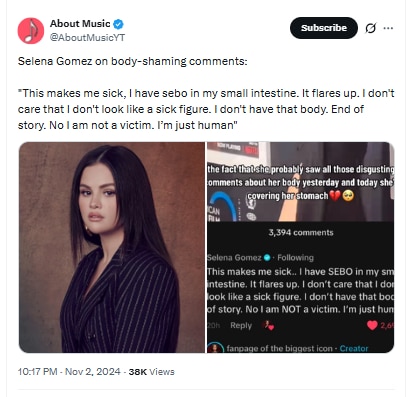
Selena Gomez has repeatedly spoken about the effects of lupus medication on her body. Nicola Coughlan has told interviewers to stop losing weight. Millie Bobby Brown grew up under a microscope even before she became an adult. Vidya Balan struggled with this throughout her career while delivering acclaimed performances. Both Ayesha Takia and Patralekha have faced deeply offensive comments about their appearance.
At some point, we need to ask ourselves why society feels so entitled to constantly judge women’s bodies. Perhaps the real epidemic is not aging. Perhaps it is our inability to let people do this peacefully.
Because aging is not failure. this is survival. This is a privilege. This is proof of living life.
Aishwarya Rai Bachchan doesn’t owe the world her 2003 face. No actor does.
And a healthy body doesn’t become “fat” just because the internet has forgotten what a real body looks like.
‘, e.appendChild