


AI and advertising wars, OpenAI and Anthropic business take a dig at each other
AI companies are under pressure to grow their revenues rapidly. They are now seeing ads in their chatbots like ChatGPT. But as they think about serving ads, they are also taking digs at each other or so we see in the barbs traded by OpenAI and Anthropic.
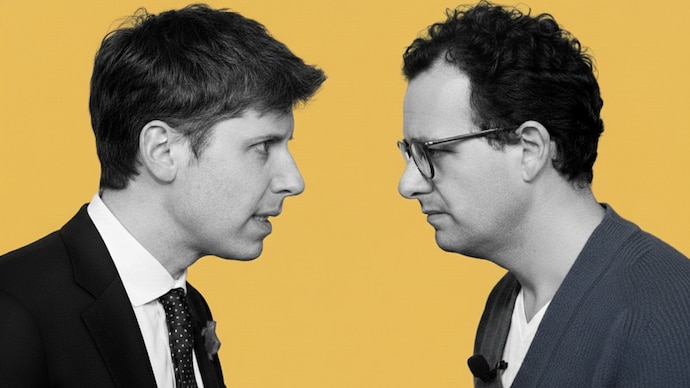

Silicon Valley’s two AI giants are at loggerheads again and this time, it’s about ads and ideology. OpenAI recently revealed plans to introduce advertising into Chatbot, a move through which Sam Altman intends to monetize the hugely popular chatbot and increase revenue. Taking a direct hit at this decision, rival Anthropic responded with an advertising campaign stating that its AI model, Cloud, would never welcome ads.
In some ways the ads are reminiscent of the classic Mac vs. PC battle that Microsoft and Apple once fought publicly, taking opposite positions in terms of product culture and aesthetics.
Anthropic Super Bowl Uses
Just a few days earlier, during the Super Bowl, Anthropic released a 60-second pregame ad saying “Ads are coming to AI. But not to the cloud.”
Shortly thereafter, OpenAI and Anthropic began publicly trading. Anthropic continued its criticism on Thursday, with its chief commercial officer Paul Smith defending the company’s stance, saying it was the company’s “conscious decision” to keep the cloud ad-free. In an interview with CNBC, Smith argued that advertising could lead companies to “optimize for the wrong things”. He suggests that Anthropic does not want to prioritize engagement and revenue over intelligence, security and trust.
“We’ve made less attractive headlines than some,” Smith told CNBC. “We’re not fighting with any other partner for attention or advertising revenue or anything,” he said.
While Anthropic delivered back-to-back jabs, OpenAI did not remain silent. Its CEO Sam Altman quickly hit back, calling the Super Bowl ad “misleading” and “blatantly dishonest.”
“I wonder why Anthropic would go for something so obviously dishonest. Our most important principle for ads says we absolutely wouldn’t do this; we obviously wouldn’t run ads in the way Anthropic portrays them. We’re not stupid and we know our users would reject it,” Altman wrote in a post on X. “I guess a misleading ad for anthropic doublespeak is used to criticize theoretically misleading ads that aren’t real, but a Super Bowl ad is not where I would expect it to be.”
Culture and users
Interestingly, there is more than just monetization strategy, ideology at the core of this clash between the two AI giants. Anthropic was founded by siblings Dario Amodei and Daniela Amodei, both former OpenAI vice presidents, who left over concerns that the company was moving too quickly on commercialization at the expense of security. Since then, Anthropic has established itself as a security-first AI company with an emphasis on aligned research and enterprise-grade deployment. And although Dario is no longer an OpenAI employee, his company has kept a close eye on his former employer and has criticized it from time to time.

OpenAI, meanwhile, has leaned aggressively toward commercialization of AI due to pressure to generate revenue. According to Altman, the company wants to bring AI to the masses, and it needs significant revenue streams. “Anthropic serves an expensive product to rich people. We’re glad they do and so are we, but we also feel strongly that we need to bring AI to the billions of people who can’t pay for subscriptions,” Altman wrote in his post on X.
As we saw, the OpenAI vs Anthropic ad battle has a hint of Windows (mass market) vs Mac (devices for the rich and elite) vibes.
In parallel with this ongoing advertising war, companies are also locked in a competition over their latest autonomous coding agents. Tensions reached a fever pitch this week when both companies released their major coding tools just twenty minutes apart. Anthropic launched Cloud Opus 4.6, designed to empower its “cloud code” agent to navigate large enterprise codebases and fix complex bugs with minimal human oversight. OpenAI immediately countered with the GPT-5.3 codec, a standalone coding agent that Altman claims can do “almost anything” a human developer can do on a computer.