



For centuries, space has fascinated humans like no other. From the brightness of the sun to the surface of the moon and even the shimmering rings of Saturn, we want to get up close and see it all. Now, two ambitious NASA-backed projects aim to actually touch Saturn’s rings, known as one of the most dangerous environments in the solar system.Selected under NASA’s Innovative Advanced Concepts (NIAC) program, the proposals envision future robotic explorers that could not only sample Saturn’s icy rings for the first time but also deploy thousands of small spacecraft to fly through them, uncovering mysteries that have been puzzling scientists since the Cassini mission ended in 2017.
first project
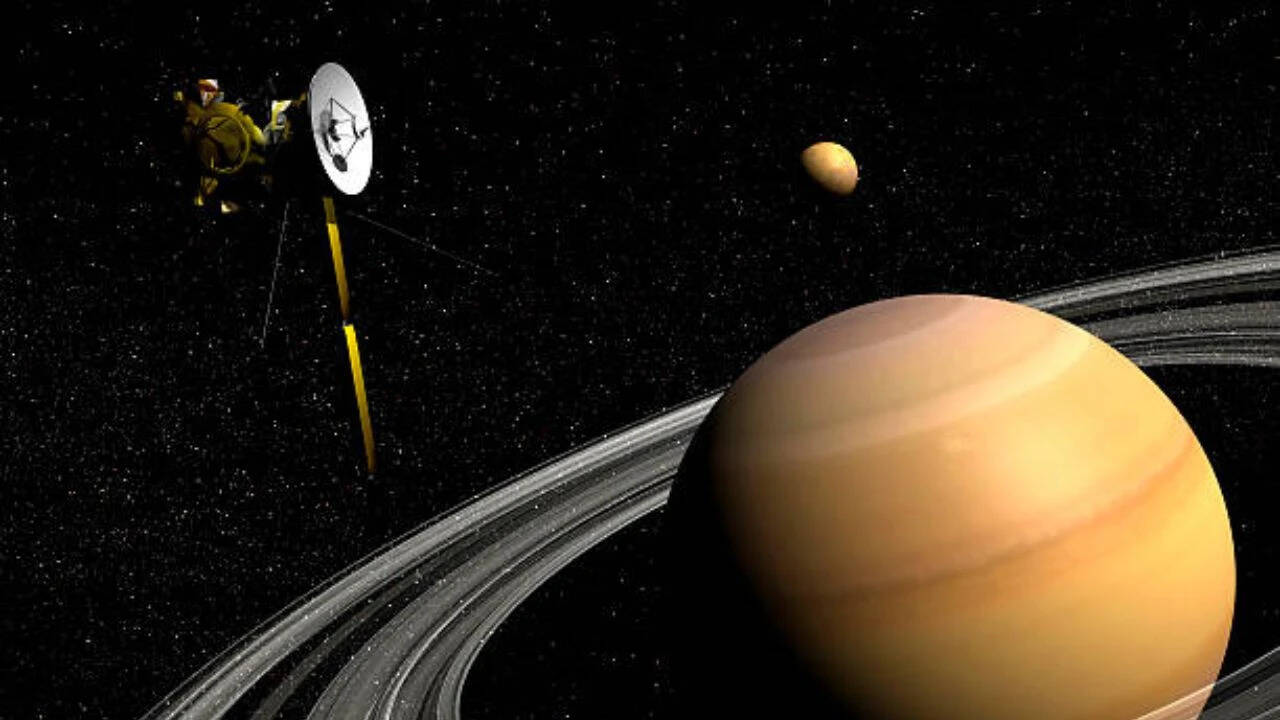
The boom will briefly touch the surface of a moving ring particle, collect material and retract before the spacecraft moves away.
The first concept is called Planetary Rings Autonomous Exploration with Praxis or in-situ sampling. It proposes what would be the first “touch and go” mission to reach Saturn’s rings. The project is led by Dr. B., Principal and Group Supervisor of the Robotics Modeling and Simulation Group at the Jet Propulsion Laboratory. Will be done by Marco Quadrelli.Despite Cassini revolutionizing our understanding of the gas giant, scientists still don’t know exactly how the rings formed, how old they are or how the countless ice particles constantly collide, merge and break apart. Those particles range from microscopic particles to pieces the size of houses and are largely made up of water ice mixed with rocky material. While Cassini photographed them at close range, it never directly sampled the ring particles.Praxis hopes to change that. Instead of flying directly into the planet’s dense rings, the spacecraft will hover safely above them before extending a long, flexible boom inspired by the precision of sport fishing. Guided by artificial intelligence, the boom will briefly touch the surface of a moving ring particle, collect material and retract before the spacecraft moves away.The mission will then repeat the process at several locations, including gaps and dense ring regions, allowing scientists to compare samples from Saturn’s vast ring system.Onboard instruments will immediately analyze the material, measuring particle size, porosity, composition and internal structure, providing vital clues to understanding whether Saturn’s rings are the remains of a shattered moon, building blocks left over from planet formation or something entirely different.
second project


It envisions deploying approximately 10,000 actively steerable femtosatellites to fly directly through Saturn’s rings.
The second proposal selected by NIAC takes a more advanced approach. Led by Northwestern University’s Michael Rubenstein, the concept envisions deploying about 10,000 actively steerable femtosatellites, tiny spacecraft each just a few centimeters wide, to fly straight through Saturn’s rings, atmosphere and magnetic field.Unlike major spacecraft like Cassini, which had to avoid dense ring regions to reduce collision risk, the femtosat swarm accepts that danger. Even if thousands of smaller spacecraft are destroyed by high-speed impacts, the mission may still be successful because the remaining probes will continue to collect data. Together, they will create an unprecedented three-dimensional map of Saturn’s ring structure, atmospheric density and magnetic environment.This distributed approach also provides a major engineering advantage. Instead of risking a multibillion-dollar spacecraft, scientists can spread this risk across thousands of inexpensive explorers, greatly increasing the chances of obtaining measurements from environments previously considered inaccessible.While both missions are in the early concept stage, NASA’s support highlights their credibility and the agency’s growing interest in returning to Saturn after Cassini. If either proposal ultimately succeeds, humanity will set another record, that of touching the rings around Saturn.