



What started as a family trip to help remove invasive snakes from Florida’s Everglades soon turns into a terrifying fight for survival. Carl Jackson believed he saw a Burmese python, approximately 12 feet long, crossing a dirt road in the Big Cypress National Preserve. But as soon as he caught the snake, he realized that he had made a very costly mistake. The huge reptile, which was later measured at 16 feet 10 inches and weighed 202 pounds, began dragging him through dense bushes towards a nearby canal. When the giant python attempted to wrap itself around him, Jackson’s wife and two children came forward to help, turning the dangerous encounter into one of Florida’s most notable python captures.
How a Florida dad captured a Burmese python
The incident occurred on January 13 during an official python removal hunt at Big Cypress National Preserve. Carl Jackson was accompanied by his wife, Tasha, and their children, 20-year-old Ryker and 16-year-old Jazlyn, who were recently certified to assist in aggressive python hunting.Jackson initially estimated the snake to be about 12 feet long. However, as soon as he held it behind the head, he realized that it was too big. Instead of attacking immediately, the giant Burmese python began dragging him through dense vegetation towards a canal. As he dragged her on the ground, the snake also tried to wrap its powerful body around her, creating a potentially dangerous situation.
His family members jumped in to save him
Seeing their father in trouble, Carl Jackson’s son, Riker, and daughter, Jazlin, immediately rushed to help. Ryker grabbed the dragon’s tail while Jazlin helped stop it from coiling around her father. At the same time, his wife, Tasha Jackson, taped the snake’s mouth shut and later closed its eyes, making it easier for the family to control the reptile. Working together, the family eventually tames the giant snake. Jackson later recalled that he came about a foot inside the canal before his wife and children helped bring the terrible struggle under control.
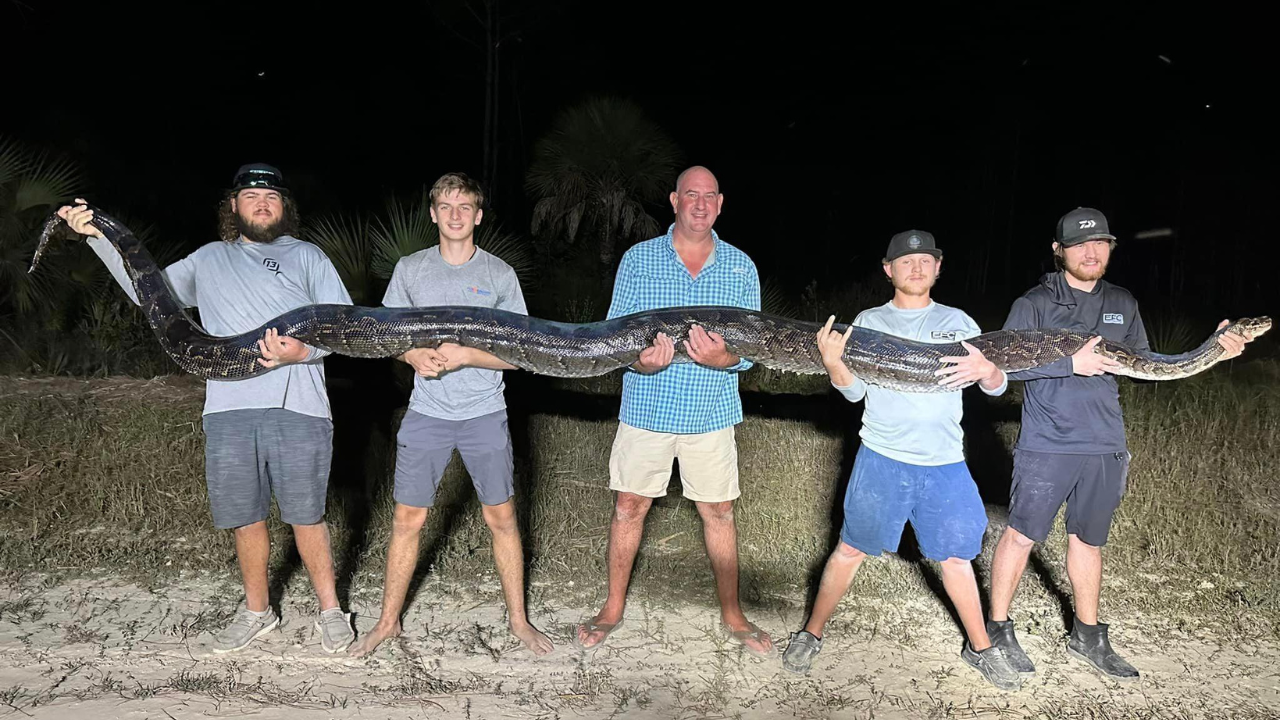
One of the largest pythons ever recorded in Florida
Only after taming the python did the family appreciate its extraordinary size. Officials measured the female Burmese python at 16 feet 10 inches long and 202 pounds, making it the second heaviest wild Burmese python ever recorded in Florida.The snake was so large that it almost filled the bed of the family’s pickup truck. Its size also highlights how established Burmese pythons have become in South Florida, where they are considered one of the region’s most destructive invasive species.
The biggest surprise came after being caught

While processing the python, the family discovered even more remarkable details. The giant female was carrying about 200 eggs, meaning its removal prevented hundreds of potential babies from entering Florida’s fragile Everglades ecosystem.The previous record-setting female python, discovered in 2022, weighed 215 pounds and contained 122 developing eggs. Although this latest snake fell short of the weight record, it may surpass it in terms of reproductive capacity.
Why are Burmese pythons so endangered?
Native to Southeast Asia, Burmese pythons are believed to have established breeding populations in Florida after escaping from pet snakes and being released into the Everglades. Over the past few decades, they have become one of the state’s most problematic invasive predators.Snakes eat a wide range of native wildlife, including mammals, birds and reptiles. Scientists have linked their expansion to significant declines in many mammal populations in parts of the Everglades, prompting state agencies to conduct regular removal programs involving trained contractors and volunteers.
A big win for Florida’s Everglades
Although the encounter could have ended very differently, the Jackson family’s teamwork kept a dangerous situation from becoming a tragedy. Their capture not only resulted in one of the largest wild Burmese pythons ever found in Florida, but also removed a breeding female carrying approximately 200 eggs.For wildlife officials, this makes the dramatic conflict much more than just a remarkable survival story. It also represents a significant victory in the ongoing effort to protect Florida’s native wildlife from one of its most successful invasive predators.