



Baahubali to Peddi: How pan-Indian cinema exposed southern cinema’s gender dilemma
A scene in Peddi showed Ram Charan kissing Janhvi Kapoor without consent, which sparked a national reaction. Would the objectification of Janhvi Kapoor in Telugu films have become a national debate if India had not adopted a pan-Indian cinema culture?
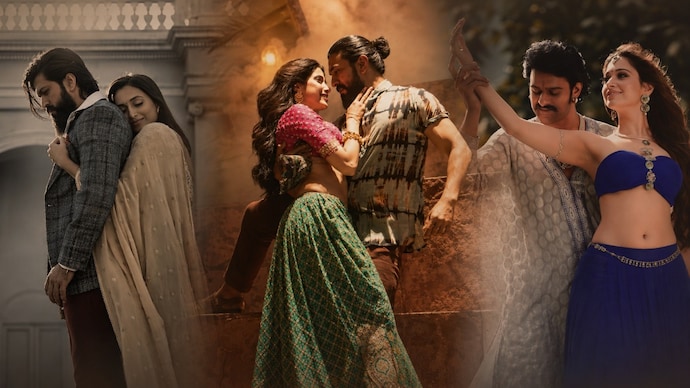

Fierce national reaction against Ram Charan pedi Janhvi Kapoor’s hypersexualization controversy has made one thing clear: South cinema’s gender problem is no longer a regional conversation.
When the film featured a controversial scene in which Ram Charan’s character kisses Janhvi Kapoor’s character without her consent, the audience did not see a “tough but lovable hero”. They witnessed sexual harassment. The outrage was intense, brutal and impossible to ignore. More importantly, it forced the producers to re-edit the film midway through – a move that showed how much audiences had changed.
❮❯
For years, commercial South Indian cinema operated within its own cultural ecosystem, where certain values went largely unquestioned. All India cinema changed this. By taking regional stories to national and global audiences, it also brought decades-old storytelling formulas under unprecedented scrutiny.
pedi This is not an isolated dispute. This is the latest example of a much bigger problem.
While pursuing a national audience, pan-Indian cinema has also exposed one of its deepest contradictions: its continued reliance on objectified women, hypermasculine heroes, and romantic sexism.
the woman who had to open
To understand how this pattern took shape, one must return to Baahubali: The Beginning (2015), the film that created a pan-India blueprint. on the surface, Baahubali Look progressive. Ramya Krishnan’s Sivagami and Anushka Shetty’s Devasena were among the strongest female characters seen in mainstream Indian cinema.
Yet the film’s treatment of Tamannaah Bhatia’s Avantika reveals a more disturbing reality. Introduced as a fierce guerrilla warrior, Avantika’s rugged appearance and combat gear symbolize her rejection of conventional expectations. But as soon as Prabhas’s Shivudu comes into her life, that identity starts disappearing.
In a scene dressed up as a romance, he finds her sleeping near a waterfall, takes off her clothes, applies makeup and reshapes the way she presents herself. The implication is hard to ignore. His warrior identity is treated as a temporary disguise. Her femininity is presented as her “real” self. And it takes a man to reveal it. What is defined as romance ultimately becomes an act of improvisation.
This scene remains one of the most debated moments in modern Indian cinema because it transforms female agency into something that can be reshaped by male desire.
From characters to props
instead of building Bahubali’s Due to more complex female characters, many pan-Indian blockbuster films that followed marginalized women.
Prabhas’s Saaho (2019) and -Radheshyam (2022) offered massive visual spectacle but gave little space to its heroines. In SaahoShraddha Kapoor starts off as a competent officer before gradually becoming a narrative assistant. In -RadheshyamPooja Hegde exists as a beautiful presence within the film’s European fantasy rather than a fully realized character facing a terminal illness.
When women were not treated as props, they were often treated as property.
in fame kgf In the films, Srinidhi Shetty’s Reena is kidnapped and held against her will, only for the story to turn the coercion into a romance. in allu arjun Pushpa: RiseSrivalli’s consent becomes something the protagonist attempts to negotiate, treating affection as a transaction rather than a choice. whether it was Liger Using misogynistic concerns for easy laughs or Salaar The formula of blaming women for male violence remained remarkably consistent.
The heroine existed largely to validate the manhood of the hero.
exception to the rule
Not every filmmaker adopted this formula. snake of ashwin Kalki 2898 ADwhich is based on the Mahabharata, proved that a pan-Indian spectacle can keep a woman at the center of its narrative. Deepika Padukone’s Sumati is not a passive passenger in the story. Her survival, choices, and resilience propel the plot forward.
Similarly, Dulquer Salmaan and Mrunal Thakur also Sita Ramam demonstrated that a sweeping romance could succeed in all languages while still providing real agency to its female lead. Mrunal Thakur’s Sita has emotional depth, intelligence and autonomy. She is not merely an object of affection but an active participant in the story.
Even Rishabh Shetty’s Kantara Chapter 1 It appears to be moving away from the casual objectification seen in parts of the original film, instead leaning towards the authority and spiritual power associated with female figures (played by Rukmini Vasanth) in local folklore.
when the audience moves back
Despite these exceptions, the larger pan-Indian scenario hinges on familiar gender dynamics. jr ntr Devara: Part 1 Its heroine (Janhvi Kapoor) was reduced to a commercial necessity, presented primarily for songs and romantic arcs rather than being an integral part of the story’s political world. The eyes fixed on Jhanvi in the viral video should not be forgotten. Chuttamalle Song.
then came pediAgain featuring Janhvi Kapoor.
What made the controversy different wasn’t the trope itself. Indian cinema has a long history of normalizing forced romance and reducing women to props. What changed was that now audiences across the country were watching the same film and reacting to it simultaneously.
The film became the center of national debate when audiences criticized the scene in which Ram Charan’s character kisses Janhvi Kapoor’s character without consent. Audiences openly described the sequence as sexual harassment. Not only this, the ineffective angle and the way it focused only on her cleavage, midriff and navel raised many questions on the portrayal of women in such big budget films. The protests were so intense that the makers were forced to make changes to the film after release.
That reaction would have been hard to imagine a decade ago, when regional industries existed within a bubble of largely untouched audiences. The same scrutiny extended to marketing as well.

Dhruv Sarja and Sanjay Dutt’s campaign KD: Devil Nora Fatehi faced criticism after its release Sarke ChunarA song that many viewers felt relied too heavily on deconstructing and sexualizing the female body through the camera’s gaze. Following the backlash, Nora Fatehi, Sanjay Dutt and the film’s producers ultimately had to apologize before the National Commission for Women.
Why does the formula persist?
The reason these patterns have survived is simple: they long predate the pan-Indian boom. The difference is that the boom has increased them.
The genre relies heavily on hypermasculinity as its most exportable currency. Tales of action, dominance and savior-hero travel easily across linguistic and cultural boundaries. They require very little translation.
But this formula often comes with an undisclosed condition. For the hero’s dominance to appear complete, someone else’s agency must shrink. That role is often that of the heroine.
She becomes the reward, the inspiration, the emotional validation, and the person who ultimately succumbs to the hero’s persistence.
Serious sexual violence is generally condemned in mainstream Indian cinema. What often escapes criticism are the small acts of coercion – stalking, teasing, unwanted advances and persistent harassment – that are presented as harmless romance. The heroine finally answers. The audience is encouraged to celebrate this discovery. Repeated again and again, these narratives reinforce the idea that resistance is merely a step before acceptance.
Now that everyone is watching…
Pan-India cinema has created a mark that filmmakers never expected. Seeking national and global audiences, these industries also abandoned the isolation that once protected their sources from criticism. Digitally connected audiences do not necessarily share the cultural conditioning that has normalized these fluctuations for decades.
As these films reach larger audiences, questions regarding their gender politics also arise. pedi That may have been the movie that started the conversation, but it’s far from the only example. What has changed is the audience. Old formulas are no longer being eaten quietly. He is being interrogated in real time.
The tropes are familiar, but the investigation is not. All India cinema did not create gender problems in South cinema. This took it beyond regional boundaries and into the national conversation.
The question now facing pan-Indian cinema is no longer whether the audience pays attention to these portrayals or not. They do. The real question is that now that everyone is watching, what kind of women will these films bring on screen.