



Understanding Major Iqbal: Why Dhurandhar’s terrifying villain loses his edge till the climax
Arjun Rampal’s Major Iqbal is equally dangerous and vulnerable. Aditya Dhar’s Dhurandhar: The Revenge gives him the kind of arc that breaks the usual Bollywood template of a villain, and yet when it reaches its peak, the film does something unimaginable.
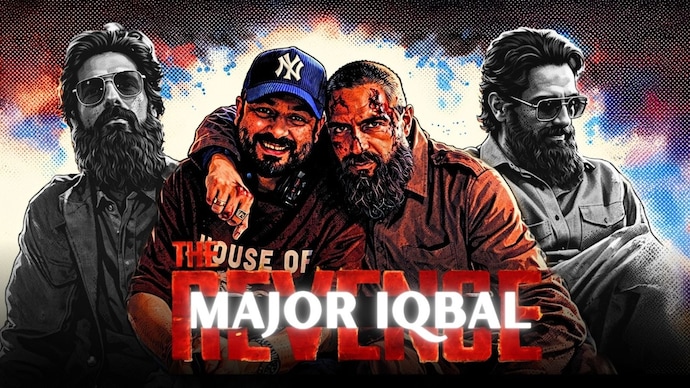

first image stalwart You have not been given any grand entrance of Major Iqbal. This is a man who is making a precise incision in someone’s skin while calmly explaining his ideology. The opening of the trailer of Part 1 is entirely his – a childhood memory of a radio broadcast, Zia-ul-Haq’s words, and a promise to “make India bleed with a thousand cuts”. This is one of the scariest presentations of villains in recent Hindi cinema, controlled, ideological and deeply unsettling.
❮❯
In fact, it is the audience’s first glimpse into the world stalwart. Bollywood has often given us villains who are violent, vicious and driven entirely by anger, but Major Iqbal is not just another angry adversary. It carries layers, ideology and internal conflict – much like the world stalwart Self.
The first installment lives up to that introduction to a great extent. Even though he is not positioned as the central antagonist, Major Iqbal acts with authority. By the time Part 2 arrives, the expectation is clear: this is the man Hamza is ultimately headed toward, the force that needs to be brought down.
And on paper, the character fully supports that expectation.
Consider this your signal to stop – you might be the first to see Arjun Rampal as Major Iqbal in theatres. But if you’re moving (and you should), this is where the film plays its hand.
Major Iqbal is not a stereotypical villain. He is an ISI operative who integrates the criminal ecosystem of Lyari with state-backed terrorist networks, a man who is on satellite phone with terrorists during the 26/11 attacks, guiding them through activities on the ground. But what makes it more disturbing is what he admits: He’s on the call not just to direct them, but to listen. Hearing Indians crying, screaming, suffering – something he even acknowledges in a later scene in Part 2. That difference changes everything.
This is not just a strategy. This is an ideology that is prevalent in real time. He is inspired by the psychological and ideological consequences of the 1971 war, and is undertaking missions to restore what he believes was lost. This is not surface level writing. It is a portrait of ideological extremism with a recognizable human face.
Arjun Rampal as the face of ideological extremism
And Arjun Rampal understands this completely. This is arguably one of the finest performances of his career, where the intent shines through in every scene – a twinkle behind the eyes during the interrogation, the tightening of the jaw when he realizes he’s being outmatched, the quiet exhaustion of a man whose belief system has been hardened to such an extent that doubt no longer exists.
He does not play the role of Iqbal like a traditional villain. He plays him as a believer, a man who is not committing cruelty, but living inside a set of principles and ideologies in which he completely believes. And that is how terrorists are born – not in an instant, but carrying within themselves a carefully constructed story, piece by piece, until no other truth exists but the one they believe in.
And as we start to understand Iqbal beyond the villain template that Bollywood has given us, the film starts to change and lose its chill. right here Dhurandhar: Revenge Introduces its most interesting layer and its biggest trade-off: the father.
Suvinder Vicky’s entry in Brigadier Jahangir
Suvinder Vicky’s presence in those scenes fundamentally changes the character. As soon as he enters, the power dynamics collapse. Major Iqbal – the man who controls the network, manipulates the system and orders the violence – suddenly appears younger. A man is being yelled at for failing to produce a male heir. A man sitting in a wheelchair enduring abuse from the patriarchy represents everything that was broken and never repaired in the 1971 war.
In isolation, this is powerful writing. This humanizes him, adds internal fractures, and keeps him from becoming a one-note antagonist. But it also takes something away. Because the more the film exposes this vulnerability, the less Iqbal feels like a force to be reckoned with. He can understand. And in doing so it becomes less intimidating. And this is where structure comes in.
layers of major iqbal
In Part 1, Major Iqbal acts as the invisible architect. His presence holds weight as the film is still building its world. The interrogation, the logistics, the relationship with Rehman Dacoit – everything establishes him as the chess player behind the board. And importantly, he exists alongside Rahman’s energy, not beneath it. That balance makes him feel dangerous.

By Part 2, the architecture changes. This is no longer Iqbal’s place. This is the rise of Hamza, the consolidation of his power, the systematic destruction of his networks and his transformation as a dominant power in Lyari. He works for design films.
when everything changes
But in the process of promoting Hamza, Major Iqbal is sidelined. He stops driving the narrative, he starts reacting to it. He follows updates. He gets disappointed. He watches as the system he built begins to collapse without him being able to control it. There’s a version of this where that helplessness becomes tragic, with the structure the thinker has built destroying him, but the film never fully commits to that idea.
Instead, the change creates a different effect. The rivalry never lasts forever. What was set up as a chess match turns into a hit list and Iqbal becomes one of the targets. By the time the narrative reaches its final confrontation, it doesn’t feel like the central obstacle that the first film quietly promised.
more spoilers
The climax of Murid has all the ingredients to be devastating – years of infiltration, the psychological burden, the emotional stakes, but it plays out as action when it should feel like it calculates.
It needs memory, anger and closure. Perhaps a glimpse of 26/11, an echo of that radio call or a full-circle moment. One could argue that this is intentional, that stalwart The traditional villain has no interest in transcendence and instead deliberately subverts the idea of power, showing how even the most powerful individuals are built on fractures and illusions.
The Father track supports that reading, and so does the vulnerability that permeates Iqbal’s character. There’s real intelligence in that approach, but implementation is only halfway done. Because the same humanization that adds depth also reduces counterweight. The father presents Iqbal so effectively that by the time the climax arrives, the character doesn’t have enough narrative runway to recreate a sense of danger.
You’re watching a man who was vulnerable a step earlier trying to regain control, and the film doesn’t give him the space to do that. And that’s why, despite the writing and the performances, Major Iqbal doesn’t land the way it should.
Not because he is weak or in a different situation. Compared to someone like Rehman Dacoit, whose arc is personal, sustained and emotionally invested, Iqbal operates at a distance, driven more by ideology than personal stakes. And in cinema, the personal almost always wins.