



Citrini says Indian IT story is over due to AI and Jefferies downgrades IT stocks, is this hyperbole or reality?
The conversation that was part of tech circles is now entering the world of finance. On Monday, Citrini Research and Jefferies raised doubts over the future of Indian IT giants. However the arguments, particularly Citrini’s, seem thin and based on wishful conclusions rather than logical reasoning.
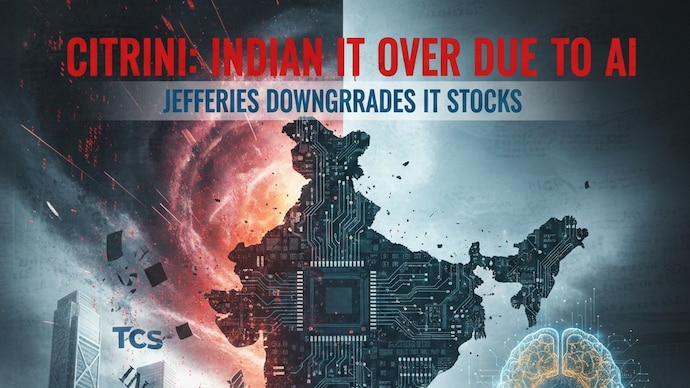

There is another bad news for the Indian IT sector. This sector was mentioned in two reports on Monday. One rather incoherent from Citini Research and the other meticulous and thorough from Jefferies. However, both reach a conclusion that looks disastrous for the Indian IT giant. In a note, which was posted on the official website and which went viral on social media with millions of views within hours, Citrini wrote that in 2028 “the services surplus that had underpinned India’s external accounts is set to vanish.” In other words, according to Citrini, the country’s IT sector will be destroyed by AI by 2028.
❮❯
Jefferies, which issues financial market research notes and recommendations, has a similar view. However, we are not talking about 2028 but about the present. Or rather, what investors should do when it comes to Indian IT giants. In a note, Jefferies says AI will put a tough squeeze on the revenues of companies like TCS and Infosys. It then suggests that the price target for IT stocks is 33 per cent lower than their current prices, taking into account modest revenue growth and poor margins in the future.
Citrini believes AI will devastate other economies including India
While based on mild arguments, there is a reason Citrini’s piece has gone viral. The piece imagines a worst-case scenario for economies around the world in 2028. It argues that as far as economics is concerned, the world as we know it will come to an end due to AI.
The article titled ‘The 2028 Global Intelligence Crisis’ is written from the perspective of someone who has lived through the next two years and is now looking back. In the piece, which has been viewed 3.2 million times on X, the researchers painted a picture of the global intelligence crisis from the projected vantage point of June 2028. In other words, they are telling us what the world economy might look like two years from now.
While the research, which took 100 hours according to the authors, speaks about the world at large, its critical analysis of India and how the rise and rise of AI will leave the Indian economy in shambles is particularly scathing.
In Citrini’s simulated 2028, the Indian rupee has fallen 18 percent against the dollar and more than $50 billion of market value has been wiped off from TCS, Infosys and Wipro in a single month. The article envisions that by the first quarter of 2028, the IMF has entered preliminary discussions with New Delhi, indicating that the Indian economy has almost failed. Why did this happen? The value proposition of Indian IT was neutralized by AI agents whose marginal cost was only the price of electricity.
“The entire model (of India’s IT services sector) was built on a value proposition: Indian developers cost a fraction of their US counterparts. But the marginal cost of an AI coding agent was essentially reduced to the cost of electricity,” the researchers say.
Of course, India is not the only country that is suffering. The entire global economy is in recession.
Citrini writes in his note, “Human intelligence derived its inherent premium from its scarcity. Every institution in our economy, from the labor market to the mortgage market to the tax code, was designed for a world in which this assumption prevailed.” “This is the first time in history that the most productive asset in the economy has created fewer jobs, not more. Nobody’s framework fits, because nobody was designed for a world where scarce inputs become abundant.”

Thin arguments, wishful thinking?
While Citrini provides research and insights for which people pay, its latest excerpt has been shared on social media. It is accessible to everyone, not just customers. According to the firm, it is also not “bear porn or AI doomer fan-fiction”. Instead, “the sole purpose of this piece is to model a scenario that has been relatively little explored.”
While there are many people on social media who have found the piece valuable, there are just as many people who have criticized it, with one calling it “bullshit for men”.
Another While another said, “The Citrini AI piece is a litmus test for who in the public intellectual sphere is interested in serious analysis and who is interested in speculative fiction masquerading as serious analysis.”
The arguments against the citrini piece have some merit. The article makes several assumptions, leading to June 2028. This overstates the impact AI is having on legacy workflows, at a time when cloud and AI tools like Codex are barely used outside a select group of technical experts. While it seems likely that AI will have a profound impact on the world of work and consequently various economies, unlike the doomsday scenario and breakdown presented by Citrini, the changes may come slowly and gradually. At the same time, Citrini’s piece also does not take into account the institutional inertia inherent in human society that naturally slows down changes. This doesn’t even take into account the policy side of things. If change accelerates, the way Citrini argues, it is certain that governments will take steps to manage the pace.