



Saturn has solidified its position as the planet with the largest known family of moons after astronomers officially discovered 128 new moons. The discoveries were officially recognized by the International Astronomical Union (IAU) on 11 March 2025 after years of observations by an international team of researchers from Taiwan, Canada, the United States and France.The newly discovered objects are all small irregular moons, providing scientists with new clues about Saturn’s violent past and the collisions that shaped its moon system billions of years ago. A study published by the American Astronomical Society titled ‘Discovery of 128 New Saturnian Irregular Moons’ says the findings also shed new light on the evolution of Saturn’s irregular natural satellite population, offering a clearer picture of how the planet’s moon system has changed over billions of years.
How astronomers discovered 128 previously unknown moons around Saturn
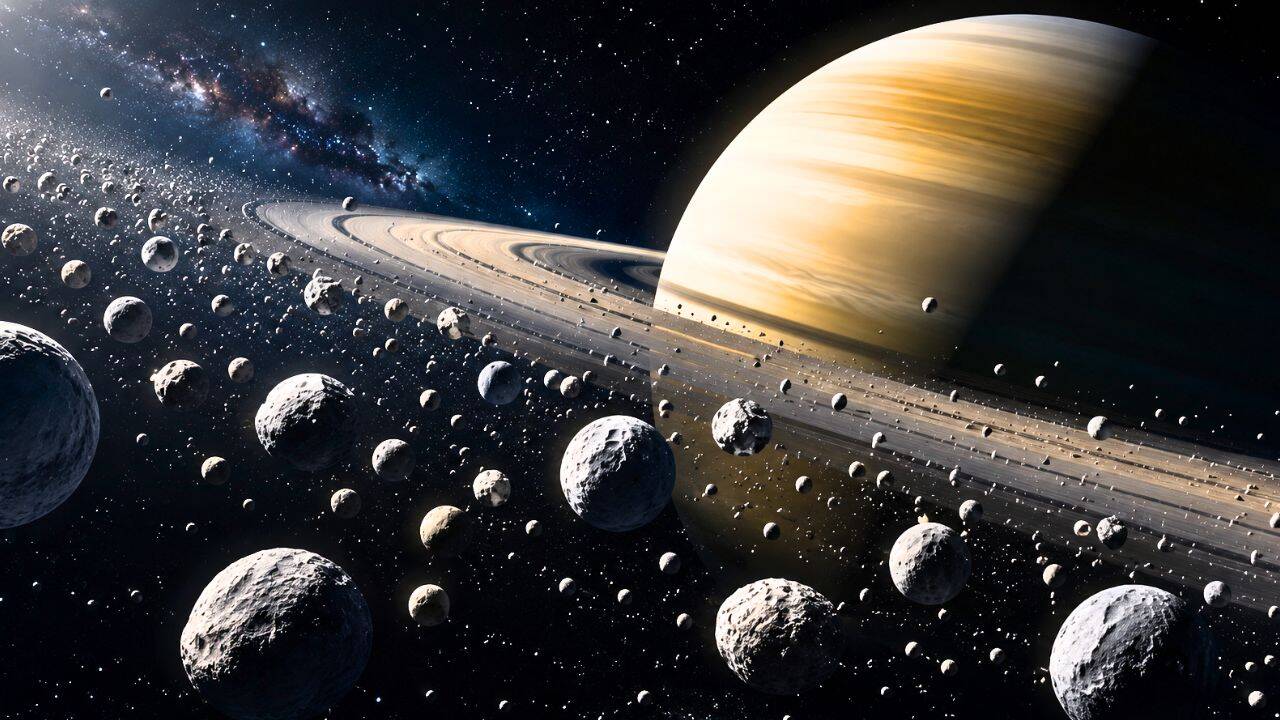
PC: AI Generated
The discovery was made using the Canada-France-Hawaii Telescope (CFHT), where researchers made repeated observations of the region around Saturn between 2019 and 2021. Instead of relying on single observations, they combined multiple images to strengthen signals from extremely faint objects, allowing them to detect previously undiscovered moons.That initial survey confirmed 64 moons, but also revealed several additional objects that have not yet been officially identified. “With the knowledge that these were probably moons, and still awaiting discovery, we revisited the same sky areas for three consecutive months in 2023,” said lead researcher Dr. Edward Ashton, a postdoctoral fellow at the Institute for Astronomy and Astrophysics at the Academia Sinica who completed his PhD in astronomy at the University of British Columbia.Dr. Edward Ashton said, “Sure, we’ve got 128 new moons. Based on our estimates, I don’t think Jupiter will ever be able to match these.”
what makes them newly discovered moon apart

Unlike Saturn’s larger and better-known moons, the newly identified objects are all irregular moons.Scientists believe that these moons did not form with Saturn. Instead, they were captured by planets early in the Solar System’s history before being torn apart by powerful collisions.“They are a few kilometers in size and are probably all fragments of a small number of originally captured moons, which were broken up by violent collisions either with other Saturnian moons or with passing comets,” said Dr. Brett Gladman, professor in the department of physics and astronomy at the University of British Columbia.
An ancient collision may have created many of Saturn’s smallest moons
The biggest question about Saturn’s irregular moons is why there are so many smaller moons compared to larger ones. According to the researchers, the unusually high number of small objects suggests that a major collision occurred somewhere within Saturn’s moon system during the last 100 million years. Although it appears ancient, it is considered relatively recent on the astronomical time scale.Dr. Gladman said that if the collision had occurred much earlier, the fragments would have continued to collide with each other until many of them disappeared. Instead, the large number of surviving small moons points to a recent event.Researchers believe the collision most likely occurred near the Mundalfari subgroup of Saturn’s irregular moons. Many of the newly discovered moons are concentrated in this region, making it the strongest candidate for an ancient impact site.“These studies show that giant planets captured some medium-sized moons 4 billion years ago, when the giant planets formed, and the moons we see now are mostly fragments of the originally captured moons,” Dr Gladman said.
Years of observations have changed Saturn’s moon calculations
The latest discoveries are the result of a carefully planned observation campaign lasting several years.By repeatedly studying the same regions of space and combining multiple observations, astronomers were able to identify objects that would have remained invisible in individual images.“Our carefully planned multi-year campaign has yielded a bounty of new moons that tell us about the evolution of Saturn’s irregular natural satellite populations,” Dr Ashton said. The international research team also included Dr. Mike Alexandersen of the Harvard-Smithsonian Center for Astrophysics and Dr. Jean-Marc Petit of the Observatoire de Besançon in France.