





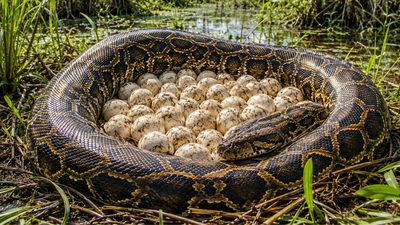
Huge nests of Burmese pythons discovered in the Everglades
The nest was reportedly discovered in the Everglades by python hunter Kevin Pavlidis, who shared video of the discovery via his Snakeaholic social media account.The footage shows large white eggs buried inside nesting areas hidden in marshland vegetation. Reportedly, both neighboring nests contained about 120 eggs, suggesting that multiple breeding female pythons were active in the same area.The discovery attracted widespread attention online, with many viewers expressing concern about the rapid spread of invasive snakes in South Florida.
Florida’s python problem
The Burmese python is native to Southeast Asia and is considered one of the most destructive invasive predators in the Everglades. Researchers believe this species established itself in Florida primarily through the exotic pet trade after snakes escaped from captivity or were released into the wild.The warm and humid climate of South Florida allowed the snakes to survive and reproduce rapidly. With very few natural predators in the region, Burmese pythons have spread across large parts of the Everglades during the past two decades.Adult Burmese pythons can grow to over 15 feet long and hunt birds, mammals, and reptiles. Scientists have also documented pythons eating deer and alligators in the wild.
Biologists in Florida found a nearly 15-foot Burmese python eating a full-grown white-tailed deer near Naples in December 2022.
Burmese python’s dramatic impact on wildlife


Wildlife researchers have repeatedly warned that Burmese pythons are seriously harming native animal populations in the Everglades. A widely cited study by the United States Geological Survey linked the spread of pythons to a major decline in mammal sightings throughout the region.According to the study, raccoon sightings declined by 99.3%, opossum sightings by 98.9% and bobcat sightings by 87.5% in some monitored areas after pythons were installed. Marsh rabbits and foxes also became much less common in heavily affected areas.Experts say the loss of native species disrupts the Everglades food chain and weakens one of the most ecologically important wetland systems in the US.
Why is the egg discovery particularly worrying?
Wildlife officials consider python nests particularly important because female Burmese pythons can lay dozens of eggs at a time, with large clutches sometimes reaching as many as 100 eggs.If even a fraction of the approximately 120 eggs discovered survive to hatch, dozens of additional predators could enter the ecosystem.The discovery of neighboring nests also suggests that breeding populations may already be well established in some parts of the Everglades, increasing pressure on native wildlife and making long-term ecosystem recovery more difficult.
Florida’s efforts to control python invasion
Florida wildlife agencies have spent years trying to slow the spread of Burmese pythons through organized removal programs, public reporting systems, and scientific research.The state works with trained contractors and authorized python hunters to capture and remove invasive snakes from the Everglades. Additional incentives are often provided to remove breeding females and nestlings because preventing hatching is considered particularly important.Florida also hosts the annual Florida Python Challenge, a separate public competition that encourages participants to remove invasive snakes from designated areas of the Everglades.Researchers continue to search for better tracking and identification techniques because Burmese pythons are extremely difficult to find in dense wetlands and marshy vegetation.
a long-term environmental challenge
Aside from the shock associated with the nest discovery, scientists say the Burmese python invasion is one of the biggest environmental challenges facing the Everglades.Wetland systems play an important role in water filtration, biodiversity, tourism, and flood protection throughout South Florida. Experts have warned that invasive species introduced by humans could permanently alter ecosystems if populations are not controlled quickly.In the case of Burmese pythons, researchers say continued monitoring, removal programs, and public cooperation will likely be necessary for years to reduce the snakes’ impact on native wildlife and protect the Everglades ecosystem.