



Vishila, Parashakti, Jan Nayagan: 3 controversies and a south storm brewing
Three major South Indian films faced controversies related to censorship, politics and morality. These controversies highlight the growing tensions as elections approach and cinema becomes increasingly aligned with political agendas.
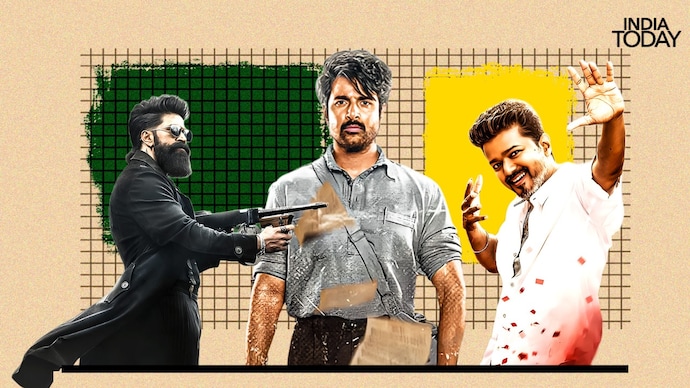

A big storm is brewing in South cinema as three big releases – Vijay’s Jan NayganSivakarthikeyan’s parashakti and fame toxic – has found himself at the center of controversies. While two of them have created trouble even before hitting the theatres, the third is facing demands for a ban within days of its release.
From censor board battles to political allegations and obscenity complaints, these storms highlight the growing relationships and how the lines between cinema, politics and public morality in the South are constantly colliding.
Jan Nayakan: Censor Board standoff and legal battle
Thalapathy Vijay’s farewell film, Jan Naygan (People’s Leader), scheduled to release on January 9, marked a significant moment when the actor transitioned from cinema to full-time politics with his party Tamilaga Vetri Kazhagam (TVK). However, the film is embroiled in a legal battle, due to which its theatrical release has been delayed indefinitely.
The controversy began when the Central Board of Film Certification (CBFC) reportedly raised concerns about the content of the film, leading to a lengthy certification process. On 6 December, the producers moved the Madras High Court seeking intervention. When the case was heard, it resulted in an internal complaint from a board member who alleged that the film contained scenes that could potentially hurt religious sentiments.
While judge PT Asha ordered the censor board to issue a U/A certificate, the CBFC filed an urgent appeal to put the release on hold till at least January 21, when the next hearing is scheduled. When relief was not coming at the desired pace, he escalated the case to the Supreme Court, filing an appeal to speed up the certification process and secure a release date. There are rumors that the case may be listed in the Supreme Court on or after January 15.
Jan Naygan The situation highlights a recurring tension: can the actor-turned-politician’s final film be seen as mere entertainment, or is it a political campaign? The CBFC’s hesitation and the subsequent legal battle underline how blurred these lines have become. For Vijay’s huge fan base and political support, the delay seems less like a bureaucratic process and more like a deliberate disruption of their leader’s message ahead of the actor’s first term in office in the Tamil Nadu elections this year.
creator of Jan Naygan We are also racing against time. If the Election Commission of India announces the code of conduct, it will automatically put a complete ban on the release till the end of the 2026 Tamil Nadu Assembly elections.
Parashakti: Political message and religious sensitivity
Sivakarthikeyan’s parashaktiDirected by Sudha Kongara, is the title of the famous 1952 film that popularized the DMK ideology and propelled the career of Sivaji Ganesan. The new film deals with the student revolution during the anti-Hindi agitation of 1965, a theme deeply embedded in the political consciousness of Tamil Nadu.
after days of super power After its release, Tamil Nadu Youth Congress demanded a ban on the film, alleging that the film contained condemnable scenes. Tamil Nadu Youth Congress senior vice-president Arun Bhaskar claimed that the film distorts the party’s history and portrays former Prime Minister Indira Gandhi wrongly. While he claimed that there is a scene in the film where the Congress flag is burnt, it should be noted that the makers have added a disclaimer that reads ‘imaginary/conjectural’ in several scenes. There is no mention of Congress in the film.
This controversy shows what kind of role historical political films play in Tamil Nadu. The language movement of 1965 is celebrated in Dravidian political memory as a defining moment of Tamil resistance against the imposition of Hindi by the Centre. However, revisiting this history on screen inevitably invites contemporary political interpretation.
Bhaskar mentioned some sequences in his statement parashakti As imaginary. He said that Indira Gandhi never visited Coimbatore on February 12, 1965, as claimed in the film. He also objected to a scene of a burning train and the subsequent anti-Hindi protest in front of Indira Gandhi. “Subsequently, scenes of a train being set on fire in his presence were fabricated and he was portrayed as accepting signatures against the imposition of Hindi. None of these incidents ever happened in history,” he said.
The Congress member criticized the climax of the film, claiming that it showed real-life pictures of Indira Gandhi, Lal Bahadur Shastri and K Kamaraj, while accusing the Congress of shooting dead over 200 Tamil people in Pollachi.
Condemnation parashaktiHe called the film a “deliberate distortion of historical facts” and called for it to be banned. He also demanded removal of such scenes and a public apology parashakti Team.
Toxic: Pornography Complaints and Cultural Ethics
of fame Toxic: A Fairy Tale for AdultsDirected by Geetu Mohandas, it ran into trouble with its teaser releasing on the occasion of the actor’s birthday on January 8. The women’s wing of the Aam Aadmi Party in Karnataka filed a complaint with the Karnataka State Commission for Women (KSCW), objecting to what it called “obscene and explicit content” in the teaser glimpse.
The teaser features Yash in a scene where he engages in a sexual encounter and intense action, which he argues is inappropriate for viewing in public without age restrictions. The AAP women’s wing stressed that the content was “causing serious harm to the social well-being of women and children” and that the scenes “undermine the dignity of women and insult Kannada culture.”
Following the complaint, KSCW wrote to the Central Board of Film Certification requesting it to investigate the content and take appropriate action. The letter specifically sought removal of the teaser from social media platforms, citing its accessibility to minors without age warnings.

Not only this, the second complaint against the film was lodged by social activist Dinesh Kallahalli. The complaint addressed to CBFC Chairman Prasoon Joshi highlighted that the teaser violates public decency and morality and exposes minors and young viewers to legally unacceptable content. In the complaint filed via e-mail, he argued that such material is not protected under Article 19(1)(a) of the Constitution and is beyond the scope of what is permissible under Article 19(2).
The complaint cites provisions of the Cinematograph Act, 1952, CBFC guidelines and the Indian Code of Justice, 2023, adding that trailers and promotional materials are also subject to strict certification norms.
The complainant urged the CBFC to review the trailer, restrict its circulation/access and take action against the makers. He also threatened legal action if immediate action was not taken.
soon after toxic As soon as the teaser was released, a section of critics targeted director Geetu Mohandas. She pointed out that it was surprising to see that Geetu, who is vocal about her feminist views, chose to portray a woman in an ‘obscene’ scene in the teaser to promote the hero’s masculinity. However, he defended his creation by talking about female pleasure and materialism.
toxic The controversy reflects the ongoing debate about acceptable content in mainstream Indian cinema. While the film explicitly promotes itself as “a fairy tale for adults” – indicating adult content – critics argue that teasers released on public platforms accessible to all ages should maintain certain standards regardless of the film’s target audience.
These three controversies, occurring simultaneously, highlight several troubling trends in South Indian cinema’s relationship with government organizations and political forces. With the big elections in Tamil Nadu approaching and the political landscape in Karnataka fluctuating, films have become a battleground for major ideological conflicts.
He said, cinema and politics have always gone together in South India. As these three films depict legal challenges, political protests and moral policing, they epitomize the complex situation that South cinema operates in these days. It remains to be seen whether they weather the storm or succumb to the controversies.