





Saaz, the film that started the discussion about Asha Bhosle’s relationship with Lata didi
Sai Paranjape’s 1998 film, Saaz, traces the relationship between two sisters who become successful singers. Were the roles of Aruna Irani and Shabana Azmi inspired by Lata Mangeshkar and Asha Bhosle in any way?

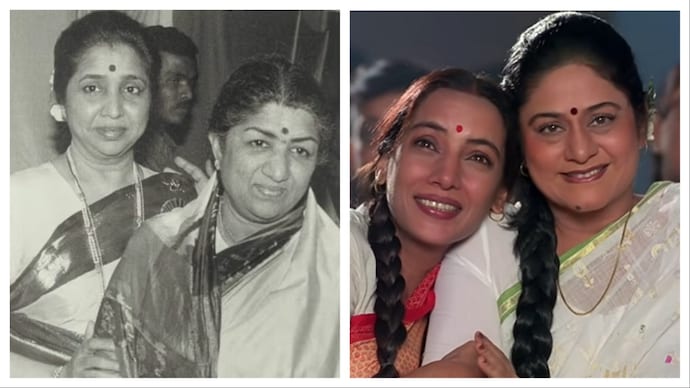


In 1998, Sai Paranjape created the musical play, instrumentAbout two sisters who come to Mumbai after the death of their parents. Girls named Mansi and Bansi have inherited their passion for music from their father, late singer and stage artist Vrindavan. After several twists and turns in the plot, Mansi and Bansi are famous singers, and also arch rivals in the volatile world of music.
❮❯
Where Saaz remembers the story of Mangeshkar
a lot of instrument – Specifically, the backstory of two sisters arriving in Mumbai after the death of their parents and finding their footing in music – It has a direct similarity with the lives of the Mangeshkar sisters, Lata and Asha. Not surprisingly, the film became the center of conversation as soon as it was released.
Like Mansi and Bansi, Lata and Asha also came to Mumbai in 1942 after the sudden death of their father, Pandit Dinanath Mangeshkar, a renowned classical singer and theater actor. Suddenly, the family had no source of income, and Asha, who was nine years old at the time, and her elder sister Lata started singing to survive.
the rest is history. Like Mansi and Bansi on screen, if compulsion forced the Mangeshkar sisters to sing in films, their unique talent has propelled them to the top of the hierarchy of female singers in Bollywood. In fact, by the early sixties, Lata and Asha were the only two female voices you would mostly hear on the radio, or see on a vinyl soundtrack, if it was a Hindi film song. While Lata was ruling, Asha was still finding her feet.
where music weaves through imagination
instrumentBeing fictionalized for the screen, it takes the sisters’ saga forward with a twist of additional drama. Mansi, played by Aruna Irani, becomes a successful professional singer. Bansi (Shabana Azmi) also wants to establish herself in this profession but Mansi says that she should get married and have children to carry forward the lineage of Vrindavan.
Despite discovering that she has a good voice, Bansi allows herself to get trapped in a very wrong marriage, before a musician named Indranil recognizes Bansi’s talent and gives her a break. Although she is at the pinnacle of success, Mansi does not like Bansi’s newfound fame. Even more so when a young musician, Himan Desai, is enamored with her, both professionally and personally.
Are these notes of the script taken from the lives of Lata Mangeshkar and Asha Bhosle? Filmmaker Paranjape never officially accepted this and the debate has raged ever since. instrument Was released.
Yet, driven by two extremely contradictory sentiments instrument The story of Mansi and Bansi has repeatedly reminded us of two of the most powerful female voices in Bollywood music, who were brother and sister. instrument Inspired by the deep feeling of love and care that can only arise when two people have endured their darkest days together. But the film’s script also introduces an aspect that has been mentioned about the Mangeshkar sisters for a long time, though only on hearsay – a story of the brother-sister rivalry that emerges when the closest people become rivals.
What did Lata Mangeshkar say
Nasreen Munni in Kabir’s book, Lata Mangeshkar…in her own voiceLata Mangeshkar ignored all the talk of brother-sister rivalry. Quoting Mangeshkar: “It is wrong to talk about our relationship being spoiled because of rivalry. We are sisters and neighbours. We talk to each other and eat together. If either of us has a problem, we tell each other. And if we have something to celebrate, we celebrate together.”
She continued to praise Asha’s undeniable versatility: “Looking at the variety of songs she can sing, no singer can match her.”
Rise of Asha and Reign of Lata
In fact, it was this versatility that helped Asha Bhosle step out of Lata Mangeshkar’s shadow. By the sixties, Bhosle was quietly making his mark with the exciting sound of Bollywood introduced by OP Nayyar. Suddenly, their collaborative efforts like come sir you And kajra mohabbat wala (Destiny), crazy cloud (bud of kashmir) And Whenever your hair flies (new era) were reimagining what Hindi film songs could be. Lata was still India’s music queen, and rightfully so. But hope, just like a flute instrumenthad staked its claim, and there was still more to come.


What did Asha Bhosle say
Bhosle once said that in her early days as a singer, her voice was mistaken for that of her elder sister – which is why she proposed changing her singing style. He said in an interview, “I started changing my singing style. I started watching English movies to learn western songs and see how they were sung. I also learned to sing qawwali and ghazal.” The idea was simple: Lata was recognized as the impeccable voice of Bollywood. Asha decided to take a detour.
Pancham’s punch and Umrao Jaan
It began in the mid-sixties with the emergence of Rahul Dev Burman-Pancham among the fans and in the industry. His songs represented the new sound of Bollywood music – rooted in Indian music but Western in rhythm and feeling. There was funk, jazz, rock ‘n’ roll galore and a full-scale orchestra. Asha’s voice blended seamlessly with RD’s pulsating musical arrangement. It was a collaboration that found its place in the seventies. Their top hits together – Come come, I am your love, Piya you come now, Now that you have stolen my heart And Damo Damo Damoamong countless others – emerged as hits of the season and became Bollywood classics.
He would also find other grooves in Pancham’s music – sadness and quiet love – that were in tune with the changing times. songs like under the eyes every day (chord), The story of the heart is of two words (the great gambler) and National Award Winner some of my stuff (permission) recognized her as an artiste who could seamlessly transition into darker tones with the baton in the hands of RD Burman.
Fans, critics and industry watchers alike have noticed the similarity between Pancham and Himan instrument (Played by Zakir Hussain). And working within the framework of fantasy, Paranjape also takes the liberty of weaving in a love triangle – Himan loves Bansi, while his niece Kuhu (Aishe Dharkar) is infatuated with Himan.
Despite proven versatility and immense success for almost two decades, the time for Asha to shed the tag of ‘Lata Mangeshkar’s undeniably talented sister’ finally came in 1981. This was the time when Umrao became Jaan. Muzaffar Ali’s film, in which Rekha played a 19th-century Lucknow prostitute, required a voice educated in classical music who could, at the same time, bring to life the pain of the hero hidden behind the glamour. If Rekha lived Ali’s dream on screen, Asha gave Khayyam’s music a peace that resonates in Shahryar’s songs. Bhosle would receive his first National Award for his songs in the film, what is heart thing For an endeavor that the industry and fans have engaged with like never before.
In fact, Umrao Jaan Showed the world an extraordinary side of Asha Bhosle’s talent. Just as disco 82 (khud-dar1982), an energetic dancefloor dance full of disco vibes, with Lata Mangeshkar having fun in a recording studio. The Mangeshkar sisters will always be reminded of the bond they shared with their music before anything else. All other emotions – bitter or tender – are open to interpretation in a Bollywood script.