





Prabhas to Vijay Deverakonda: Is the scale swallowing the soul in Telugu films?
From pan-Indian stars like Prabhas and Allu Arjun to local deities like Nani and Vijay Deverakonda, the passion for scale and spectacle has made the traditional family entertainer a rare spectacle in Telugu cinema.

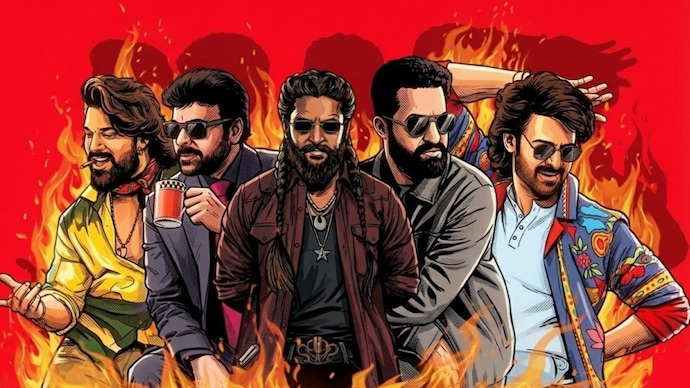


If you mention Telugu cinema in a room today outside the Telugu states, someone will bring up the scale of SS Rajamouli’s Mahishmaathi. bahubali movies. Or the extension of the interval in RRR, where Jr. NTR moves forward with the animals beside him. Or Prabhas emerging as Karna Kalki 2898 AD. Or Allu Arjun as Pushp Raj Pushpa 2: RulesTo stand defiant and refuse to bow.
❮❯
The terminology associated with Telugu cinema now revolves around scale, spectacle, pan-India reach, VFX-heavy worlds and mythological arcs. It is a reputation earned through effort, risk and refusal to remain tied to a regional identity, when the canvas could span the entire country and beyond.
Young actors and their likes reflect this change, largely gravitating towards heavier, intensity-driven narratives. From Prabhas at the top to Vijay Deverakonda in the new generation, the change in priorities is hard to ignore.
Question: Was this the whole meaning of Telugu cinema? For those who grew up avid Tollywood, this was never the whole story.
Telugu cinema before the all India burden
Long before they became markers of universe and global box office success, Telugu films were creating something quieter – and far more difficult – an emotional space in which to feel.
A hero can be broad and weak in the same frame, without seeing that weakness as a weakness. Family disputes can create more tension than the battlefield. A romantic hesitation can be heavier than a drawn sword.
Telugu cinema did not become powerful simply because it had big stars or a huge audience base. It became powerful because it knew how to feel close – personal, recognizable and emotionally available – no matter how lavish the staging. People came to theaters not just to watch the spectacle, but to forget their problems and invest in the characters, who felt like an extended family. Hope was relational.
There was a time when a star’s image did not feel threatened by intimacy.
Allu Arjun in Ala Vaikunthapurmulu Can dance, swag and deliver punch lines, and still ground the story in parental disapproval and familiarity. The whistles weren’t just for style; They have come from recognition. In DearPrabhas’s charm worked as he was willing to stay out of respect. In mr perfectThe compromise was made as a matter of maturity, not defeat. Centering in a star vehicle is a difficult emotion, it requires conviction.

Mahesh Babu inside Srimanthudu Dystopia was not required to create stakes; Their struggle was rooted in identity and responsibility. In MurariThe supernatural threat was superficial. The emotional engine was family, heritage and the belief that love and willpower could overcome fate. even Attarintiki Daredi It worked because beneath the humor and heroism lay a simple emotional desire to repair broken relationships.

These films were not small. He had the songs, the fights, the height, the star presence. But spectacle could never swallow the emotion. Action blocks were built around relationships, not the other way around.
That confidence, the confidence to let a hero look vulnerable inside the living room before launching him onto the battlefield, seems rare now.
affinity inflation
Take Mahesh Babu and Venkatesh’s iconic Seethamma Vakitlo Sirimalle Chettu. The scene at the railway station where the elder brother awkwardly checks whether the younger one has money or not and puts some in his pocket after a fight, is a masterclass in exercising restraint. It’s quiet, a little uncomfortable but emotionally loaded. No slow motion. No applause-driven dialogue. There’s no background score instructing you on when to feel.
Now, imagine that scene being presented today. One would suggest setting the station in a fictional city in 1984, perhaps a CG-enhanced platform. Someone else would recommend darker dramatic lighting to make it more “cinematic”. Perhaps a swelling orchestral signal to underline the emotion. If scheduling gets complicated, VFX can always add to the crowd. And why align the dates when face swapping is an option.
The exaggeration may seem absurd, but if made today it could be the reality of the scene.

We have reached a point where intimacy feels little unless it is enhanced technologically. A simple human exchange risks being labeled “flat” until it looks expensive. Silence bothers producers. Restraint once indicated confidence. Now this risks being construed as a lack of ambition. But who is feeling this, the audience or the producers?
Archives vs. Cultural Memory
Box office data deserves respect. Yes, the highest-grossing Telugu films are dominated by large-scale, pan-India productions. This reflects expansion and strategic ambition. But cultural memory operates differently from revenue charts.
like movies Dookudu, Mirchi, Rangasthalam, Together Ala Vaikunthapuramulu, Adhuras, Attarintiki Daredi And Srimanthudu, Keep circulating in daily life. Their songs are played in weddings. Their scenes are shown again on television. Their dialogues integrate seamlessly into conversations. They simply were not successful. They were assimilated and celebrated, in fact still celebrated.
A film can dominate its opening week and still fade away. The second may earn comparatively less yet survive for years through repeated viewings and re-releases. Telugu cinema had for a time excelled in post-production.
This year’s Sankranti proved that hunger persists. Chiranjeevi’s Mana Shankara Vara Prasad Garu may not have had a pan-India run, but it attracted audiences as it offered humour, family conflict and an emotional finale, exactly what festival viewing traditionally thrives on. Families also come when they are given something they can watch together without getting tired.

Hunger has not gone away. It is not being fed continuously by big names.
Re-release Don’t Lie
Re-releases reveal more about audience engagement than opening weekends. constant enthusiasm for Khaleja, Jalsha, Kushi, Darling, Arya 2 and Nuvvu Naku Nachaav Cannot be explained through mere appearances. Yes, these are star-driven films, but they are built on dialogue delivery, character quirks and relational tension. Audiences return to them because they are comfortable and rewatchable. You rarely see the same nostalgia for scale-heavy action epics. The grandeur may be admired, but the intimacy is what people return to.
Producers often say that audiences are not coming to theatres. Perhaps the better question is: What is the audience being offered?
line-up speak
You don’t have to guess about changes. The current line-up bears that out.
Allu Arjun moves beyond home-business balance Ala Vaikunthapurmulu to the All India Army Pushpa FilmsFuture projects are reportedly positioned in the multiverse with Atlee and the superhero realm with Lokesh Kanagaraj.

After this Mahesh Babu Guntur Karam – an entertainer who struggled with execution – is stepping into the spectacle that is taking the world by storm with Rajamouli.


transition from ram charan game changer Towards projects undertaken on a similar scale.
Prabhas follows Salar: Part 1 – Armistice And Kalki with Soul And Salar 2.
Jr NTR moves forward Devara: Part 1 In another high level collaboration with Prashant Neel.
Other actors also show inclination. Nani, after the emotional tone of hi nannashift towards deeper projects like hit 3 And Heaven. Vijay Deverakonda, once defined by Geetha Govindam and Arjun ReddyNow larger than life arc-like lines are formed unruly public And battlefield.

This is not about blaming ambition. The budget has increased. Markets demand scale. The economics of a dramatic recovery favor larger openings. But when almost every major name moves towards films of intensity, world building and larger canvas at the same time, something else is quietly disappearing. Complete family entertainment programs led by top stars are no longer a routine. They are rare. This is not accidental. This is strategic. The question is whether strategy is gradually replacing instinct.
The other side of all India success
The biggest demerit of the pan-India success wave is that it has created growing anxiety. Once a film reaches the market, the next film has to look bigger. Loudly. More ambitious than vision.
In that environment, ordinary genres feel pressure to inflate themselves. A horror-comedy that tries to look like a Harry Potter style fantasy with Nolan type mind games. A political drama stretches itself to look epic. game changer It had the bones of a focused entertainer but expanded in scale. Devara: Part 1 It had emotional conflict but was wrapped in mythological heaviness to indicate magnitude. Honourable King It could have leaned more towards a playful horror-comedy, which was the original idea, but came with a load of grandiosity. It would be unfair to put the burden entirely on the actors. The attempts at emotional storytelling still come through at times. Ambition is not the issue. There is a hesitation in trusting simplicity.
Producers sometimes declare that entertainers should not be expected to reason. Telugu audiences have never demanded strict realism. What they demand is conviction. There is a difference between dramatic exaggeration and careless writing. The former pleases. The latter gets tired.
homophonic risk
This is not a plea to abandon scale. The global reach of Telugu cinema is a matter of pride. The issue of concern is tonal uniformity. When most of the lead stars pursue intensity-driven narratives together, the dichotomy disappears. The heavy frames, mythic stakes, and dark world begin to blur together.

Cinema thrives on diversity. A grand epic feels grander when it exists alongside an intimate family drama. Telugu cinema had at one time consistently balanced both.
The most enduring moments in its history were often quiet ones: a brother reconciling, a father softening, a lover choosing maturity. Spectacle can elevate a scene. It cannot take the place of emotional truth.
The industry has mastered scale. The next challenge may be to remember moderation. If Telugu cinema can combine the two without allowing one to swallow the other, it will not only expand the markets, but preserve the grammar that made it resonate in the first place.