





McKinsey reveals 5 human roles that AI will replace and 6 skills that could save your jobs
McKinsey’s Skills Transformation Index shows that AI will increasingly take over routine tasks, taking pressure off some roles while making human skills like problem-solving and leadership more valuable. Here’s the full story.



The latest research from McKinsey takes a first-hand look at how artificial intelligence could change the way people work in the years to come. Rather than predicting mass job losses, the firm’s new Skills Change Index shows that AI will impact some roles far more than others, depending on the skills they rely on.
In a recent post, McKinsey said, “AI will not make most human skills obsolete, but it will change the way they are used.” The company said conversation and problem-solving will become more important as people increasingly work with AI agents and robots. These views are based on an analysis of approximately 6,800 skills and their exposure to automation over the next five years. Here’s the full story.
McKinsey reveals 5 human roles that AI will replace
According to McKinsey data, roles built on routine and rule-based tasks face the greatest automation risk. These are jobs where the bulk of the daily work can already be done by software systems and AI tools.

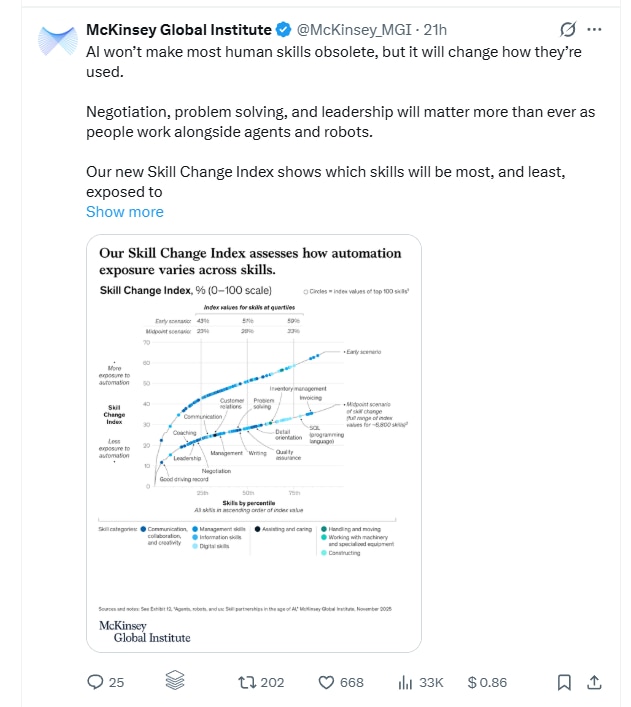
Clerical and invoicing roles appear near the top of the skills change index. Tasks such as billing, reconciliation and documentation are increasingly being handled by automated systems with limited human involvement. Inventory and stock management roles also rank higher, as AI-powered tools are now able to forecast demand and track supply with speed and accuracy.
Quality assurance roles that rely on checklist-style reviews are another area under pressure, especially in digital operations and manufacturing. Data-centric roles that rely heavily on structured database queries, including SQL-based reporting work, also show higher exposure, as AI tools can easily generate reports and extract data. Detail-oriented back-office roles involving verification and consistency checking fall into the same category, as machines perform repetitive precise tasks more efficiently.
McKinsey Shares 6 Human Skills That Can Save Their Jobs From AI
At the bottom of the skill change index are those skills that remain difficult to automate, even as AI becomes more capable. These skills depend largely on judgment, negotiation and human decision making.


Problem solving is considered a safe skill because it involves assessing complex situations and making choices where there is no single right answer. Leadership is also important, as managing people, setting priorities, and handling accountability cannot be easily automated.
Conversations rely on trust, persuasion, and situational awareness, making them less susceptible to automation. Communication and customer relations skills also remain relatively safe, especially in roles that require understanding people and responding to their needs. Coaching and people development show similar resistance, because learning and development depend on personal guidance rather than fixed rules. Together, these six skills point to where human involvement is essential.
What to keep in mind?
McKinsey’s research does not suggest that jobs will disappear overnight. Instead, it indicates that tasks within jobs will change. In the firm’s midpoint scenario, many skills see an increase or decrease in automation risk, but very few are eliminated entirely. The study basically suggests that roles built primarily on routine execution will need to adapt, while roles focused on thinking, decision making and working with people are likely to remain relevant.