



For nearly three decades the art world has been engaged in a strange cultural ritual. People stand in front of the walls, looking at them with unusual seriousness and trying to interpret a joke left by someone during the night. A mouse with a plank. One policeman hugging another policeman. A child is moving towards a red balloon which has already slipped. The name beneath the stencil is always the same: Banksy.No biography, no interviews, no public appearances. Just a pseudonym that became one of the most recognizable signatures in modern art.Banksy’s anonymity was not just a curiosity but a part of the work. Street art was always in tension with the law, and a guy who mocked governments and corporations with spray paint couldn’t easily step out into the light of day without losing that rebellious energy. Over time mystery became inseparable from art. The world wasn’t just looking at Banksy’s graffiti; It was also looking for the person who had painted them.
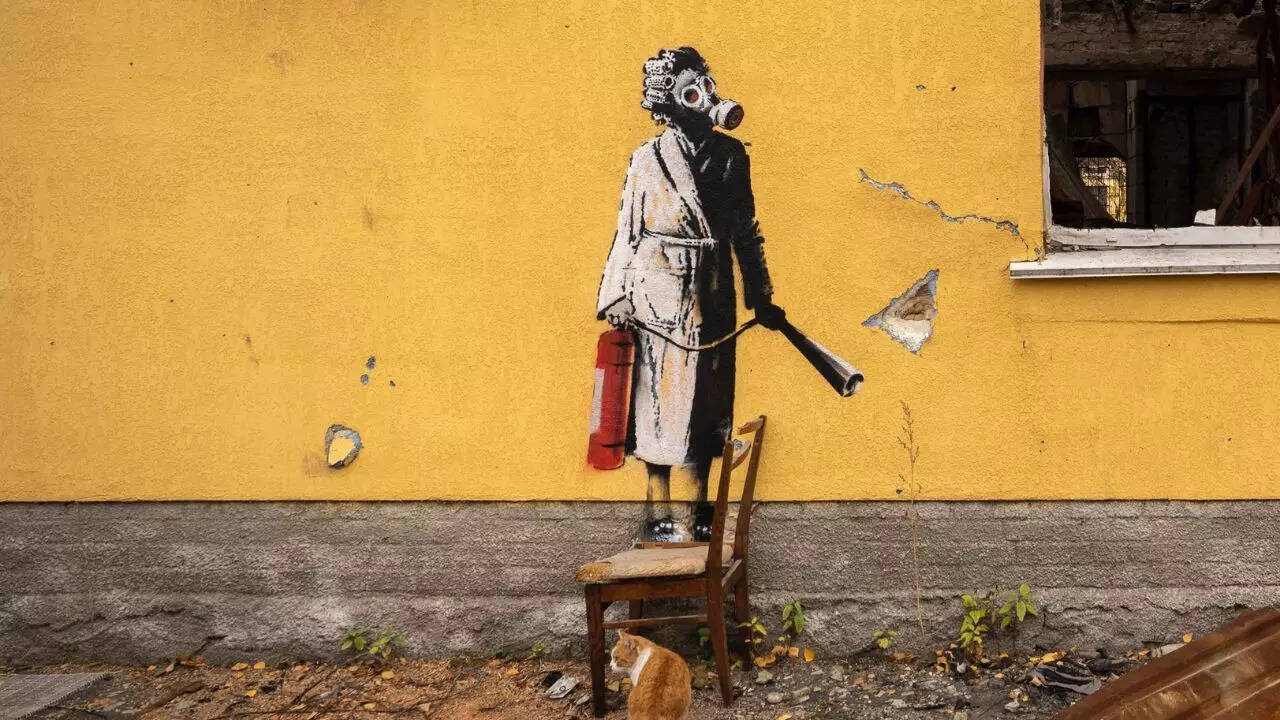
The answer, when it finally began to emerge, did not come in the form of any dramatic revelation or triumphant revelation. Instead it emerged gradually through patient reporting. The Reuters investigation traced clues scattered across continents and decades. The series moves from the graffiti culture of Bristol to the bombed-out buildings of Ukraine and finally to a forgotten police file in New York. What the journalists uncovered was less a dramatic display than a gradual dismantling of a myth that had been carefully maintained for years.The story begins in Bristol, a port city in southwest England, where a thriving underground scene of musicians, graffiti artists, and political activists developed at the turn of the twentieth century. Bristol in the 1990s was fertile ground for experimentation. Spray paint was cheap, public walls were abundant and authority provided a steady supply of targets for satire. In that environment a young graffiti artist began to develop the style that would later define Banksy’s work.A technical choice proved decisive. The artist began using stencils instead of painting freehand. The stencils allowed images to be applied quickly and repeatedly. They also allowed the artist to work at pace, which was necessary any time police patrols came into view. This method created the clean silhouettes and sharp outlines that later became synonymous with Banksy’s visual language.Topics emerged just as quickly. War, policing, capitalism, and consumer culture all appeared in early works, usually filtered through a mischievous sense of humor. Banksy’s characters often appeared simple but had a sharp political edge. Children confronted soldiers, animals mocked officials and everyday objects were transformed into cool acts of rebellion. One image in particular caught people’s imagination: a little girl moving toward a heart-shaped balloon floating in the sky. The work was emotionally simple, instantly recognizable, and quietly devastating.

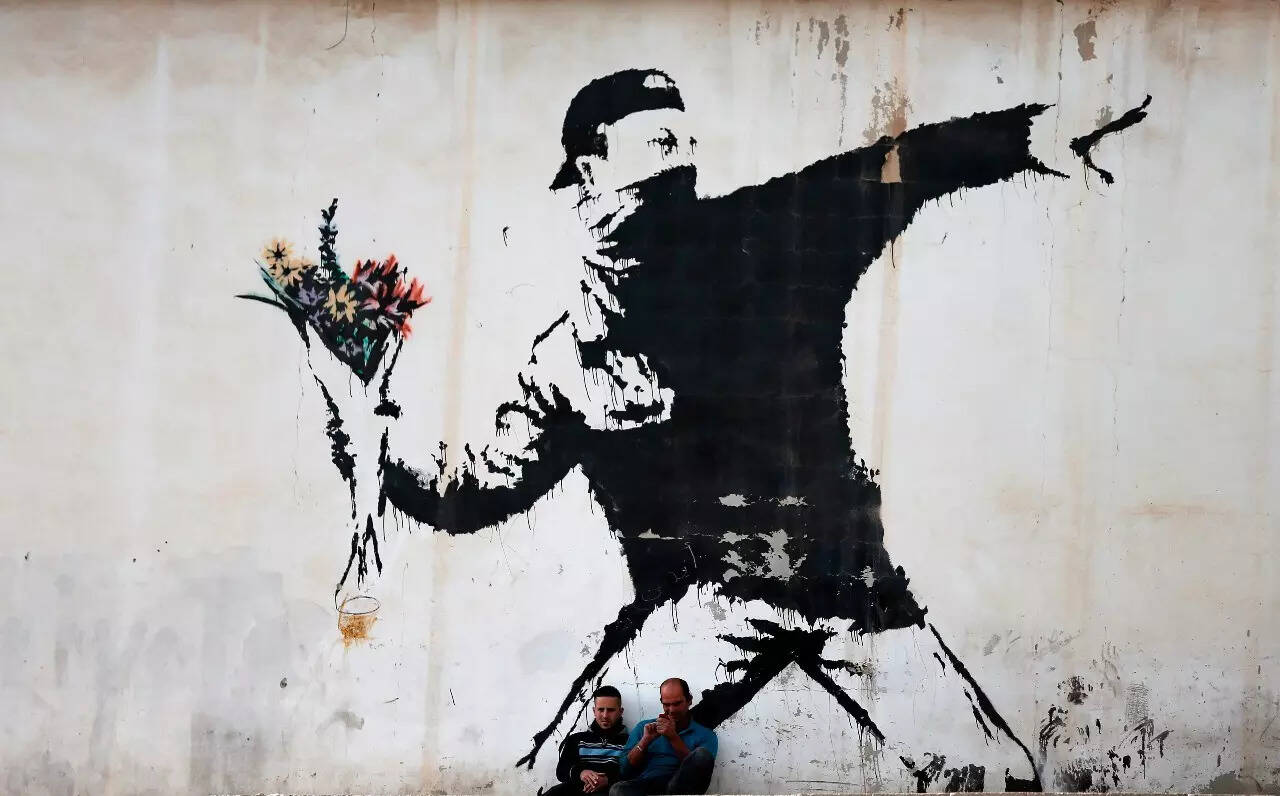
As Banksy’s murals began to appear in cities around the world, the mystery surrounding the artist deepened. Journalists and enthusiasts proposed several candidates for the identity behind the pseudonym. One of the most frequent names was Bristol artist Robin Gunningham, whose background matched the timeline of Banksy’s early career. The other was musician Robert Del Naja of the band Massive Attack, who himself had been part of the Bristol graffiti scene years earlier. Speculation developed into a small cultural industry, in which entire communities analyzed itineraries and stylistic similarities in an attempt to identify the elusive artist.Meanwhile Banksy continued to work. Murals appear in London, Paris, New York and the Middle East, often containing scathing comments about war, immigration and political power. Anonymity lasted so long that it seemed almost supernatural. Banksy seemed less like an individual artist and more like an invisible presence capable of appearing on any blank wall.The modern investigation of his identity began in an unexpected place. In 2022, during the war in Ukraine, several new Banksy murals appeared on damaged buildings near Kiev. Photos showed gymnasts balancing on debris and children confronting armed soldiers. The works quickly attracted international attention. He also raised a practical question. If Banksy had traveled to an active war zone to create them, someone would surely have seen him.Reporters began talking to residents of the villages where the murals appeared. Eyewitnesses reported that a small group was arriving in an ambulance. Two masked painters worked rapidly with stencils and spray paint while a third man accompanied them. The man was recognizable because he had artificial legs and an arm. He turned out to be a British war photographer who had previously worked with Banksy’s wide circle of artists and musicians. Details suggest that those involved in Ukrainian graffiti may have connections to the Bristol scene, from which Banksy originally emerged.
The clues soon link back to one of the long-standing suspects. Robert del Naza traveled to Ukraine around the same time that the frescoes appeared. The discovery briefly revived the idea that the composer might be Banksy himself or at least be closely associated with the operations behind the artworks. Yet the investigation ultimately revealed that the real breakthrough was hidden elsewhere, in a piece of paperwork that had lain quietly in an American archive for more than two decades.In September 2000 a young British graffiti artist climbed onto the roof of a building in Manhattan during New York Fashion Week. A large billboard advertising Marc Jacobs clothing stood on the street there. The artist began making changes to the advertisement, adding exaggerated teeth and creating a speech bubble next to the model’s face. Even before the work was completed, the police officers caught him in the act.At the time the incident seemed like a routine case of vandalism. The charges were reduced, a small fine was paid and the man was released. Little did anyone realize that the man standing on that rooftop would soon become one of the most influential artists of the twenty-first century. Yet this case left behind an invaluable scar. Inside the police file was a handwritten confession signed by the person who had defaced the billboard. The signature read Robin Gunningham.The discovery provided the strongest evidence yet that Banksy and Gunningham were the same person. The name had been rumored for years, but police documents turned the speculation into something more concrete. The mysterious street artist whose work spread around the world appears to have started his career as a graffiti painter from Bristol, who was once arrested while vandalizing a billboard in New York.Even this conclusion did not completely resolve the story. After the mid-2000s the public record trace for Robin Gunningham almost completely disappears. Addresses, property documents and other bureaucratic traces disappeared. Former colleagues later suggested that the explanation was straightforward. The artist had changed his legal name. The new identity was intentionally generic, a name that could easily blend into everyday life without attracting attention.In the end Banksy’s story highlights a strange paradox about modern fame. The artist created some of the most widely recognized images in contemporary culture while remaining personally invisible. His works criticized power structures and commercial systems, while those same systems turned his paintings into highly valued commodities. The myth of Banksy became as powerful as the artworks themselves.The investigation which revealed his identity as Robin Gunningham does not completely dispel that myth. The graffiti is still visible throughout the night. Pictures still speak in the same mischievous voice. The artist still avoids public appearances and interviews. What has changed is only the knowledge that behind the legend stands a man who once walked the streets of Bristol with a stencil and a spray can, and discovered that invisibility could be the most powerful artistic tool of all.