





The modern Spanish monarchy is sometimes described in historical circles as holding a theoretical dynastic claim to the Byzantine imperial title, being the last continuation of the Ancient Roman Empire in the East. This claim dates back to 1502, when Andreas Palaiologos, the last recognized claimant to the Byzantine throne, bequeathed his imperial titles to Ferdinand II of Aragon and Isabella I of Castile in his will.The transfer was largely symbolic and was never used politically by Spain. Yet the story behind it ties together several major historical developments: the fall of Constantinople in 1453, the decline of the Byzantine imperial line, the Reconquista in Spain, and the changing balance of power between Christian Europe and the Ottoman Empire. Historical records show that Andreas hoped that the newly unified and victorious Spain could succeed after centuries of warfare against Muslim rule in Iberia where others had failed and lead a crusade to restore Byzantium.However, despite inheriting the claim, the Spanish rulers never attempted to revive the Byzantine Empire or claim the title.
Fall of Constantinople and end of the Byzantine Empire
The story begins with one of the most important events in medieval history.In 1453, the Ottoman Sultan Mehmed II captured Constantinople, the capital of the Byzantine Empire. The Byzantine state had survived for more than a thousand years as the eastern continuation of the Roman Empire.During the siege, the last ruling emperor, Constantine XI Palaiologos, died fighting as the Ottoman army breached the city walls. Contemporary accounts indicate that Constantine had no surviving children, which immediately created uncertainty about the succession of the imperial dynasty.

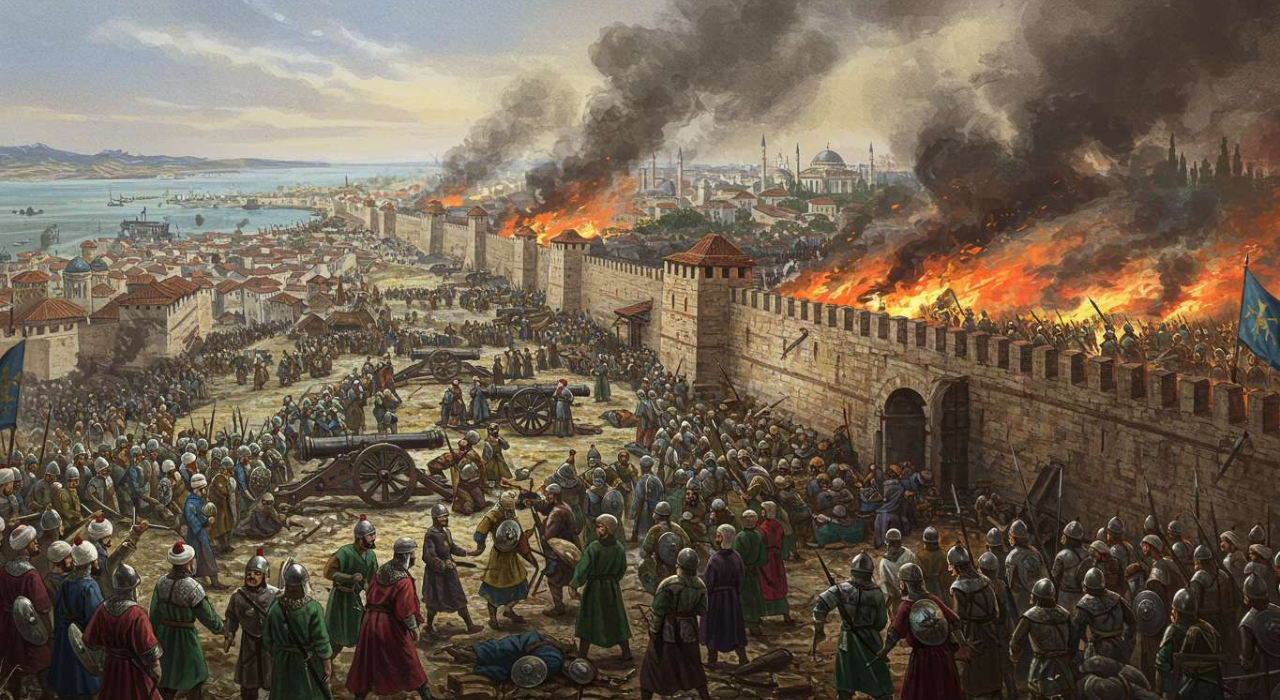
Fall of Constantinople (1453), end of Byzantium
After the fall of the city, the Ottoman Empire took over the Byzantine territories and Mehmed II assumed the title. Kaiser-e Roommeaning “Caesar of Rome”, presenting himself as the legitimate heir to the Roman imperial tradition.Meanwhile, the surviving members of the ruling Byzantine family, the Palaiologos dynasty, fled westward into exile.
Palaiologos dynasty in exile
The main figure in the subsequent succession story was Andreas Palaiologos (17 January 1453 – June 1502).He was the son of Thomas Palaiologos, ruler of the Morea, a Byzantine province in the Peloponnese, and the nephew of Constantine XI, the last emperor who died at the Fall of Constantinople.
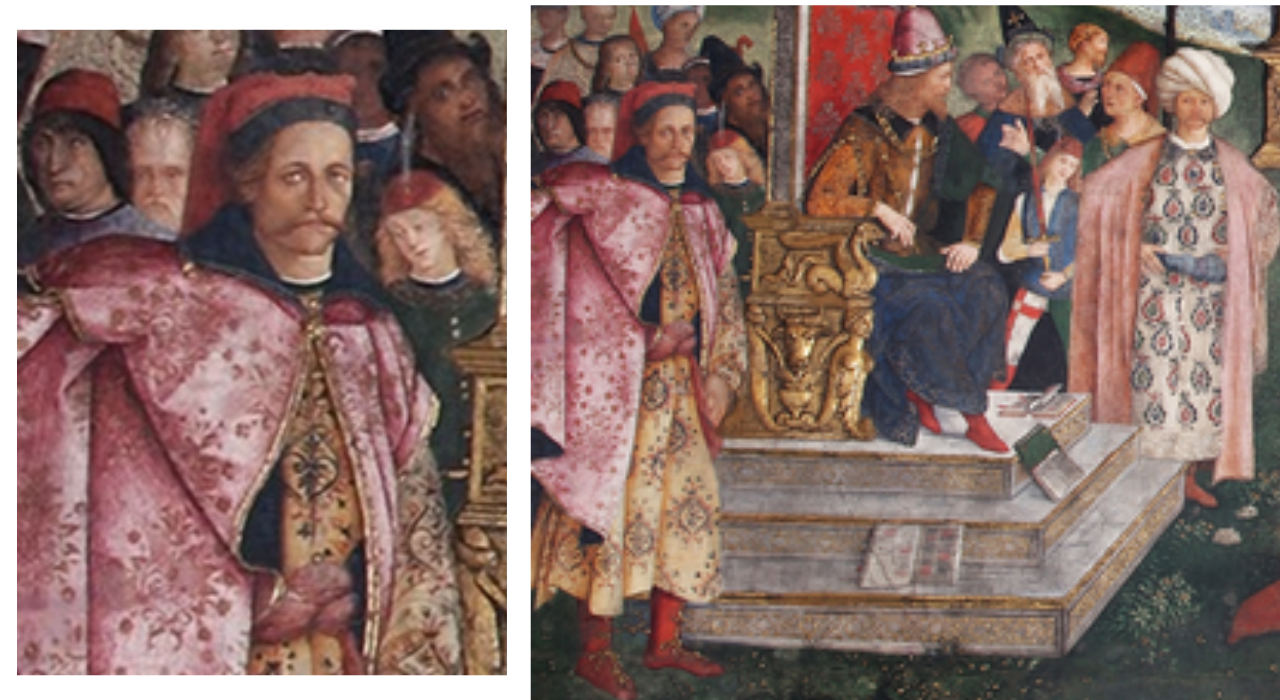
Possible portrait of Andreas as part of Pinturicchio’s St. Catherine’s Controversy (1491) in the Hall of the Saints in the Borgia Apartment, Vatican Palace, via Wikipedia
After the Morea was conquered by the Ottomans in 1460, Andreas’s father fled with his family to Corsica, which was then under the control of Venice. When Thomas died in 1465, twelve-year-old Andreas moved to Rome, where he became head of the Palaiologos family and the principal dynastic claimant to the Byzantine throne.From 1483 onwards, Andreas began to use the title “Emperor of Constantinople” (Imperator Constantinopolitanus in Latin). His father never formally used the imperial title, but Byzantine refugees living in Italy recognized Andreas as the fallen empire’s symbolic heir.Despite the title, Andreas did nothing. The Byzantine Empire no longer existed, and was heavily dependent on financial support from the Papacy, which gradually diminished.Although some primary sources suggest he may have had children with his Roman wife Caterina, historians generally conclude that there is no solid evidence that Andreas left living descendants.
Unsuccessful attempts to recapture Byzantium
Throughout his life in exile, Andreas attempted to find a Western ruler willing to support a campaign to retake Byzantine lands.A moment seemed promising. In 1481, the Ottoman Sultan Mehmed II died, and his sons Bayezid II and Cem became involved in a succession struggle. Andreas attempted to organize a military expedition from southern Italy in the hopes of crossing the Adriatic Sea and restoring the Byzantine state.The effort collapsed before it began after Bayezid II consolidated his rule, ending the Ottoman succession crisis.Andreas never returned to Greece, although historical records show that he hoped that, at the very least, the Morea might someday be re-conquered.
Selling Byzantine imperial claims to France
By the 1490s, Andreas’ financial situation had become desperate. Historians once attributed this poverty to an extravagant lifestyle, but many modern scholars believe that the main cause was the continual reduction of the papal pension that supported him.In 1494, he made a dramatic decision: he sold the rights to the Byzantine imperial title to King Charles VIII of France.The arrangement was conditional. Andreas hoped that Charles would launch a crusade against the Ottomans, recapture the Morea, and reinstate him as ruler there.For the French monarchy, the purchase had symbolic value. Claiming Byzantine imperial heritage enhanced the prestige of the French crown by linking it to the ancient Roman imperial tradition, and could also be used rhetorically to justify leadership of a future anti-Ottoman crusade.
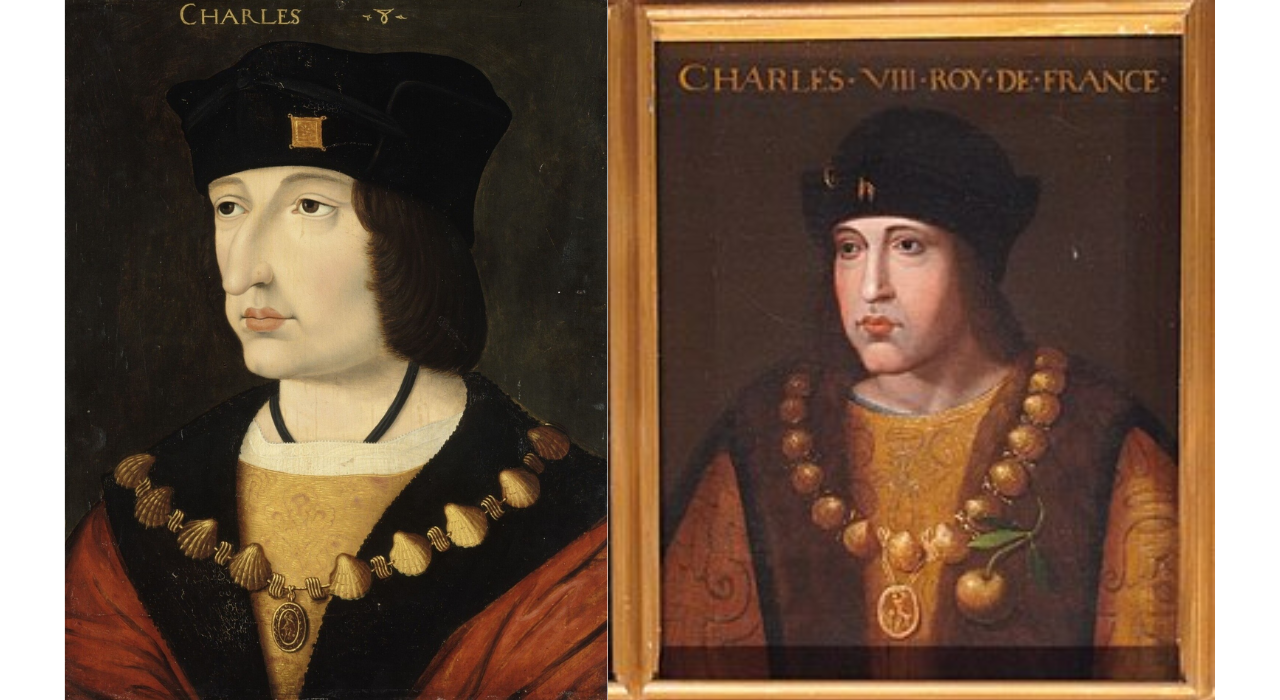
Portrait of Charles VII/Wikipedia
However, Charles VIII died in 1498, and the planned crusade never came to fruition.After the king’s death, Andreas himself resumed using royal titles.
Why did Andreas move to Spain?
In the last years of his life, Andreas once again sought a Western patron who could challenge Ottoman power.This time they turned to the rulers of Spain: Ferdinand II of Aragon and Isabella I of Castile, collectively known as the Catholic Monarchs.His rise changed the political landscape of Europe.In 1469, the marriage of Ferdinand and Isabella united the crowns of Aragon and Castile, and laid the foundation for a unified Spanish monarchy. His reign culminated in the War of Granada (1482–1492), the final phase of the Reconquista, a centuries-long campaign by Christian states to reclaim the Iberian Peninsula from Muslim rule.
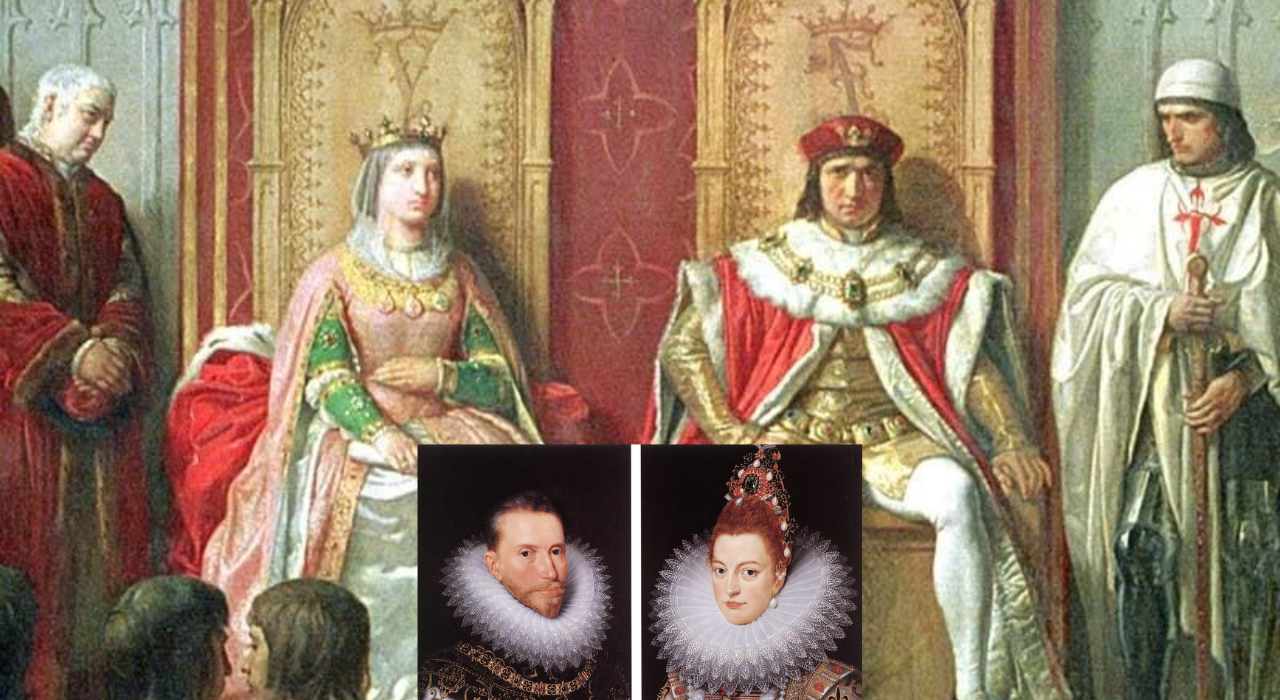


Known as Catholic monarchs, Ferdinand and Isabella were both from the House of Trastamara.
On 2 January 1492, the Muslim ruler Muhammad XII (Boabdil) surrendered the city of Granada, ending nearly eight centuries of Islamic political presence in Iberia, which had begun with the Umayyad conquest of 711–718.This victory made Ferdinand and Isabella one of the most powerful Christian rulers in Europe.Sources say that Andreas believed that his recent success against Muslim forces made him the most laudable champion of a renewed crusade against the Ottoman Empire. The Crown of Aragon also had historical titles associated with medieval Greece, including Duke of Athens and Duke of Neopatras, which may have strengthened the symbolic appeal of the transfer.
Spain’s will in 1502
Andreas Palaiologos died in Rome in June 1502. He was buried in St. Peter’s Basilica.In his will, he transferred his royal titles to Ferdinand II of Aragon and Isabella I of Castile.In dynastic terms, the implication was clear: if the Byzantine Empire were ever restored, the claim to its throne would be that of the Spanish monarchy.However, Catholic monarchs never used this title.Historical sources show that even at that time, wills were considered largely symbolic. Andreas died penniless and had no territory, army, or political authority.
Why did Spain never try to restore Byzantium?
Despite inheriting the claim, Spain did not attempt to reclaim Constantinople or revive the Byzantine Empire.Several factors seem to explain this.At first, the title had little practical significance. Andreas had sold the same claim to France years earlier, and the “empire” he claimed to transfer existed only as a dynastic memory.Second, Spain’s priorities lay elsewhere. After 1492, the Crown was busy consolidating control over Iberia, penetrating North Africa, and protecting its growing network of territories in Italy and the western Mediterranean. At the same time, far more consequential horizons were opening up in the Atlantic. That same year, Ferdinand and Isabella, after years of hesitation, agreed to finance Christopher Columbus’s voyage to the West. This decision was partly about competing with Portugal for routes to Asia, but it also reflected a broader ambition: to expand Spanish power and Christian influence beyond Europe. In that context, a vast and uncertain crusade to recapture Constantinople was far from the center of Madrid’s calculations.
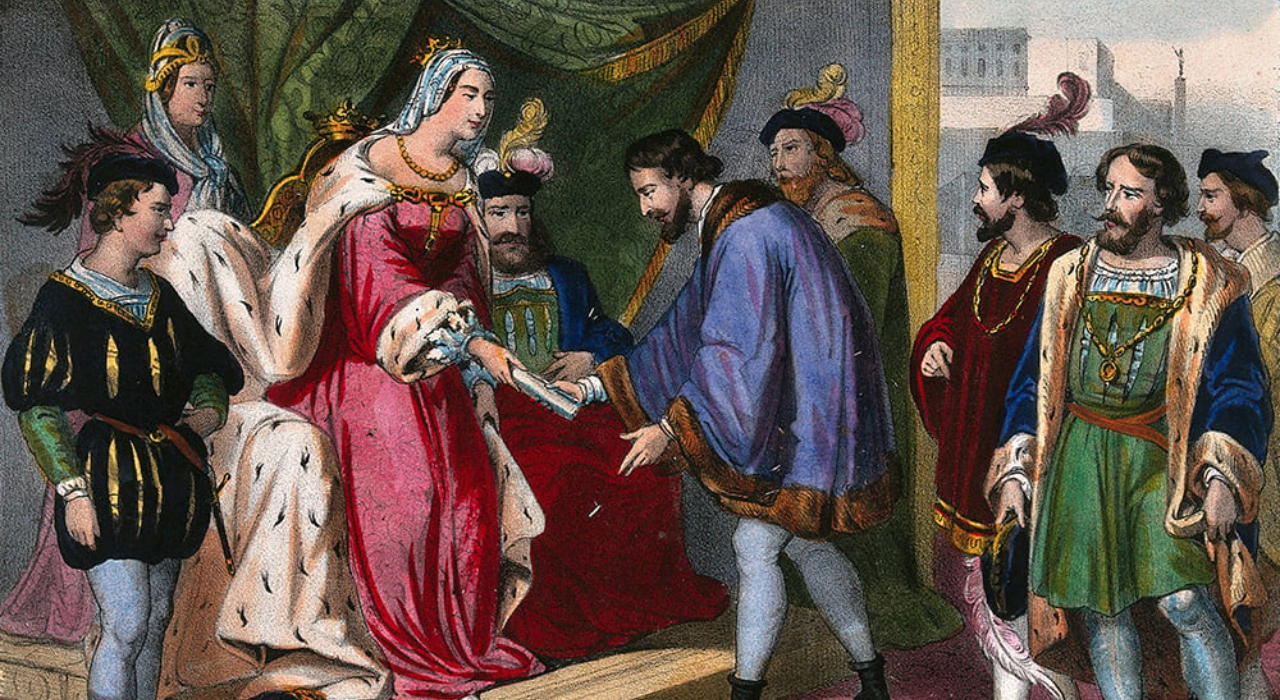
Christopher Columbus was funded mainly by the Spanish kings. (Photo credit: Wellcome Library, London/Wikimedia Commons)
Furthermore, launching a crusade to conquer Constantinople would have required a projectile of military power across the Mediterranean and deep into Ottoman territory, a logistical challenge that would have been exceptionally difficult for a sixteenth-century state.Third, the Ottoman Empire itself was a formidable superpower. Rather than a declining state, it controlled vast territories and had a powerful army capable of defending Constantinople and its surrounding areas.Spain fought the Ottomans repeatedly, most famously at the Battle of Lepanto in 1571, where a Christian naval coalition defeated an Ottoman fleet, but these conflicts focused on controlling the Mediterranean rather than reclaiming the Byzantine capital.
Claim goes to the Spanish Bourbons
The Spanish monarchy continued through several dynasties after Ferdinand and Isabella. His successors included the Habsburg kings of Spain and later the House of Bourbon, who still hold the Spanish throne today.Through this dynastic continuity, the theoretical Byzantine inheritance, originating in the 1502 will of Andreas Palaiologos, would have passed down the same line of succession.Historians generally view this claim as a symbolic curiosity rather than a legitimate royal succession.Nonetheless, the episode reveals an unusual historical chain linking the fall of Constantinople, the ambitions of a displaced royal family, and the rise of early modern Spain. The last claimants to the Byzantine throne placed their hopes on the Catholic emperors, confident that their victories against Muslim rule could one day be repeated against the Ottomans.That crusade never came. The title remained unused, and the empire to which Andreas tried to take over was never restored.