



AI is taking jobs: Whoop CEO Will Ahmed says companies have found a convenient excuse for layoffs
Whoop CEO Will Ahmed says many of the companies blaming AI for layoffs are actually cutting jobs because their businesses are struggling. His comments come when many tech companies are announcing job cuts while increasing investment in AI.


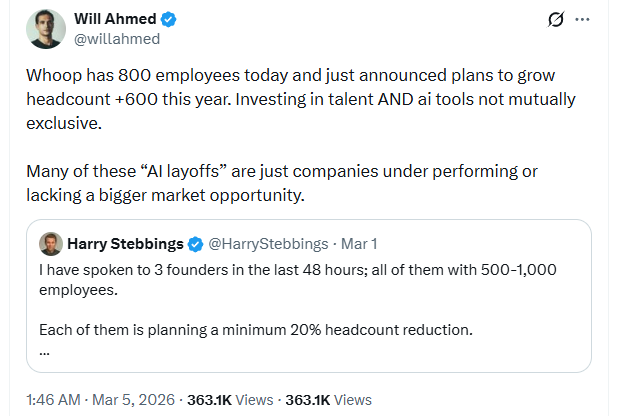
AI is increasingly being cited as a reason for companies to reduce their workforce, especially as businesses adopt new tools that promise to automate parts of their operations. But Will Ahmed, founder and chief executive of wearable technology company Whoop, believes that explanation is sometimes overstated. In his view, AI is being used as a convenient justification for layoffs that may actually be connected to other business realities.
❮❯
Speaking about the current wave of job cuts across industries, Ahmed suggested that artificial intelligence has become an easy explanation when companies announce workforce cuts.
“There are a lot of companies that are laying off right now and blaming it on AI,” Ahmed said. “But they’re really laying off because businesses aren’t performing particularly well. And that’s a convenient excuse.”
His comments come at a time when several technology companies have announced layoffs while emphasizing investment in AI. Jack Dorsey-led payments firm Block recently said it has cut more than 4,000 jobs as part of a sweeping overhaul aimed at incorporating artificial intelligence into its operations and improving efficiency.
Other major technology companies have also announced workforce cuts in recent months. Amazon said earlier this year that it would lay off about 16,000 employees. Meta has eliminated more than 1,000 positions from its Reality Labs division as it redirects resources toward artificial intelligence wearables and new smartphone features. Pinterest has said it will reduce its workforce by “less than 15 percent” and reduce office space as it shifts resources toward AI initiatives. Software company Autodesk has also announced plans to cut about 1,000 jobs.
The layoffs are not limited to technology companies. Investment bank Morgan Stanley has also reduced its workforce, cutting its headcount by about 3 percent or about 2,500 people across all divisions including investment banking and trading, wealth management and investment management. The cuts had no impact on financial advisors. According to a person familiar with the matter, the move was based on strategy and individual performance, and the bank plans to make appointments in other areas.
There have been layoffs at Morgan Stanley despite strong financial results. The bank posted record annual revenue in 2025 and beat Wall Street estimates for fourth-quarter profit earlier this year, driving a sharp increase in investment banking activity as dealmaking accelerated and loan underwriting fees soared.
While many companies are reducing their workforce, Whoop is planning the opposite. Ahmed said the company intends to significantly expand its staff this year as it prepares for future growth and a potential initial public offering.
The Boston-based company plans to grow its workforce by 75 percent and add more than 600 roles across departments including software, research, design, hardware, product development, manufacturing, sales and marketing. The majority of the new positions will be based at Whoop’s headquarters, although the company will also be hiring in other markets.
Recruitment is planned throughout North America, Europe and Asia, as well as in Gulf Cooperation Council countries including Bahrain, Kuwait, Oman, Qatar, Saudi Arabia and the United Arab Emirates. Whoop currently operates in approximately 60 countries, and international markets now account for approximately 60 percent of its sales. Four years ago, the United States made up about 70 percent of its member base.
Founded in 2012, Whoop develops screenless fitness bands designed to track health data such as sleep, recovery, and physical stress. The company currently employs approximately 800 full-time employees after adding approximately 300 employees over the past two years.
Ahmed said the company’s hiring plans are linked to new technology it wants to develop in the health and wellness sector.