



Why does a small film like Dhandora matter to Telugu cinema?
A quiet Telugu social drama, Dhandora has garnered renewed attention after its OTT release for its restrained take on caste and everyday injustice.

A wide shot opens up near a paddy field in a village. Four men are carrying a dead body between them for cremation, a child is walking a few steps behind. The camera doesn’t move. There is no music to guide this moment, just sounds as we walk.
Someone told that election gifts have started in the neighboring village. Saree for women. Wine and peanuts for men. The other one asks if that’s all. The reply comes, we are also giving Rs 500. A man complains that it is the same as last time and unless it is Rs 1,000, he will not bother to vote. Anyway, what difference will one vote make, some say. Even if you don’t go, they will mark it in your name. Take whatever they give. Vote for whoever you want.
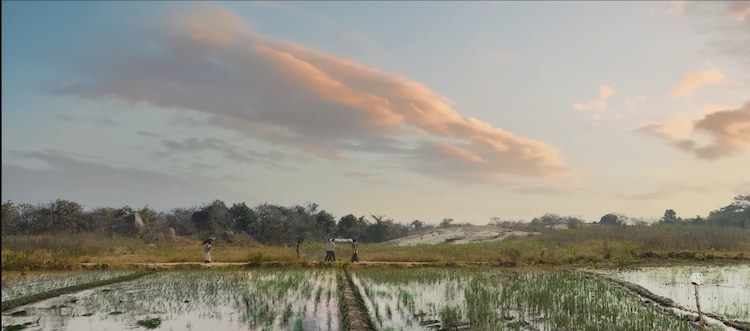
They pause for a moment. The body is heavy. The child looks up and asks why his grandmother is being taken so far away from the village. The answer comes quietly: God has written our destiny this way. Births and deaths are meant to occur outside the boundaries of the village.
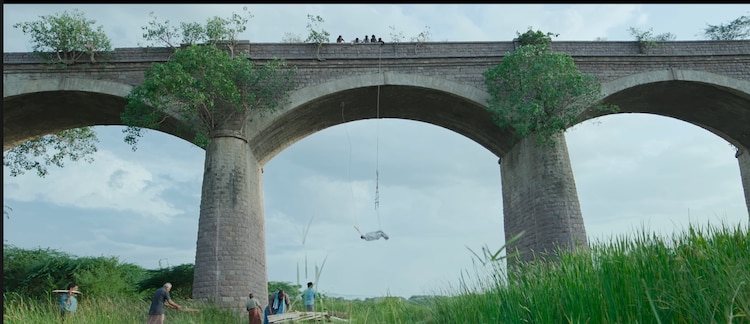
They keep going. At the bridge, they cannot take the normal route to the lake. The temple stands in the way, not merely as a place of worship, but as an obstacle. Their race is not allowed to pass through, leaving them with only one option: to lower the body from the bridge using ropes.
The ropes are tied. People gather below. The body is slowly lowered. The rope breaks halfway. The body falls. The loose end of the rope hung in the air and waved for a second longer than expected.
And then the title appears: dhandora.
For a moment it doesn’t look like a Telugu film at all. Not because of the language, but because Telugu cinema rarely allows itself to be so quiet, so uncomfortable and so disinterested in spectacle. This inconvenience persists because it cuts exponentially compared to where the industry stands today.
From Oscar conversations to international collaborations and Hollywood filmmakers inviting directors like SS Rajamouli to visit the sets, Telugu cinema is now global. Numbers that once seemed unimaginable have become regular headlines. But somewhere within that expanse, grassroots, socially attentive cinema has waned. After the pandemic, films that demand patience rather than awe have become increasingly rare.
dhandora It may not have completely made its mark during its theatrical run, but its OTT release has helped it get the attention it deserves from audiences and industry voices alike. What makes this film special?
A story where thinking becomes the problem
what makes dhandora A destabilizing experience is not a single act of violence or dramatic confrontation, but the ease with which injustice becomes embedded in everyday life. The film is less interested in identifying villains and more interested in highlighting how thinking itself gets messed up. Here caste discrimination does not come in the form of anger or show-off. It operates quietly through habit, obedience and social convenience.
Set in unified Andhra Pradesh in 2004, the film begins with the death of Shivaji, a respectable upper caste farmer of Tullur village in Medak. Even in death, he is denied dignity. The elders of his own caste refused to cremate him in the village cemetery. What happens next is treated not as a mystery to be solved, but as a rift that exposes how fragile social connection really is.
The questions the film raises are deceptively simple. Why does a community turn against one of its own people? Which choices led Shivaji to this point? What does his son Vishnu risk by turning against the order that everyone else accepts? Why does the Sarpanch enter into a conflict which he could have easily avoided? And how does Ravi, a man from a marginalized caste, become a disproportionate casualty in a system that ultimately destroys everyone, in different ways?
A village that looks familiar
one of Dhandora’Its quiet powers lie in how it builds its village. Each character, even those who later make cruel or cowardly choices, is first established as familiar. These are not symbolic figures or issue-based stand-ins, but rather people who feel like relatives and neighbors with whom you can identify.
Informal conversations, shared meals, idle humor and everyday dependencies create bonds even before conflict enters the frame. That intimacy is intentional. When caste and hierarchy finally assert themselves, the betrayal becomes even deeper because it comes from people who otherwise appear normal, even kind.
The film refuses to put the demons to rest. Instead, it forces viewers to sit with an uncomfortable truth: These humans have been shaped by a system so deeply normalized that cruelty seems routine. The hurt comes not from what they do alone, but from how much they are recognized while doing it.
cinema without rest
dhandora No interest in hero vs villain. It’s about humans versus the structures they continue to nurture, often without malice and almost always without reflection. The most troubling idea of this is this: oppression does not always move in predictable directions. Systems built on hierarchy eventually turn inward.
Director Muralikant stages this world without embellishment. There are no unnecessary fight scenes, no heroic highs, no background score telling the audience when to get angry or excited. Even the humor, when it appears to be there, is uncomfortable rather than relieving, born of irritation and irony rather than punchline.
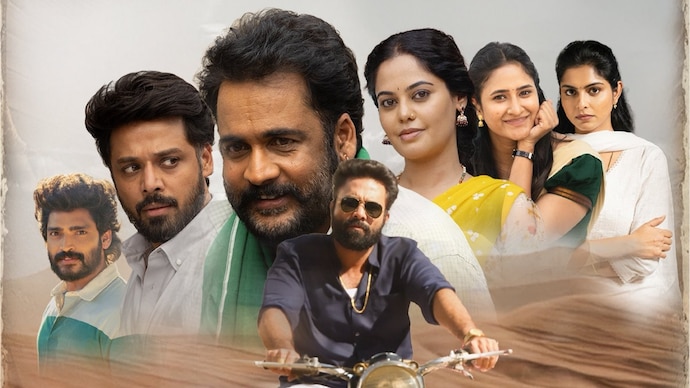
Sivaji delivers a performance built on control, presenting the film’s moral tension through posture and restraint. As the story progresses, Nandu grows into his role and plays a conflict role without leaning towards heroism. Ravi Krishna brings vulnerability to the character torn between love and inherited fear, while Navdeep, as the sarpanch, provides comic relief rooted in exhaustion rather than jokes. The supporting cast imbues the village with lived-in credibility.

Technically the film remains grounded. Mark Robin’s music supports the narrative rather than overpowering it. Venkat Shakamuri’s cinematography captures the countryside without romanticising it. There are rough edges, but there is never any carelessness.
Here is the trailer:
An honest film with visible cracks
dhandora Not a perfect movie. Its uneven pace and narrative gaps prevent it from being completely immersive, especially in the first half. Some changes feel sudden, and the emotional weight sometimes arrives before the script is fully developed.
But these flaws do not weaken the intention of the film. If anything, they underline how difficult it is to tell stories like this without softening their edges.
Why does Dhandora matter now?
When? dhandora It got noticed after its release in theatres. Critics responded positively. The intention was accepted. What it didn’t get was footfall. Like many serious rural dramas, it slipped through the cracks of the theatrical ecosystem driven by urgency and scale.
This changed after its OTT release. Audiences started getting the film late and were wondering how they had missed seeing it. The conversation grew and grew in scope to the moment Jr. NTR publicly praised the honesty and conviction of the film.
There is an irony here that seems almost appropriate. A film about dignity denied had to wait for itself. The passion for watching spectacle is increasing in cinema culture, dhandora It stands as a reminder that sometimes a film’s greatest political task is to look at reality and not blink.