



New year, same phone: From the iPhone 18 to the Samsung Galaxy S26, prepare for phones to get even more boring in 2026
2026 is not the year of the “new look”. This is the year our phones finally become powerful enough to stay beyond our reach. We don’t need a new shape. We need a tool that can handle 48 hours of AI-heavy tasks without any hassle.

It is that time of the year again. A new year, a new hope. Reset time. Literal in some cases, but mostly figurative. Whatever the case, where you live or what you do, this is an opportunity to reflect, introspect and move forward, no matter how good or bad the past year has been, because nothing is permanent. This too shall pass.
For some time now, the common perception about smartphones has largely gone aside that they are no longer exciting. In fact, they are becoming more boring with each passing day. They look alike and they are all beginning to feel alike in more ways than one. Liquid glass has slowly but surely infiltrated almost every smartphone, regardless of brand or ambition. And so, the question on everyone’s mind is, will 2026 be different? Well, yes and no, but mostly not.
iPhone-ification of design
Today’s smartphones, they all look alike. Barring foldables, every other “slab” phone seems to be cut from the same cloth. The main content is coming from Cupertino. Every other brand is just reiterating it. Apparently, there was some high-level meeting that we don’t know about, where everyone decided, you get flat edges, you get even flat edges, and you…guess what…more flat edges. There may be some brand-specific differences here and there like for example Realme made the camera module on the Realme GT 8 Pro modular, or Vivo chose to stick with the ubiquitous watch dial on the X300 series devices, but strip away those surface-level specifications and what you’re essentially left with is the iPhone blueprint below.
Even at Apple, the design is starting to look dated, but that’s not stopping everyone else from working on it. The upcoming launches of Oppo – Oppo Reno 15 series – and OnePlus – OnePlus Turbo 6/OnePlus Nord 6 – prove that the trend is here to stay, which means that even in 2026, you can expect flatter edges that look almost identical to 2024 and 2025 smartphones. This is fine to some extent because when brands follow the “if it ain’t broke” formula in one area, they have room to innovate elsewhere. Well, while the devices in our pockets look more alike than ever, the technology under glass is undergoing its most radical change in a decade.
look at the holy trinity
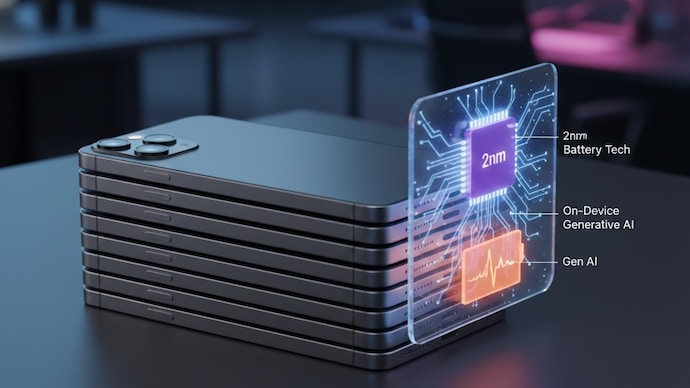
The entire industry has focused its attention on a holy trinity of invisible upgrades: faster processing, silicon-carbon battery chemistry, and on-device generative AI.
For years, the smartphone industry has lived on 5-nanometer and 3-nanometer nodes, but the move to 2-nanometer led by TSMC and Samsung Foundry is being seen as a huge leap into the era of nanosheet transistors. Apple is leading the change with its widely reported A20 chip. It is expected to power the iPhone 18 Pro and iPhone 18 Pro Max. Supply chain reports suggest that this chip could be 15 percent faster and 30 percent more power-efficient than the previous generation. Most likely, this performance will come with a higher price tag. A 12-inch 2-nanometer wafer is estimated to cost around $30,000 (Rs 30,80,000), which is 50 percent more than 3-nanometer wafers.
That’s probably why Apple is expecting the iPhone 18 series to launch in September 2026 with the iPhone 18 Pro and iPhone 18 Pro Max, while the base iPhone 18 and 18e could be pushed back to a Spring 2027 release. This difference could give Apple time to promote and sell more expensive Pros while effectively managing component costs and supply chain yields. The iPhone 17 could continue to bring in big money in the meantime, given how popular and in-demand it is proving to be around the world, while setting the stage for a sequel that everyone will be waiting for with great anticipation. If everything goes according to plan – provided it goes to plan – it has WINNER written all over it.
Speaking of Samsung, the South Korean major is expected to follow more or less a similar trajectory with the Galaxy S26 Ultra, which is rumored to use the Snapdragon 8 Elite Gen 5 globally, while the standard S26 model may rely on the Exynos 2600 in select markets to offset the rising cost of high-end silicon. Reports indicate that Samsung may surprise buyers by not raising prices, especially in the US. The launch timeline is a mystery, but all devices are expected to launch between February and March.
If the processor is the brain, the battery has long been the weakest link. In 2026, the “boring” phone is finally solving the battery concern that has plagued users since the original iPhone.
Late last year, the OnePlus 15 emerged as the frontrunner in this race, with a massive 7,300mAh battery. It’s set to lead the charge this year until the 16 arrives, although OnePlus has something even stranger planned with the OnePlus Turbo 6 launching with a massive 9,000mAh capacity. It’s not just a larger physical cell, it uses a Si-C anode that replaces traditional graphite. Silicon can hold significantly more lithium ions, allowing higher energy density in a smaller volume. At least it can be said that the results are transformative. You can read India Today Tech review of OnePlus 15 for a more in-depth analysis.

Samsung is reportedly taking a more cautious but arguably more stable route. Instead of changing the chemistry, the Galaxy S26 is expected to use “stacked” batteries, a technology borrowed from the electric vehicle (EV) industry. By stacking the battery’s internal components like sheets of paper instead of rolling them up, Samsung may be able to fit about 10 percent more capacity into the same physical footprint. To that effect, the S26 is rumored to have a 4,300mAh battery (compared to 4,000mAh in the S25), while the S26 Ultra may move towards 5,500mAh (compared to 5,000mAh in the S25 Ultra), prioritizing safety and thermal management over raw capacity.
The last but not least item on the agenda is on-device generator AI. With the Snapdragon 8 Elite Gen 5 and Apple silicon, phones are now able to run large language models (LLMs) locally, without requiring an Internet connection. Hopefully more features and brands will create new use cases to sell their smart accessories. But when every phone can erase objects from photos, the novelty quickly wears off. That’s why 2026 is less about what the phone can do and more about how long it can do it. The real winners this year are not those who have the most AI filters, but those who can power those demanding AI tasks to go for two full days without being charged.
ray of hope
While the standard slab phone may seem outdated, 2026 is expected to be the year Apple finally enters the foldable market. The iPhone Fold is rumored to launch alongside the iPhone 18 Pro in late 2026, though wide availability could be pushed back to early 2027. The device will represent the ultimate “not boring” moment for Apple fans – and a eureka moment for the industry – featuring a book-style design similar to the Galaxy Z Fold series.
Technical hurdles for Apple center on display creases and durability. Reports suggest that Apple is working with Corning on a special version of the Ceramic Shield that can bend without permanent distortion. However, this innovation will come at a premium. The iPhone Fold is expected to launch with a price tag of $2,000, positioning it as a luxury productivity device rather than a mass-market replacement for the iPhone 18. However with Apple’s entry into the field, hopefully there will be infinitely more action and prices will eventually drop, making foldables more than just party tricks. We will see.
Simply put, 2026 is the year of smartphone maturity. Although we may remember the days of radical design experiments, the shift toward boring exteriors is a reasonable compromise for the promise of big gains in strength and longevity. We’re moving away from phones that are sold as fashion statements (though they’ll still exist, we believe, at different price points) and toward phones that are invisible, ultra-efficient devices. Whether it’s the rumored $2,000 iPhone Fold finally breaking Apple’s mold or the long-awaited Samsung Galaxy S26, the excitement this year isn’t about how the phone looks in your hand. This is what you can do without having to worry about a power socket.