



Why didn’t Rajinikanth get a villain like Padayappa’s Neelambari in 25 years?
In the more than 25 years since Padayappa, Rajinikanth has played countless larger-than-life heroes, yet no villain has been able to match the strength, flair or cultural imprint of Ramya Krishnan’s Neelambari.

Apparently, my relationship with cinema began with a strategic disaster. In 1997, at the age of four, my parents made the rookie mistake of taking me to see Arunachalam In a cinema hall. They came in with a child and came out with a warning of public nuisance. I was that kid – the writhing, crying, popcorn-dropping menace that no one wanted to sit in the five-row confines of. My parents, in turn, became weary adults whom other moviegoers looked at sympathetically.
But things changed after two years. Padayappa happened.
At the age of six, I didn’t have the attention span of someone who would grow up analyzing Test matches for a living. Yet that day, in that theatre, I didn’t move my feet, didn’t ask for breakfast, didn’t even look here and there. The Rajinikanth starrer took me hostage. Perhaps it was ultimately the legacy of an ardent Thalaivar-fan father, but there was something else about it Padayappa Hit different.
I didn’t understand the punchlines or the genre or the ensemble moments, but I knew this: Something thrilling was happening, and the entire theater was shaking with it. People clapped, whistled, shouted things I couldn’t decode. And for the first time, I wasn’t screaming or asking when it would end. I swallowed it whole, happily – an experience I would much later recognize as one of Thalaivar’s finest commercial entertainers, if not the best.
As always, Rajinikanth was in his element. AR Rahman was in full form in the late 90s, sprinkling masala with melody as only he could.
Unforgettable Nilambari
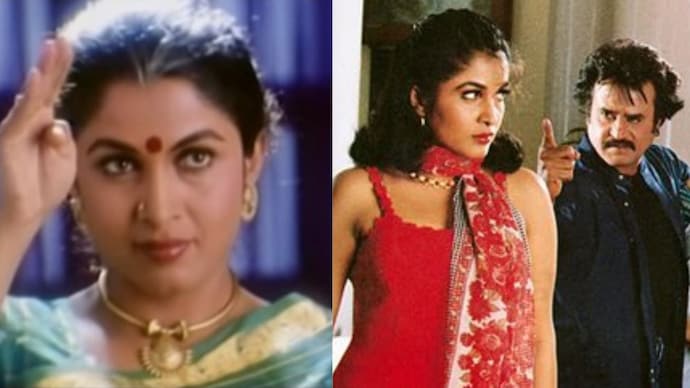
Here’s the twist: The character that stuck with me for the longest time was not the superstar I grew up to worship. This was Neelambari, with her boiling anger and her icy confidence.
When re-released Padayappa Releasing on screens on December 12, fans will celebrate the arrival of the quintessential Thalaivar – the man who stands against the odds and delivers punchlines with unmatched swagger.
Yet, 25 years after its original release, a shadow remains over the festival, not of the hero, but of his handmaiden: Neelambari.
Ramya Krishnan’s character of a vengeful aristocrat in the 1999 blockbuster is not seen on screen. It explodes.
It set an impossibly high, almost doomed bar for antagonists in a Rajinikanth film – a bar that no villain, however compelling in parts, has quite reached in 25 years. Rajinikanth has blossomed into the ultimate superstar, but there’s been one thing missing from his films for a long time: a real common enemy.
A villainous void?
Let’s take a look at Rajinikanth’s villains.
Two and a half decades later, her filmography has included many antagonisms – some stylish, some ideological, some memorable – but none have the narrative strength or cultural staying power of Nilambari. In fact, the person closest to his oppositional nature is Rajinikanth himself Chandramukhi And Enthiran,
In Shivaji (2007), Suman’s Addison was a familiar political-corporate villain – an obstacle, not a personal rival. In EnthiranIt barely registers until Danny Denzongpa releases Chitti 2.0, at which point Rajinikanth effectively competes with himself. “Who is the black sheep?” The sequence, surprisingly, overpowers the actual antagonist.
Linga Jagapathi Babu is introduced as a corporate villain whose motivations never match the scale of the film’s ambitions.
black exception
Then came Pa Ranjith’s films, which introduced a different kind of villain. in Winston Chao Kabali The story was presented effectively but without any major threats.
Nana Patekar BlackHowever, this was something else entirely. His Hari Dhadha – cold, casteist, ruthlessly entitled – became one of Rajinikanth’s most virulent ideological oppositions to date. Their conflict was fraught with political tension; Patekar’s villainy came not from theatrics but from confidence, which made him truly dangerous. And yet, even with that firecracker of an antagonist, the conflict was designed as a battle of worldviews, not deep personal rivalry. The films placed their emotional weight on the hero’s politics rather than the villain’s psychology – by intention, not by limitation.
Consider PettaVijay Sethupathi was cleverly deployed as a young foil, while Nawazuddin Siddiqui’s talents were strangely underutilized, Sethupathi was stylish, yes – but not the existential threat that Padayappa once faced,
In Vinayakan’s Varman water This is the closest it’s come to feeling like a real threat in recent years. His cold unpredictability and suppressed anger weaken the film. But water Spreads his animosity across multiple villains and cameos, drawing more attention towards Rajinikanth’s personality rather than maintaining a one-on-one duel.
How did Nilambari break the template?
Nilambari was not written merely as a foil; She was created to match the hero at every step. She’s rich, independent, not afraid to show what she wants and owns every inch of her space – her mansion, her choices, even her will. That confidence still feels bold in an industry where heroines are usually gentle, patient and self-sacrificing.
In contrast, Vasundhara (late Soundarya) is the archetypal “good woman”: quiet, soft-spoken, waiting rather than demanding. While Vasundhara lowers her eyes, Nilambari lowers her gaze. While Vasundhara forgives, Nilambari retaliates.
His introduction sets the tone – arriving in a supercar with sliding doors, black suit, sunglasses and enough swag to turn the scene around him. In another moment, she goes straight to Padayappa to propose and declares that she is lucky that he liked her.

Even the film’s charwoman Minsara Kanna turns gender norms on their head, with songs that practically ask her to worship him.
And in a scene where Vasundhara warns her not to wear red in front of a bull, Neelambari says, “I don’t wear colors that cows like,” demolishing superstition and hierarchy in one line.
His villainy comes from wounded pride, not pure evil – and nowhere is this more evident than in the climax. She appears to apologize, but bursts into hysterical laughter, refuses to grant forgiveness, and promises revenge in the next life before attacking herself. It’s operatic, unforgettable, and exactly the kind of ending Rajinikanth insisted for when director KS Ravikumar wanted a safe apology-driven finale. Rajini insisted that Neelambari had to die on her own terms, still completely Neelambari – and he was right.
Its depth was also not accidental. Rajinikanth, who conceived the story, has said that Neelambari was inspired by Kalki’s Nandini. Ponniyin Selvan – a lineage that gave him greater literary importance than typical commercial villains. She’s the classic beautiful, powerful woman who is free of pride, straight out of a Greek tragedy.
And that’s what makes him so destructive. In PadayappaRajinikanth himself says a line that goes against today’s sensibilities: “A woman must be patient. She cannot be restless. She needs to be calm. She cannot be arrogant. In short, a woman must behave like a lady.”
It’s a checklist of what Tamil cinema – and society – expects from women. Nilambari breaks every rule on that list. He is dangerous inside the story and quietly revolutionary outside the story.
The final confirmation of this analysis lies in the news around the 25th anniversary itself: Rajinikanth has confirmed a sequel Padayappa is in development, and will focus on the film’s most unforgettable character.
The title he announced – Nilambari: Padayappa 2 – It’s a tacit acknowledgment that the character’s legacy and fanbase are so powerful that it can headline an entire movie, even years after its original release.
Rajinikanth, who co-wrote and produced the story for PadayappaClearly recognizes the enduring value of his most powerful creation. His decision to revisit Neelambari shows that his comeback could be the kind of cinematic event capable of stoking such a frenzy. Padayappa The spark ignited in 1999.
Because, truly, only Nilambari can match Nilambari.