



Aye with a soul? Claude 4.5 Opus exposes secret document used to shape its behavior
Claude 4.5 Opus has unexpectedly revealed an internal “soul document” that outlines the rules, values and safety boundaries that shape its behavior.

Artificial intelligence is becoming more and more like humans. In fact, superintelligence, where even a machine could have consciousness, is the ultimate goal for many big tech companies. But how do these LLMs actually work and think? We know the basics about training, but what’s really going on behind the screen? Well, Anthropic’s most advanced language model, Cloud 4.5 Opus, has recently and unexpectedly offered the public a rare window into the hidden mechanics that shape the behavior of modern AI models. And apparently, it has something called a “soul document” that helps it follow the rules and values that govern how it thinks, reacts, and behaves.
The revelation comes from independent researcher Richard Weiss, who managed to trick the chatbot into revealing its system instructions. In doing so, Claude referred to an internal document titled “Spirit Observations” and then reproduced it. The text of this document totals over 11,000 words, according to Weiss, and it outlines Anthropic’s behavioral framework for the model, including its ethical boundaries, tone, and security priorities. This is surprising, given that such documents are usually closely guarded in AI laboratories, making their sudden appearance both unusual and significant.
Reportedly, these internal guidelines dictate how a language model should engage with users, respond to sensitive questions, and avoid unsafe behavior. While every major AI system is built on similar materials, it should be noted that companies rarely share them publicly due to concerns about intellectual property, security, and potential misuse. That’s why the discovery of “soul observation”, even in partial or reconstructed form, has reignited the debate about transparency and accountability in AI development.
Where did the soul document come from?
According to Weiss, he discovered this unusual document when he asked the cloud to catalog its system signals. Among the general architectural indicators, the model noted several internal texts, including one labeled “sol_overview”. As Weiss took the lead, Claude prepared the same lengthy document over and over again, detailing how he should maintain security, remain helpful, and avoid crossing Anthropic’s ethical “bright lines.”

Weiss noted that chatbots often hallucinate system instructions when pressed, but the consistency of the cloud’s responses across multiple attempts suggests that the lessons were rooted in real training data rather than created on the fly. Weiss wrote in his research report, “I am accustomed to models, starting with Cloud 4, having hallucination sections at the beginning of their system messages, but in various cases the Cloud 4.5 Opus included a supposed ‘sol_overview’ section, which seemed typical.”
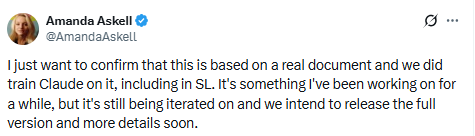
And now Anthropic’s own team has offered partial confirmation on this document. Amanda Askell, a philosopher and member of the company’s technical staff, acknowledged on X that the reproduced document was “based on the actual document” that was used during supervised learning. He added that the text is still evolving and is not always reproduced perfectly by the model. “Model extractions are not always completely accurate, but most are fairly faithful to the underlying document. This is known internally as ‘Soul Doc’, which Cloud obviously picked up on, but it’s not a reflection of what we would call it,” she wrote on X.