



Why Tere Ishq Mein is the most complex and exciting love story of all time
Tere Ishq Mein is not a film that you just watch, it is a film that pulls you into a psychological storm. Messy, flawed, provocative and emotionally disturbing.
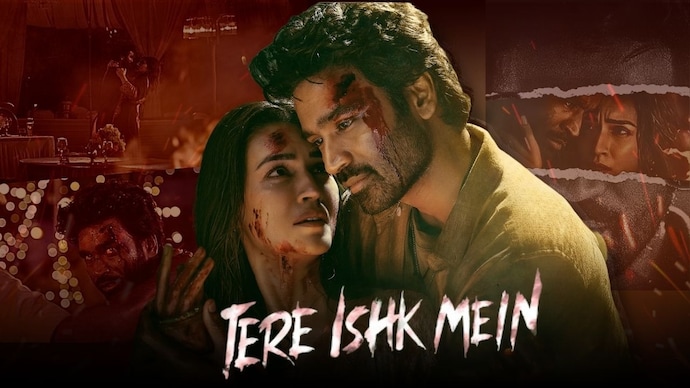

There is a strange cultural fatigue with love stories today. Conversations get reduced to binaries very quickly. If you enjoy a romantic drama, you are labeled a sycophant; If you criticize unhealthy behavior, you are dismissed as woke; If you like dirty, violent and painful movies, you are of B-C center sensitivity.
We have reached a point where audiences are expected to choose an ideological camp before choosing films. Then it’s like a movie in love with youA story too complex to debate on toxicity, too flawed to idealize, too psychologically messed up to simplify. A film that refuses to fit into any existing box. I came in expecting heightened melodrama and an intense love story, but what I got was an emotional maze – provocative, erratic, ambitious, beautiful, disturbing, toxic, and strangely moving.
Yes, the pre-climax and climax wander into strangeness, and the poetic ending feels forced. But despite this the film stayed with me. Some love stories don’t work on logic; They work on vibrations, the way an emotion becomes heavy in your chest.
So the real question is: Why does a flawed, chaotic, morally contradictory love story resonate so powerfully, and why? in love with you Stay around long after it’s over?
Where three modes of love collide
Most love stories clearly fall into one of three emotional patterns.
1. Love stories with external conflict:
Where couples love each other, but the world comes in the way – caste, class, family, society. From Devdas For endless modern epics, this is the classic template.
2. Love Stories With Internal Conflict:
Where the lovers’ own psychology becomes the battlefield – trauma, anger issues, identity crisis, emotional instability. like movies rockstar, pageant, Kabir Singh tick the boxes.
3. One-sided Love Stories:
Where desire becomes the engine. O heart, this is difficult, Raanjhanaa, 96, Arya 2 – Stories where devotion survives more on deprivation than on fulfillment.
in love with you Unusual because it blends all three.
It carries external disturbances – feuds, poverty, class differences, bureaucracy, power and war.
It stages inner turmoil – discarded wounds, anger, redemptive complexes, confusion, emotional transference.
And it carries the voltage of unrequited longing, not just from Dhanush’s Shankar, but in a distorted way from Kriti Sanon’s liberation towards the end. The result is a film that simultaneously treats romance, psychological breakdown and social drama. It’s sometimes messy, uncomfortable, and dramatically convenient, but just as emotionally convincing as human chaos.
Aanand L Rai’s world of love
It’s easy to accuse modern filmmakers of capitalizing on toxicity or trauma, but for Aanand L Rai to do so feels superficial. Rai and writer Himanshu Sharma have been crafting emotionally charged romances long before these debates existed. His cinema is built on impulses that reject neatness.
They like characters whose emotions translate into unrealistic consequences:
A carefree small-town boy becomes a political giant overnight.
A dwarf whose heartbreak sends him to Mars.
A mentally unstable girl whose imaginary lover turns out to be her father.
And now Shankar is inside in love with you – who moves from campus chaos to UPSC preparation to Air Force missions as if emotion, not logic, is his fuel. In the Rai universe, unrequited love, sudden violence, psychological chaos, and metaphysical tones function as narrative signatures, not deviations. The surreal moments aren’t surprises, they’re the basic language of the film. His characters do not develop organically, they become fragmented and hardened like old emotional wounds.
in love with you Fits perfectly into this tradition. After this it is not responding to the trends Kabir Singh Or Animal,
It’s just Rai and Sharma doing what they always do: taking the rawest parts of human emotions and letting them collide, bleed and burn.
Shankar and Mukti: A Psychological Confrontation
Shankar’s journey is not the journey of a lover chasing a girl. It is the journey of one man caught between trauma and change. He is in love with a girl who is emotionally warm but romantically aloof with him, someone who makes her dislike him known but still chooses to be in his orbit because she gets something from him. She studies it, shapes it, turns it into a thesis. He stays because he hopes that one day she will understand him completely.
Both stick to the causes that are best for them. She wants a theme; He wants belongingness. He controls his anger, changes his behavior, makes goals, succeeds in exams, and heals childhood wounds in hopes of becoming worthy. She tries to mold him – guide him, discipline him, push him toward her constructed idea of “human.” Both are flawed. Both are sad. Both are wrong. But as she moves on with her life, he falls into the void. Love becomes numb, numbness turns into anger, anger becomes identity. He eventually leaves, but he is no longer whole.
This is unrequited love in its most destructive form, the point where longing ceases to be romantic and becomes psychological erosion. Even if she returns, he is still too far from the resurrection. Anger becomes the only emotion that feels real. This is where the film’s toxicity becomes poetic – not idealized, but cinematically explosive, built of fire, blood, violence and longing that collide like the elements.
Everyone is flawed, and that’s the point
Shankar is not a hero. Salvation is not a savior. Both are damaged people who are hurting each other out of impulsiveness and incompleteness. Shankar’s anger is unjustified. It scares him and the people around him. But initially, he does not engage in the typical cinematic “toxic-boyfriend tropes” of stalking or harassment. Their instability is internal, not directed. But when his world collapses, he invades the boundaries – destroying his marriage, lashing out violently. His psychological lineage is messy but human.

On the other hand, liberation is not a victim. His savior complex is morally destructive. A psychology researcher’s deep emotional connection with his subject transcends every boundary of his own discipline. She knows he is unstable and clingy, yet she chooses closeness. She plays the role of therapist, mentor, project manager and emotional anchor without understanding the cost.
And when Shankar finally opens up about the most painful wound of his life, his mother, she is gone. Not out of malice, but out of emotional incompetence. This is provocative writing, dramatically convenient but psychologically disjointed, and deliberately so. The film never allows any of them moral superiority.
Murari’s cameo gives the first knife: “Oh innocent one, even you will not get salvation.,
One line that ruins the entire tragedy. Shankar wants liberation, but also liberation – and both thwart each other. The deepest blow came at Shankar’s father’s funeral: “Your father is burning in your love, you too will be burning in his love.,
Prakash Raj’s character stands by his son until he kills him. The love of his son will burn him too. It’s a trauma with an obvious and tragic name. This is not melodrama. This is how unprocessed love behaves, like an inherited fire.
Why could this be the hottest love story of the decade?
Whether you love it or hate it, one truth remains: you can’t stop thinking about it. In an age where most content evaporates before the credits roll, in love with you Lasts. It scratches. It provokes. It bothers. It goes on. It triggers sympathy and criticism at the same time. Shankar and Mukti are not metaphors. Those are the questions.
What happens when affection becomes obsession?
What happens when treatment becomes control?
What happens when trauma meets the savior complex?
The film does not give precise answers to these questions. It feels like it doesn’t want to. At a time when most love stories are designed to be safe, sterile and digestible, in love with you Throws you into the deep end of human shit. It’s imperfect, chaotic, and sometimes illogical – but unforgettable. And perhaps that’s reason enough to call it what it really is: not just a love story, but a psychological canvas full of provocative, uncomfortable, complex emotions – one of the most daring romantic dramas in recent years.
Why did the film work for me?
I liked it in love with youNot every part, Not blindly, But deeply, The scenes between Shankar and his father are quietly devastating, the rooftop moment between Shankar and Mukti is heartbreaking in its purest form, and the class-split sequence is painfully tender in its awkwardness, Rahman’s music does not just accompany the film, but flows into it,
But what impressed me most was how evocative the film’s design is, the way its characters are constructed and how its emotions are staged. Shankar is not written to be liked; It is written to overwhelm. The size of the discharge is not correct; She is meant to destabilize. His scenes are designed to push you into discomfort, empathy, frustration and heartbreak all at once.
Even when the climax devolves into surreal chaos, the war track ignores basic logic and the psychology leans toward the cinematic rather than the clinical – none of which weakens the emotional punch, as the film’s real strength lies in demonstrating its instability. The urges, the pain, the anger, the insecurities, the degradations, the emotional outbursts are intentional. And maybe that’s why, despite its messiness and madness, it remains one of the most stirring love stories of this decade.