





Zoho executive says tech companies have reached tipping point, jobs will be lost due to AI
AI is boosting productivity in many industries. While this is helping companies do more with less, Zoho leaders warn that AI is pushing the tech industry toward a future where there will be fewer human jobs and flatter teams.

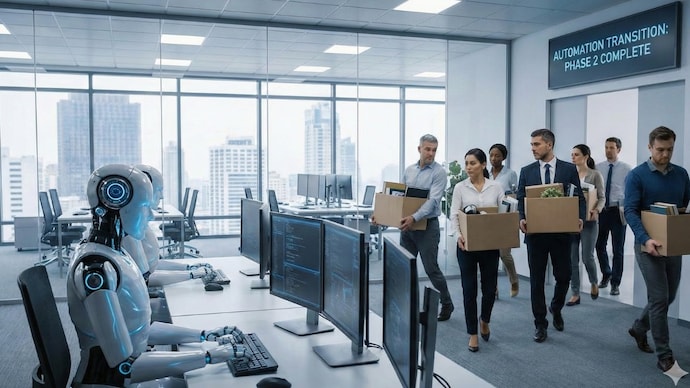


Artificial Intelligence is changing the world we live in and the offices we work in. While the impact of AI-powered automation can already be seen in many white-collar jobs, the tech industry finds itself at the center of perhaps the biggest change. From coding vibes to speeding up complex development tasks, companies are increasingly turning to AI to improve their organizational structures. Many human jobs are at risk from the expansion. Zoho, an Indian brand with global ambitions, and its executives also seem to be standing at a major crossroads.
In a recent post on X, Raju Vegesna – who, according to his
He wrote, “Every industry reaches a productivity tipping point after which the number of jobs in that industry begins to decline. We have seen this again and again as productivity increases make the workforce smaller.” “In America, about 1.5 percent of the workforce is in farming today, yet they produce about ten times as much as they did before, about 40 percent. Productivity grew. The workforce shrank. The same pattern was seen in manufacturing. Now we’re seeing it in tech.”

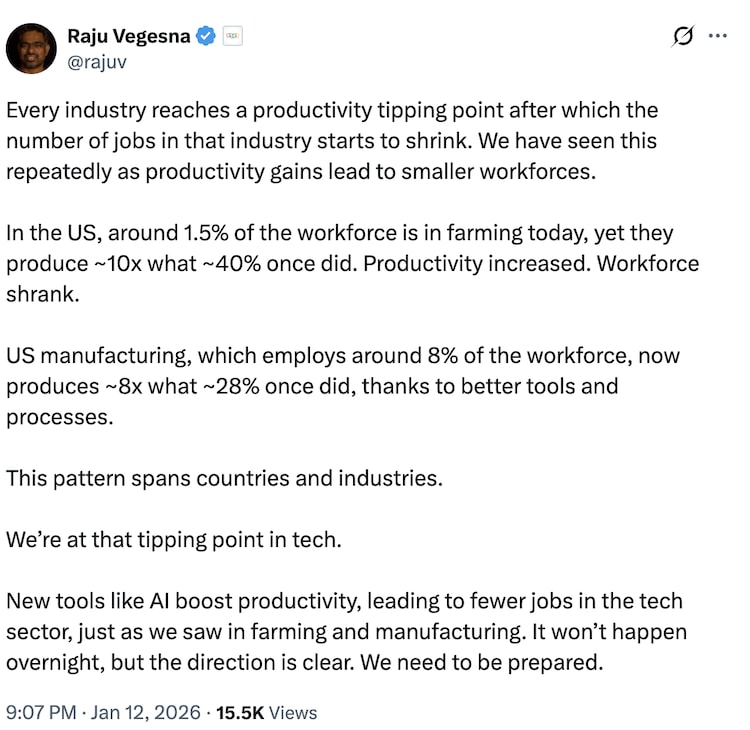
Vejesna highlights how AI tools are already increasing output for engineers, meaning companies may need fewer people to deliver the same, or even better, results in the near and distant future. Although he suggests that this change will not happen overnight, AI will ultimately create fewer jobs overall, even if new roles emerge.
AI is already changing things at Zoho
And it’s not just Vejesna who is raising concerns about job cuts following productivity gains. Earlier, Zoho co-founder Sridhar Vembu had also talked about the disruptive potential of AI in software development. In a series of posts, he explained how artificial intelligence is making senior engineers dramatically more productive, while simultaneously reducing the need for large teams of junior developers.
“AI makes senior architects more productive and reduces the need for junior engineers,” Vembu wrote. He said experienced engineers now work like conductors of an orchestra, guiding AI tools to deliver complex results that once required entire teams.

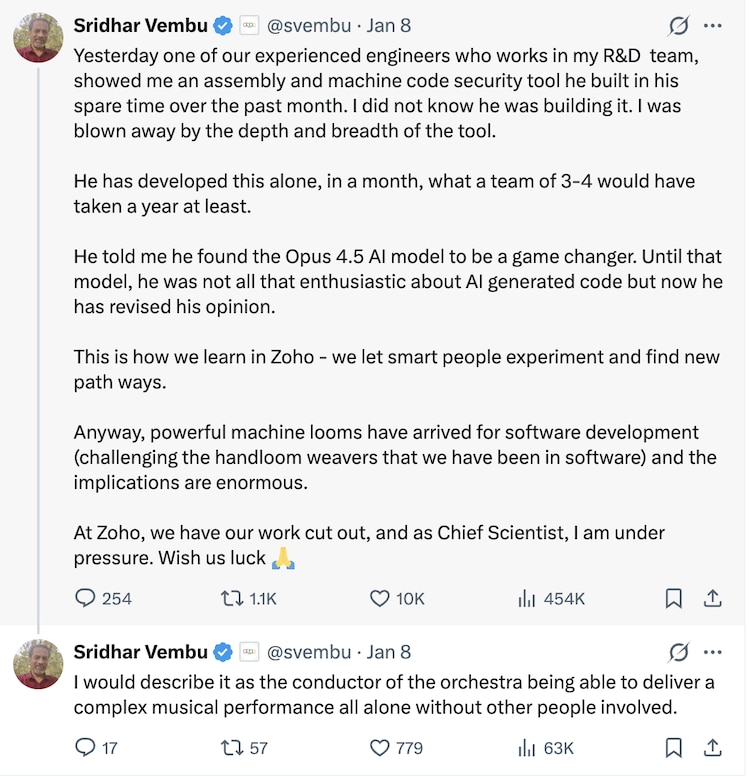
In another post sharing an example from inside Zoho, Vembu revealed how one of the company’s engineers recently created an advanced assembly and machine-code security tool in just a month, a project that would traditionally take a team of three or four engineers close to a year. “He single-handedly developed it in one month, which would have taken a team of 3-4 people at least a year,” Vembu wrote.


“He told me he thinks the Opus 4.5 AI model is a game changer. Until that model, he was not so enthusiastic about AI-generated code but now he has revised his opinion.”
While Vembu is encouraging about AI-led productivity gains, he also flagged a growing future dilemma. He questioned “But if we don’t have junior engineers, we won’t be able to train the next generation of architects – after all, how does one become a software architect without first becoming a junior engineer?” He has written.
Still, while acknowledging the extent to which AI is already changing the industry, Vembu said the technology is fundamentally reshaping, and in some ways overtaking, the workforce. “Powerful machine looms have arrived in software development,” he wrote, “challenging handloom weavers what we are doing in software – and the implications are huge.”