





Will WhatsApp leave India? Explained about the privacy issue that angered the Supreme Court
Despite the Supreme Court’s stern warning on data-sharing and privacy, WhatsApp is not ready to leave India immediately, but the coming weeks may decide how it should operate here.

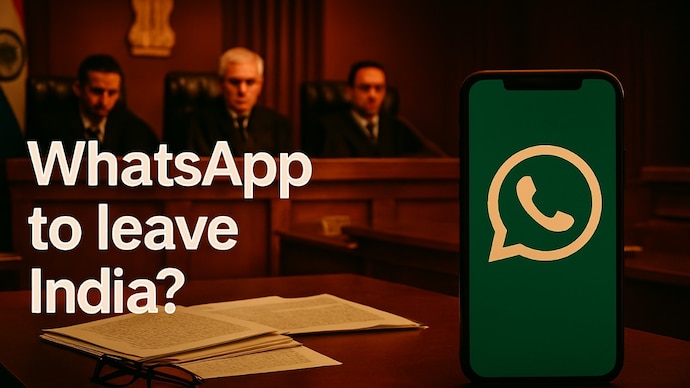


Over the years, WhatsApp has become so deeply woven into daily life in India that it almost feels like a public utility. From family groups and office updates to payments and business chats, apps quietly remain at the center of digital conversations. This is why the Supreme Court’s sharp warning to WhatsApp’s parent company Meta has caught everyone’s attention. When the Chief Justice said, “If you cannot follow our Constitution, leave India,” it was not just courtroom drama. It was a clear message about the extent to which India is willing to go to protect user privacy. So what exactly made the country’s top court so angry, and does it mean WhatsApp could be forced out of India?
WhatsApp privacy drama with India: How did it start?
The controversy stems from WhatsApp’s 2021 privacy policy update, which was sent to every user. The policy states that as part of the Facebook family of companies, WhatsApp may share user information with other Meta-owned firms. As per the policy, this data may be used to operate, improve, optimize and support marketplace services and offerings.
For users, the choice was extremely simple. Either accept the updated policy and continue using WhatsApp, or delete the account completely. There was no real “opt-out” for sharing data while on the platform.
WhatsApp later clarified that personal chats between friends and family remain end-to-end encrypted. However, data shared with businesses on WhatsApp can be collected and used, including for advertising on Facebook. That distinction did little to quell concerns, especially in a country where WhatsApp has widespread reach and influence.
WhatsApp privacy an issue again in 2026: What happened and why?
The matter reached the Supreme Court during the hearing related to the appeals filed by WhatsApp and Meta against the Competition Commission of India order. CCI had imposed a penalty of Rs 213.14 crore on this policy citing its impact on competition and user choice.
During the hearing, the bench led by Chief Justice of India Surya Kant took an unusually tough stance. The court questioned how consent could be genuine when users were left in a “take it or leave it” situation. Justice Joymalya Bagchi described this as “manufactured consent”, suggesting that users were effectively forced to agree.
At one point, the Chief Justice further said, “Where is the question of opting out? This is a civilized way of stealing personal information.” He also emphasized the dominance of WhatsApp and pointed out that consumers have little viable alternative because “everybody uses it.”
The court repeatedly emphasized that the right to privacy is not negotiable. “We will not allow even a single piece of information to be shared. You cannot play with the right to privacy in this country,” the bench said. Making it clear that commercial interests cannot outweigh constitutional protections.
What did WhatsApp say on the allegations of user data sharing?
India Today Tech contacted WhatsApp and it declined to comment. But in its defense in court, Meta’s senior lawyer Mukul Rohatgi argued that the service is free and no money is taken from users. He also informed that the related issue is already pending before the Constitution Bench. Another senior lawyer, Arun Kathpalia, told the court that not all user data is shared and the scope of sharing is limited. According to WhatsApp, the company does not access individual messages and only specific categories of information are included in it, TOI reported.
However, the court seemed to disagree with these arguments, especially given the scale and influence of WhatsApp in India.


Court has given Meta a deadline of February 9 to fix it
Perhaps the most important development is what comes next. The Supreme Court has asked WhatsApp and Meta to file an affidavit giving clear and unambiguous assurance that they will not share user data. The matter has been listed for issuance of interim directions on February 9.
The bench also made it clear that if no such undertaking is given, the companies’ appeal against the order of the National Company Law Appellate Tribunal (NCLAT) may be dismissed. This will weaken the legal position of WhatsApp in India.
Will WhatsApp leave India?
Despite the dramatic court language, WhatsApp is unlikely to exit India immediately. India is WhatsApp’s biggest market, and moving away from it would be a big business decision. The court’s comments should be seen more as a pressure tactic than an actual eviction notice.
What the Supreme Court is suggesting is that working in India comes with non-negotiable responsibilities. If WhatsApp wants to continue, it will have to respect Indian constitutional values, especially the right to privacy.
For users, the case could become a turning point. This could determine how much control Indians actually have over their personal data and whether “free” digital services can continue to demand such high hidden costs. You can stay connected with India Today Tech for all updates.