



What is Starlink Internet – and what it is not
Starlink may be a feat of engineering, but as Elon Musk says, we all can’t beat physics. And so, although there are some things that it does brilliantly, which is connecting far-flung areas of the Earth and bringing more people online, it is not a replacement for traditional 5G and broadband internet. Not now, not in the near future.
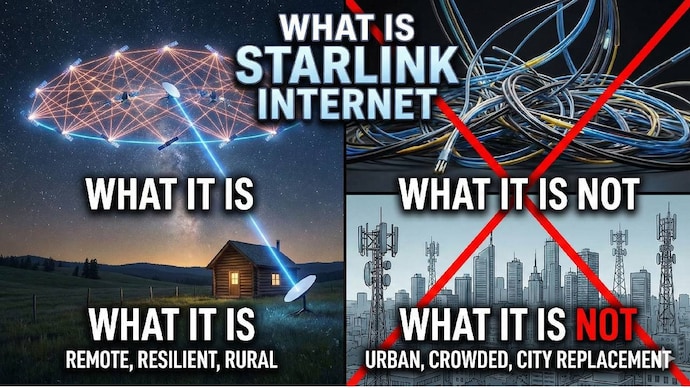

What is Starlink? It is, of course, owned by Space Exploration Technologies Corp., known to many as SpaceX, which was founded by Elon Musk, who is widely regarded as the real-life Tony Stark. The website describes Starlink as reliable high-speed internet from space. But what does it mean and how does it do it? The answer isn’t as simple as searching a website. This became crystal clear after Indian entrepreneur Nikhil Kamath’s recent podcast with Musk. The interview was full of interesting anecdotes on life and artificial intelligence, yet one specific section stood out for its practical clarity: what Starlink is and what it is not.
For years, Starlink has been surrounded by a mixture of hype and confusion. Is it a replacement for 5G? Will this kill traditional broadband? When finally available in India, will it work in the middle of Mumbai or New Delhi? Kamath also had the same question. “Can it (Starlink) really be efficient in a densely populated city where it is competitive with local network providers?” he asked, to which Musk replied, “Unfortunately no, physics is not on our side”, putting an end to all speculation once and for all.
What is Starlink: A laser trap in low Earth orbit
To understand Starlink and the physics behind it, we have to look at altitude. Traditional Internet satellites are placed in geostationary orbit about 36,000 kilometers above Earth. This long distance creates high latency which is an annoying lag that you experience during video calls or while streaming content from platforms like Netflix and Spotify.
Musk explained that Starlink is theoretically different because of its proximity. Its thousands of satellites orbit at an altitude of only about 550 kilometers (aka low Earth orbit). Because they are so close (relatively speaking), data travels much faster, providing high-speed and low-latency Internet, not at the same rate as ground-based connections but comparable.
The real magic that Musk highlighted is the resiliency of the network. He described the system as a laser trap. These satellites are not just talking to the ground, but also to each other using laser links. This creates a network of connectivity in space.
Musk offered a real-world example: When undersea fiber cables were recently cut in the Red Sea, traditional Internet traffic was disrupted. However, Starlink faced no such problems. The satellites easily bypassed broken physical cables on Earth, bouncing data between themselves in orbit and staying connected. In a way, you can think of Starlink as a global backup drive for the Internet, a seemingly indestructible infrastructure that floats above the Earth, free from all earthly disturbances.
What is Starlink: A lifeline for the most underserved
Musk was emphatic about Starlink’s primary demographic. It is designed almost exclusively for remote areas and locations where digging holes to lay fiber optic cables is extremely expensive or geographically impossible.
In rural areas, cell towers are often few and far between, so coverage can be uneven. Starlink could change that. This shines above helps bring the most underserved populations online. Having said that, Musk sees the technology as a complement to existing telecom companies rather than a direct competitor. It fills the gaps that Jio or Vodafone cannot fill economically, or maybe eventually they will, we don’t know for sure yet, in which case Starlink could be another option to consider.
This also extends to humanitarian crises. Musk said that when natural disasters like earthquakes or floods knock out cell towers and power lines, Starlink usually remains operational because its infrastructure is in space. He emphasized an ethical policy in this regard: SpaceX prefers to provide free access during disasters, refusing to put up a paywall in front of people seeking help during a tragedy.
What Starlink is not: An urban replacement
This is the most important distinction Musk makes, and it’s one that often confuses people – even Kamath. Starlink is not a solution for densely populated cities.
If you live in the center of a major metropolitan city with fiber internet and good 5G, Starlink isn’t designed to replace those connections. In fact, Musk acknowledged that physics does not allow him to compete in that environment.
He used a brilliant flashlight analogy to illustrate his point. Imagine a satellite in space as a flashlight, shining a cone of light at Earth. Because the satellite is 550 kilometers away, that beam is wide. However, that single beam has a fixed capacity for data. If you shine that beam into a rural area, some people there get incredible speeds. If you shine that same beam on a city block with 50,000 people, the bandwidth drops immediately.
Musk was candid about the numbers, saying that Starlink might be able to provide service to only 1 or 2 percent of a dense city’s population, perhaps at a specific “cul-de-sac” where fiber was not laid, or a specific building with poor reception.
He summarized the limitation succinctly, “We can’t defeat something that’s a kilometer away.” A local cell tower in some city is just down the street. A Starlink satellite is in space. In high density locations, the cell tower wins every time. In other words, Starlink is impressive – no less than a feat of engineering – but it can’t beat the urban telecommunications giants because as groundbreaking as this technology is, it’s not yet fully available. Maybe it will never happen, maybe it shouldn’t happen.