





Was Ranveer Singh right to give legal notice to FWICE? What do the industry, lawyers say?
The Federation of Western India Cine Employees (FWICE) has withdrawn its non-cooperation directive against Ranveer Singh after the actor issued a legal notice against the film body. As the Don 3 impasse continues to escalate, lawyers and industry veterans have started raising their voices.




The Federation of Western India Cine Employees (FWICE) on Wednesday withdrew its non-cooperation directive against actor Ranveer Singh. “We will respond to the legal notice in a legal manner,” the film body said.
“We are still appealing to Ranveer Singh. We invite him to sit with us to resolve this matter amicably and save the interest of the industry,” the FWICE statement said..
❮❯
Here is the notice from FWICE announcing withdrawal of non-cooperation directive against Ranveer Singh:

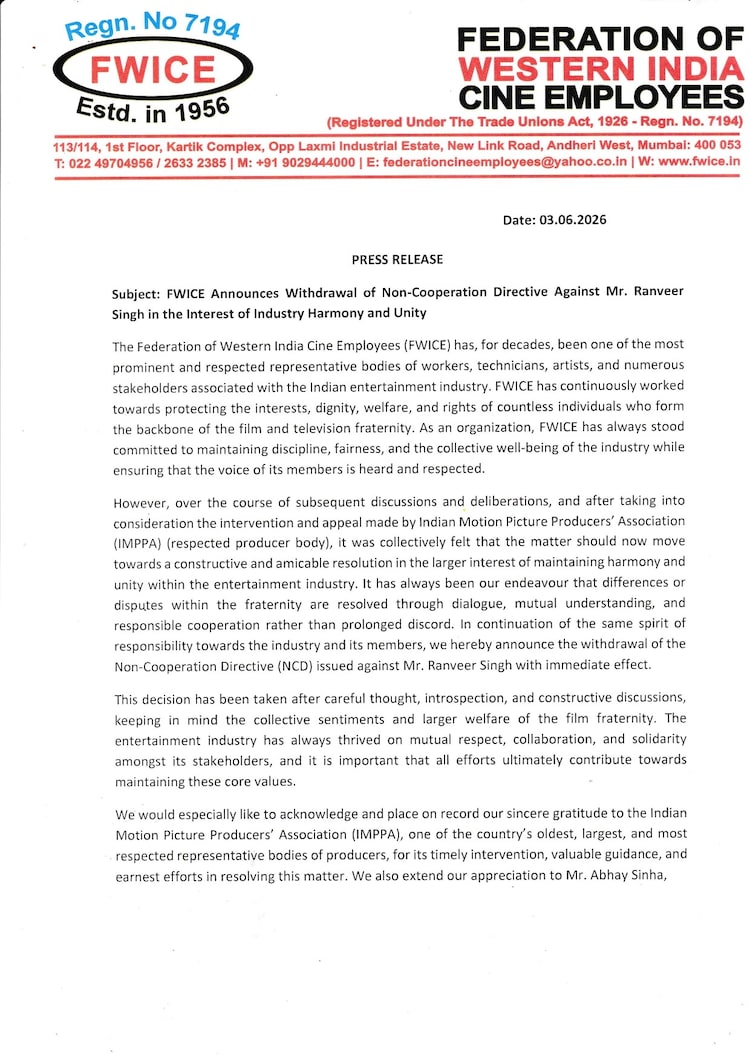
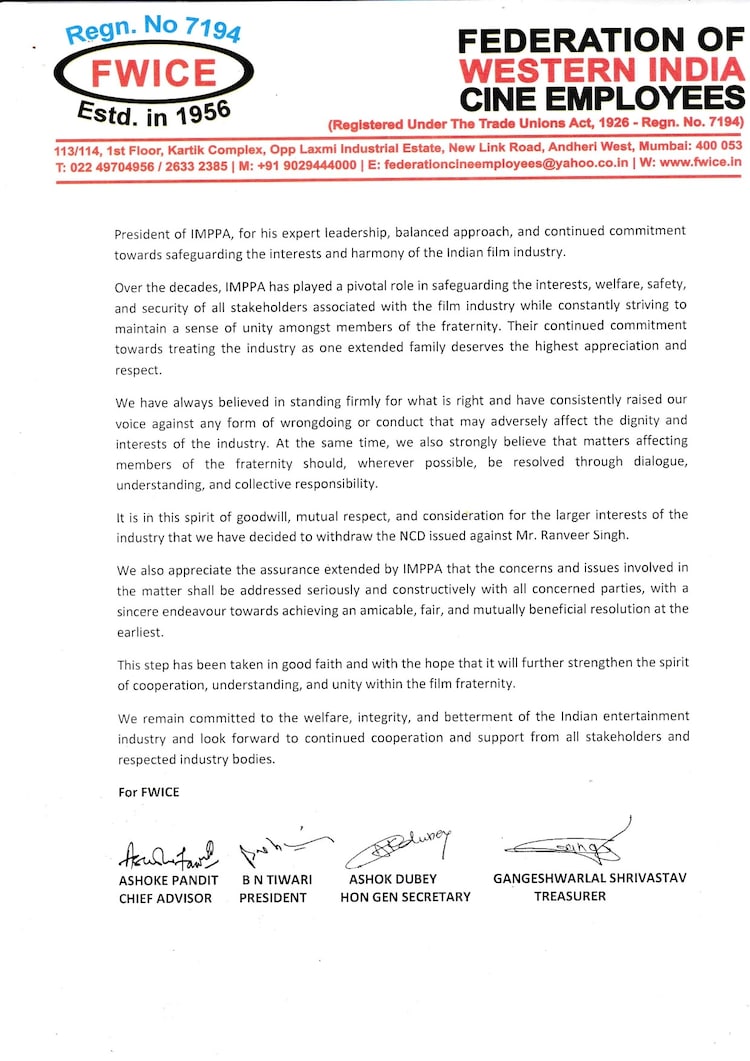
Earlier on Tuesday, Singh had sent a legal notice to the Federation of Western India Cine Employees (FWICE), more than a week after the film body issued a non-cooperation direction against the actor, asking over five lakh of its employees to boycott working with him. The direction came after filmmaker Farhan Akhtar complained to FWICE that the actor has been left out of his project don 3 A few days before shooting began, the loss occurred.
don 3 The ‘action’ obviously started long before a single shot was filmed, but there’s always a twist in all things Bollywood. which began as a conflict between Singh and don 3 Excel Entertainment, the production house co-owned by Akhtar and Ritesh Sidhwani, has suddenly turned into a full-fledged war between Singh and FWICE. The actor’s legal notice puts an official seal on this fact.
While FWICE’s non-cooperation directive on the actor has been lifted, at the time of writing, Singh’s legal notice against the film body remains intact. FWICE Chief Advisor Ashok Pandit confirmed receipt of the notice to India Today on Wednesday. However, the contents of the notice have not been disclosed. The film body will reportedly reveal details at a press conference in Mumbai later today.
Bollywood believes that discussions will be held to resolve the matter
Meanwhile, Bollywood feels that the solution to such disagreements lies in discussions, as court cases in India take years to resolve. “They (Ranveer Singh and Excel) should sit down and talk. They need to arrive at a mutually agreeable solution internally. Ranveer also needs to realize that Excel is a reputed production house. Asking for too many changes in the script and locations can be avoided once everything is planned,” says veteran producer Kuku Kohli, who is associated as the general secretary of the Indian Motion Picture Producers Association (IMPPA).
Kohli says if there has been a change in Ranveer’s attitude then it is his result stalwart Movies are becoming blockbusters, as many people say, it is wrong.

Will Ranveer’s legal notice increase the fight?
But what is the legal meaning of Ranveer Singh’s notice? We asked representatives of the lawyer community to shed light on what the consequences of Singh’s action could be.
Advocate Avadhi Joshi says, “If a person feels that the action of an industry body is affecting their ability to work, then approaching the court is a valid and legal remedy. Contractual disputes and non-cooperation directives are separate legal issues.”
However, Joshi agrees with Bollywood on one matter: it makes business sense for both sides to sit down and resolve the issues. Joshi, founding partner, Minara Legal, says, “Commercially, settlements are usually faster and less disruptive. Even after a legal notice, there remains scope for discussion and an amicable solution.”
“Manufacturers face significant risks from delays in litigation,” says lawyer Alay Razvi, pointing to a precedent by the Competition Commission of India (CCI), the main competition regulator in India. Razvi, managing partner of Accord Juris, says the CCI precedent “found that FWICE’s non-cooperation directions amount to anti-competitive conduct under Section 3 of the Competition Act, 2002.”
Razvi says: “With 34 vendor unions under FWICE, the directive could seriously disrupt film shooting and production schedules. Producers of Ranveer’s upcoming projects may face delays, increased costs and difficulty in hiring crew, as affiliated employees may refuse to cooperate despite the directive lacking legal enforceability. Don 3’s Rs 40 crore compensation claim also remains unresolved, creating financial uncertainty.”
Was the FWICE directive legal?
Which brings up an important issue: Was the FWICE non-cooperation directive a clear-cut violation of an individual’s right to earn a livelihood? Was it legal in the first place?


“This directive potentially violates Article 19(1)(g) of the Constitution (right to practice any profession/trade) for both Ranveer and the workers seeking to employ him,” Razvi says.
He questions the authority of FWICE to issue non-cooperation instructions. Razvi says, “FWICE is a trade union, not a regulatory authority, and lacks jurisdiction over contractual disputes between actors and producers. The non-cooperation directive stems from his exit from Don 3, which is a contractual matter between him and Farhan Akhtar’s production, on which FWICE cannot legally adjudicate.”
Pointing to veteran filmmaker TP Aggarwal’s recent move to challenge FWICE’s non-cooperation directive against Ranveer Singh, Razvi argues, “Indian courts have previously examined industry boycotts that cross legal boundaries, and an actor can challenge directives that unlawfully interfere with his right to work or amount to forced blacklisting.”
Razvi further says, “FWICE’s non-cooperation directive is not legally valid and violates fundamental rights.” Although FWICE may advise members not to work with Ranveer, members can ignore this without penalty – it is not a binding ban.
For Joshi, the validity of the FWICE directive is a “key legal question”, subject to judicial scrutiny. “While associations may represent member interests, any action that effectively restricts a person’s ability to work may face judicial scrutiny as interference with the right to practice a profession and earn a livelihood.” Joshi says.
Negotiations outside the court are ideal: Lawyer
Legal community wants out-of-court resolution on this issue don 3 The legal community believes that a standoff would be ideal, all things considered. “Prolonged disputes can create uncertainty, delay projects and impact commercial planning,” says Joshi. However, courts can grant interim relief long before a final decision.
“Even after several discussion rounds (negotiations) both sides remained firm, the impasse remained, necessitating court intervention. Even now, out-of-court settlement is possible – Indian courts generally encourage mediation in civil disputes, and both parties can still negotiate settlement terms during the litigation. However, the chances of (conflict) escalating have been reduced by Singh sending a legal notice to FWICE, and the case has now become public and both sides are facing media reactions. Preparing,” Razvi said briefly.
With so much publicity ahead of release due to legal tussle, Farhan Akhtar probably won’t set aside the budget for the first trailer don 3 Issuances. Of course, he has to get his Don back in front of the cameras first.