



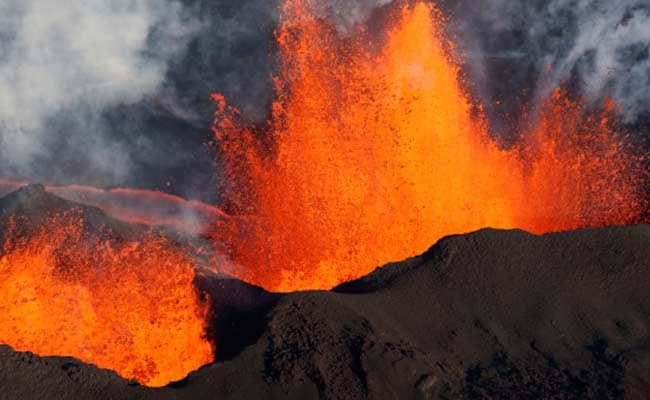
Vast regions of magma beneath ancient volcanoes continued to spew carbon dioxide to the surface long after they stopped erupting, a study said Wednesday, potentially showing that past global warming events may have lasted longer than expected. Why did you go?
Humans are emitting more planet-warming carbon-dioxide (C02) than all the world’s volcanoes combined. But scientists hope that by studying climate change in Earth’s distant past, they can understand how the world warms — and, importantly, how it might cool again.
Scientists have long been puzzled by how long it took Earth’s atmosphere to recover from the mass extinction event 252 million years ago that ended the Permian period.
It was the most severe extinction event in our planet’s history, wiping out approximately 90 percent of marine species and 70 percent of land species.
Scientists believe that this turmoil was caused by a huge volcanic eruption in Siberia. The eruptions created large igneous provinces – vast underground regions of magma and rock – that have been linked to four of the five major mass extinctions since complex life appeared on Earth.
It took about five million years for Earth’s climate to recover.
But according to scientific models, the world should have regrouped more quickly.
“Earth’s natural thermostat appears to have gone haywire during and after this event,” said Benjamin Black, a researcher at Rutgers University in the United States and lead author of a new study in the journal Nature Geoscience.
‘This gives me hope’
To learn more, the US-led team analyzed the lava chemically, used computer models to simulate inner-Earth processes and compared it to climate records preserved in the rock.
Their results showed that even once volcanic activity during previous episodes had ended, magma continued to release carbon dioxide from deep into the Earth’s crust and mantle, continuing to warm the world.
“Our findings are important because they identify a hidden source of CO2 in the atmosphere during moments in Earth’s past when the climate became suddenly warmer and remained warmer than we expected,” Black said in a statement. “
“We think we have understood an important part of the puzzle of how Earth’s climate was disrupted, and perhaps equally importantly, how it recovered.”

Black told AFP that the process described in the study “certainly cannot explain current climate change”.
All the world’s volcanoes currently “release into the atmosphere less than one percent of the carbon equivalent to human activities,” he explained.
The type of volcano the team investigated was last seen on Earth 16 million years ago, Black said, and was so massive that it “could cover the continental United States or Europe in lava for half a kilometer.” “.
But if the findings are confirmed, it could turn out that Earth’s thermostat is working better than scientists thought.
“This gives me hope that geologic processes will gradually be able to pull anthropogenic CO2 back out of the atmosphere,” Black said.
“But this will still take hundreds of thousands to millions of years, which is obviously a long time for humans.”
(Except for the headline, this story has not been edited by NDTV staff and is published from a syndicated feed.)