





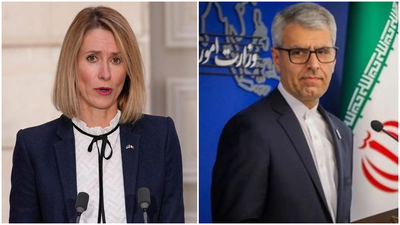
File photo: EU foreign policy chief Kaza Kailash and Iran’s Foreign Ministry spokesman Ismail Baghai
Iran on Sunday sharply criticized the European Union over its position on transit rules in the Strait of Hormuz, accusing it of double standards amid rising tensions over the US-Iran conflict.Iran’s Foreign Ministry spokesman Ismail Baghai targeted EU foreign policy chief Kaza Kailash, saying that Europe uses international law selectively. “Oh, that ‘International Law’?! The one that the EU dusts off to lecture others, while silently giving the green light to a war of US-Israeli aggression… Avoid preaching,” he said, calling Europe’s stance “extreme hypocrisy.”Baghai stressed that Iran, as a coastal state, has the right to regulate movement in the strategic waterway and opposed calls for unrestricted passage.
Iran defends Hormuz control, rejects ‘unconditional transit’
Baghai said Tehran has the right to take action in the strait, stressing, “No rule of international law prevents Iran from … taking the necessary measures to prevent the Strait of Hormuz from being used for military aggression against Iran.”He also rejected the concept of free passage under current circumstances, saying, “‘Unconditional transit passage’ into Hormuz? That fantasy emerged the moment American/Israeli aggression brought American military assets into the backyard of the Strait.”


EU warns against transit fees, offers maritime support
His comments came after Callas stressed that transit through major waterways must remain open and free, warning that any “pay-for-passage scheme would set a dangerous precedent for global sea routes”.Europe could play a role in restoring normalcy once hostilities subside, he said, adding that the EU’s Espionage naval mission could be strengthened to protect shipping throughout the region.
Tension increases as Iran hints at taking tough steps
The exchange came after Iran indicated it might give priority to ships willing to pay fees under the new transit protocol, citing limited capacity. The situation worsened when Iran’s Revolutionary Guard announced that the strait would remain closed, warning that any ships coming near it could be “targeted”.The development comes amid broader tensions over the US naval blockade of Iranian ports. Iran has said the Strait of Hormuz will not fully reopen until the United States lifts the blockade, with Iranian Parliament Speaker Mohammad Bagher Ghalibaf warning that a final peace deal is still “far off”.The strait, which carries about a fifth of the world’s oil and gas supplies, remains the epicenter of the crisis, with its disruption impacting global trade and energy markets.