



Taking pictures of the Moon: Sundar Pichai, Elon Musk and Jeff Bezos are in a race to build a data center on the Moon
With increasing energy requirements and space constraints on Earth, top tech leaders and companies are apparently accelerating efforts to establish data centers in Earth orbit and eventually on the Moon.
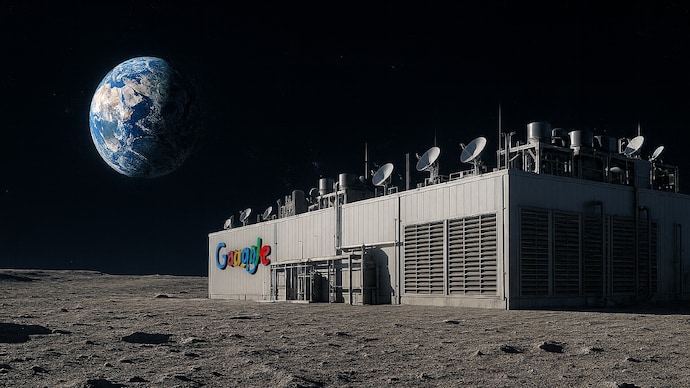

This is all happening right now within Silicon Valley. Day after day we hear about plans and schemes that seem straight out of a futuristic technological utopia. Today the topic is setting up data centers on the moon and in space. And the planners involved: Google CEO Sundar Pichai, Nvidia CEO Jensen Huang, Amazon founder Jeff Bezos and, as it happens, Elon Musk. These tech leaders and their companies are already exploring setting up huge data centers on the Moon and in space because it seems to be the best way to prepare the infrastructure for AI.
This information is courtesy and reported by The Wall Street Journal. According to estimates, increasingly AI-empowered data centers will consume about 1.5 percent of global electricity in 2024, and this figure is only expected to increase. But Earth’s energy isn’t unlimited, and AI isn’t the only thing hungry for it. As computing demands grow faster than power infrastructure, the tech industry is starting to ask a dramatic question: What if data centers didn’t have to be on Earth at all?
Tech companies are already working on this.
Google recently launched the latest salvo in this cosmic contest with Project Suncatcher, an ambitious plan to deploy solar-powered AI data centers in orbit. The idea is simple. AI is power hungry and faces land shortages and huge water needs for cooling. So why not run machine-learning workloads in space using the Sun’s unlimited energy, bypassing Earth’s limitations, to get unlimited space and power. Google plans to start testing this moonshot project with two prototype satellites by 2027.
And Google is not alone. Smaller companies like StarCloud, LoneStar Data Holdings and Axiom Space are also working on off-planet storage and compute. In the US-China race for AI dominance, China also recently unveiled plans to launch 12 AI-powered satellites into low-Earth orbit to form what it calls the world’s first orbital supercomputer network, known as a three-body computing constellation.
They’re all betting that space – and eventually the moon – will become the next logical step for digital infrastructure as humanity’s demand for the next generation of technology skyrockets.
Earth has limits, so AI may have to leave it
The plan to move AI infrastructure off the planet isn’t just a wild idea. Tech companies aren’t just looking upward for inspiration, they’re running out of space, energy and cooling capacity on Earth. Space offers a solution.
Solar energy remains stable in space and does not require water for cooling. For many technology leaders, logic is becoming impossible to ignore.
As Amazon founder Jeff Bezos said earlier this year: “There is no Plan B. We have to save the Earth.” Bezos has long advocated shifting human activity, including heavy industry and data centers, off the planet. He recently described the Moon as “a gift from the universe”, suggesting that its low gravity and abundant solar energy make it an ideal base for infrastructure that would not be needed on Earth. Interestingly, his company Blue Origin is already developing rockets and landers capable of helping build these systems in lunar orbit.
Testing data centers in orbit and on the Moon
The shift from theory to actual testing has already begun. Florida-based Lonestar Data Holdings confirmed earlier this year that it had tested a small data center on the moon. The device survived the landing and sent back data before shutting down early, still strong evidence that humanity may have big plans to take computing to the lunar surface in the future.

Meanwhile, StarCloud, which is also working with Nvidia, plans to launch a satellite equipped with a high-performance GPU, claiming it will “set a record for the most powerful in-orbit computing power”.
Not surprisingly, Elon Musk is also part of this story. SpaceX has provided the rocket launches for many of these early missions, and its reusable rockets make testing in orbit — and even on the Moon — much cheaper. Musk’s broader Mars ambitions naturally align with the rise of off-planet computing. Every step towards reliable space infrastructure supports their vision of a multi-planetary future.
Musk’s SpaceX is also supporting Google to help the company build its Project Suncatcher.
Problems waiting in space
Of course, building a data center in space comes with major challenges. As StarCloud CEO Philip Johnston has previously cited, managing heat in a vacuum and protecting the chips from intense radiation are the two biggest engineering hurdles.
Then there are the legal complications. Lonestar founder and CEO Chris Stott says that under international space law, a satellite or lunar module falls under the jurisdiction of its launching nation – “virtually an embassy in space.” This raises questions about data sovereignty, security and cross-border regulation.
But humans can eventually work around these limitations and it seems big tech companies are already tackling them. For now, these space-based data centers are still experimental, small modules, limited compute, and early prototypes. But this idea may gain momentum in the coming years.