



Smart AC with self-clean feature? Yes, here’s everything you need to know about this feature
Smart air conditioners today not only promise better cooling, they now claim they can even clean themselves. But how does this technology actually work and does it really make a difference to performance and air quality? India Today Tech tells.

If you’ve shopped for an AC in the past year, chances are you’ve noticed brands heavily highlighting a feature called auto clean or self-clean. From the name itself, it sounds reassuring, almost futuristic, like your AC can take care of its own cleanliness. And brands promise just that. This is a feature that helps rid your AC of dust, bacteria, and odors that build up over time.
In fact, over the past few years, the self-clean feature has become one of the major selling points for smart air conditioners and is now turning into a standard offering in many mid-range models as well. But what exactly is this “self-clean” technology? And is it actually useful, or just another marketing gimmick that looks good on a brochure? In this excerpt, India Today Tech decodes it for you.
What is self-clean technology in AC?
Simply put, self-clean is a feature designed to keep your AC unit clean and hygienic inside. It includes parts such as the evaporator coil and internal air passage. Therefore, this is not the usual AC cleaning or servicing that we get from regular AC technicians. That cleaning is cleaning the dust from outside and servicing the AC with pressurized water. Instead, self-cleaning is an internal cleaning feature.
Now different brands use different technologies for this feature. Some fans offer a drying feature, where the fan runs after the AC is turned off to dry out moisture and prevent mold. Others use ionization cleaning, which releases charged particles into the air to neutralize pollutants. Then there is frost cleaning, which freezes the inside of the AC and then cleans it. This method has become the most popular in recent years, and we will talk about it in detail here.
How does frost cleaning work?
The purpose of the self-cleaning feature including frost cleaning technology is simple. It targets the congestion inside the AC and cleans the moist areas that often become a breeding ground for bacteria, mold and odor-causing germs. Different brands use different buzzwords and marketing terms to advertise the feature. But the technology is more or less the same.
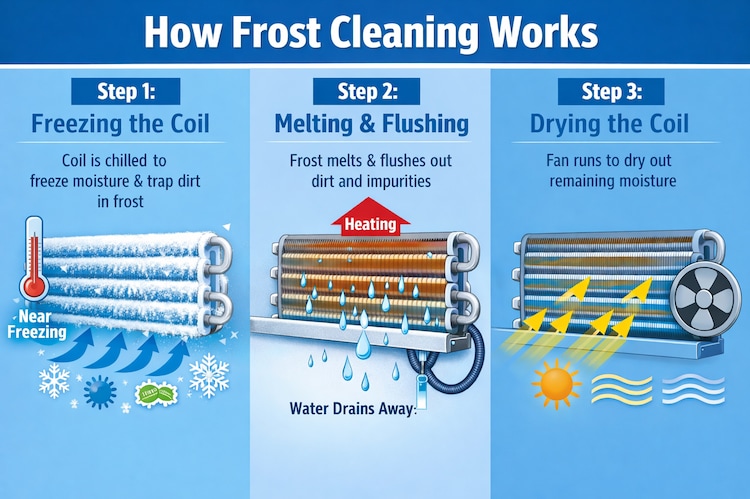
First of all, when you activate the self-clean mode, the AC reduces the indoor coil temperature to near-zero levels. This causes moisture in the air to freeze on the coils, trapping dust, pollen, bacteria and other impurities in a thin layer of frost.
Next, the AC gently heats the coil or reverses the cycle so that the frost melts. As the snow turns to water, it carries all the trapped dirt down through the drainage pipe, essentially washing the coils from the inside.
Finally, the fan runs at low speed for a few minutes to dry the internal components. This last step is especially important as it dries out any remaining moisture that could be causing any odor or fungal growth inside your AC unit.
Now note that, traditionally, the only way to deal with this kind of internal dirt was professional servicing, where a technician would open up the unit and manually clean the coils. And this servicing is still important and should ideally be done once or twice a year.
But self-clean features aim to reduce what gets created between those trips. Think of it as a daily cleaning of your AC, not a replacement for deep cleaning. So, you can run the self-clean feature every 2 weeks or a month.

Does self-cleaning really make a difference?
Here at India Today Tech, we got to experience the self-clean process first-hand when we reviewed Haier’s Gravity Smart AC. In this particular unit, the entire cleaning cycle took about 21 minutes.
First, the machine started making ice and a slight crackling sound of the ice actually forming could be heard. Then it heated the coils and finally expelled the water through the drain.
It seemed to work. The AC reminded us to run the self-clean cycle after a few weeks, and once the process was complete, the air felt fresher and the cooling seemed more effective.
It is especially useful for Indian cities, where there are high dust levels, humidity, pollution and long AC usage seasons. Often moisture inside the unit becomes a real problem. Many users complain of a foul smell when they switch on the AC after not using it for a few weeks. Self-clean features tackle this problem by directly drying the coils and preventing fungal growth.